CNC Scales

Joined
Aug 31, 2010
Messages
726
I'm making a small run of 100 M4 fixed blade knives, and I'm wondering where to turn for machined scales.

All suggestions welcome. Thanks a bunch!
 
Something that's important when considering having scales made, is the quality of the work can only be as good as the underlying geometry.

4.jpg~original


There's a Dunning Kruger Effect when a CNC shop is making scales for people. Generally speaking, the organic surface modeling is not a core competency of most job shops. This is also true for the Knifemaker doing his own 3D CAD work and is the primary reason why midtec scales frequently have a crappy clunky look and feel to them.

There is a lot more to good CNC scales than a good CNC machine. Quality programming, and most important, high end surface modeling.

... just something to consider, look at relevant examples of their previous work...
 
Also, something Nathan mentioned to me when he and I discussed something similar last year; be careful about having one shop do the cad for the blades and another for the scales. Try to have one shop do both. It will make everything easier to fit correctly.

Precision Plus does stuff like this. Check them out.
 
Thank you for taking the time to reply, Nathan. I certainly value your insight highly.

Thank you for the other leads, Gentlemen. I will check them out.

I don't know anything about machined scales. I've only seen some that were contoured in approximately 1/32" increments, and ground smooth to finish. The holes were the right depth for corbys.

I can hardly imagine the difference you're probably used to, Nathan. Magnitudes.

I'd certainly expect to pay a lot more for scales that take me the least time to finish.

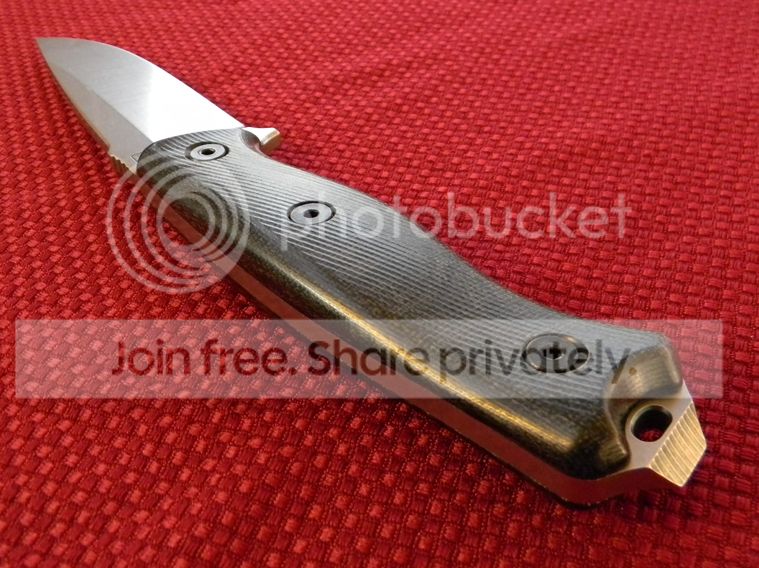
Nathan, is that picture representative of the finish of your scales as delivered?
 
Nathan, is that picture representative of the finish of your scales as delivered?

Yes, it can be. Those are as machined and buffed to bring out the color. We can do that, but most folks take them as machined and do any secondary finishing themselves.

Some folks tumble the scale or grit blast them. Some leave them as machined. I like a quick buff. Coarser textures often get a rub with some fine grit paper or belt to take the edge off. The idea behind improving grip is about undulations and increased surface area, not sharp texture that bites into your hand.

Some of our scales production go to shops with close control over their tang geometry. Their tangs are very accurate and the last I saw the scales simply attach directly. This is important if the blade is getting a coating and grinding flush isn't a good option.

My own tangs are accurate like that and the scales simply screw down and are flush, but I could never get that kind of accuracy before I had big machining centers, my first little CNC mills just weren't that good.

However, we also make scales for folks using waterjet. Waterjet is really a roughing process and usually needs the perimeter ground flush.

There are a few pitfalls that a maker going midtech can avoid and save themselves a lot of headache. It's best to get the scale shop involved before cutting blades to insure the data is good before moving forward. Waterjet and laser are both roughing processes and don't even need very good data, they can literally jump across a gap in the data, and I've even seen holes that weren't modeled round, but the waterjet doesn't care. But gaps in the data and lack of C1 tangency causes artifacts when extrapolated into three dimensions. This requires approximating the tang in order to get a good clean scale geometry, and than means additional expenses from my end and additional fitup on yours. It's way better to get everyone on the same sheet of music first.

edit to add: C2 curvature continuous and splines offer the best potential for very good surface quality when extrapolating into 3D. Almost nobody in the knife industry models with that, but that's what the big boys in industry use (such as automotive and consumer product design) because it is the best.
 
Last edited:
Nathan,

Please forgive my ignorance, but what do most folk in the knife industry do for modelling?

Thanks,

Chris
 
Nathan,

Please forgive my ignorance, but what do most folk in the knife industry do for modelling?

Thanks,

Chris

That's a good question, though I need to be careful here or I'll offend somebody...

There is an extremely common tendency to let the process drive the design rather than the other way around. Tail --> wags --> dog

An experienced maker designing a grip the old fashioned way might draw it out on cardboard first. And the wood gets shaped by hand to have a certain look and feel, taking into account the ergonomics of the intended use. This is good and how knowledgeable makers provide value with their skill and know-how.

And for some reason this all gets thrown out of the window once they go midtech?

A bad scenario is a maker takes a pattern they like and sends it to a water jet and gets a bunch of blanks cut. Then they decide they want some scales to go with it, but they don't actually have a proper CAD file of the geometry their blades were cut from, so now they're trying to get scales made to fit a tang and there is almost no chance they're going to get a good fit.

The CNC shop making the scales simply cuts the profile shape into a flat sheet of something. Perhaps adding a round over or a chamfer, but nothing like the comfortable contoured scales the maker himself knows how to make, but doesn't know how to get into 3D.

^ that is an all too common midtech mess

A somewhat better way is a maker with some CAD skills models something in SolidWorks or similar and has good data that reflects his pattern. That's good because he has control over the data and things are at least going to fit. He uses the common extrusion and cut tools in his CAD program and makes a prismatic scale shape. Perhaps he cuts it from a few different directions and adds rounds and blends and gets something that's a 3D scale that reasonably well reflects the right look and shape. Maybe cuts a couple grooves or whatever to try and dress it up. But it's still ugly and clunky and nothing like the handmade scales he knows how to make. This is simply because high end surface modeling is not a normal skill set in a machine shop or knife shop.

In my opinion the best case scenario is someone who really knows what they're doing in CAD (perhaps the maker, perhaps not) creates a high quality trace of the blade pattern profile so there is high quality data so the waterjet and scales shop are on the same sheet of music. Then a person who really knows how to drive high end 3D CAD models the maker's handmade work, tweaking it here and there for the CNC process, but basically creating a clean 3D model that reflects the makers true skill in designing a grip, that can be machined on a CNC. There are tricks and tweaks such as underlying NURBS geometry that can result in seamless (no patches) master surfaces that a CAM system can cut following 3D surface ISO lines etc, but 9 times out of 10 just a clean accurate machinable geometry that reflects the makers design is great.

At the end of the day, the material cost and cutter cost and machine time all cost the same. You may as well start with the best underlying geometry you can. It makes a better finished knife and it really doesn't cost anything. It just takes a little planning upfront.

 
Wow, thank you for that reply.:cool:..that was above and beyond what I expected. Guess it shows that I didn't really understand what it was that I was asking.

It seems to me that the hardest part for making an ergonomic CNCed handle is figuring out when the model is right. By hand you can feel it, and if it needs 0.04" off on the profile, or 0.02" off per side somewhere, you can feel it and measure as you go. In CAD you get something that looks right, but I reckon it would be tough to check it against a hand made prototype to see if it was right. Seems like you are stuck with expensive trial and error getting one trial handle made at a time to check whether it feels right. Not so bad I guess if the CNC gear is yours, but a bummer if you have to outsource. Maybe that's one of the hurdles with going mid tech? Even rapid prototyping in SLS isn't cheap.

Thanks again. You have given me some more guide posts to work to :).

Sorry for kinda hijacking your thread Grizzled Gizzard:o
:D

Chris
 
Yes, you're right, it's impossible to really know what something is going to feel like just looking at it on a screen. Something physically tangible is necessary. The best approach starts with the maker and his hands. Personaly I like to used cardboard and Play Doh when ideating a handle. But once you have a good physical model it is the basis of a 3D CAD model based upon basic scanning and measurements.

Even then, it still takes a few tweaks to get it "just right". Keep in mind the fixture holding the scales isn't going to change during these tweaks because the tang shape and hole location is generaly fixed by that point. The machining software is parametric, so tweaks to the part geometry update the toolpaths automatically so making variations is quick and easy. I typically make about 6 blank sets in advance when tweaking a design and use 3-5 of them dialing in the part. Once you have a fixture and a design and toolpaths, making multiple iterations dialing in the look and feel is pretty straight forward.
 
WOW! Thank you so much for such a detailed explanation, Nathan! That was super informative!

I've tried getting blades put into CAD. Here in the middle of nowhere, I had a hard time finding someone to get a One dimensional CAD file, and it was way more expensive than it was for Pete Bruno. I just sent him a kydex blank, and he emailed the CAD file for me to check. It was perfect.

I can hardly imagine getting a proper 3D CAD file for the scales within driving distance.

Would it be easier to send a knife with removable, finished scales?

I can't thank you enough, Nathan. :)
 
Back
Top