
-
The BladeForums.com 2024 Traditional Knife is available! Price is $250 ea (shipped within CONUS).
Order here: https://www.bladeforums.com/help/2024-traditional/
You are using an out of date browser. It may not display this or other websites correctly.
You should upgrade or use an alternative browser.
You should upgrade or use an alternative browser.
cold steel gurka kukri thoughts
- Thread starter Sig_Op
- Start date

jdk1
Gold Member
- Joined
- Apr 21, 2010
- Messages
- 2,058
It's a great khukuri. It's very well designed and is a perfect size and weight for general use in the woods. It is one of the blades which does well on heavy and light wood, as well as some machete tasks. So far, the SK5 steel has been superb as well. I HIGHLY advise anyone looking for a modern khuk (or large blade in general) to give this one a really close look. It is an awesome blade and comes with an outstanding sheath. I have the original version without the crazy guard. I personally can't imagine anyone being disappointed with this blade. Good luck.

- Joined
- Aug 21, 2011
- Messages
- 775
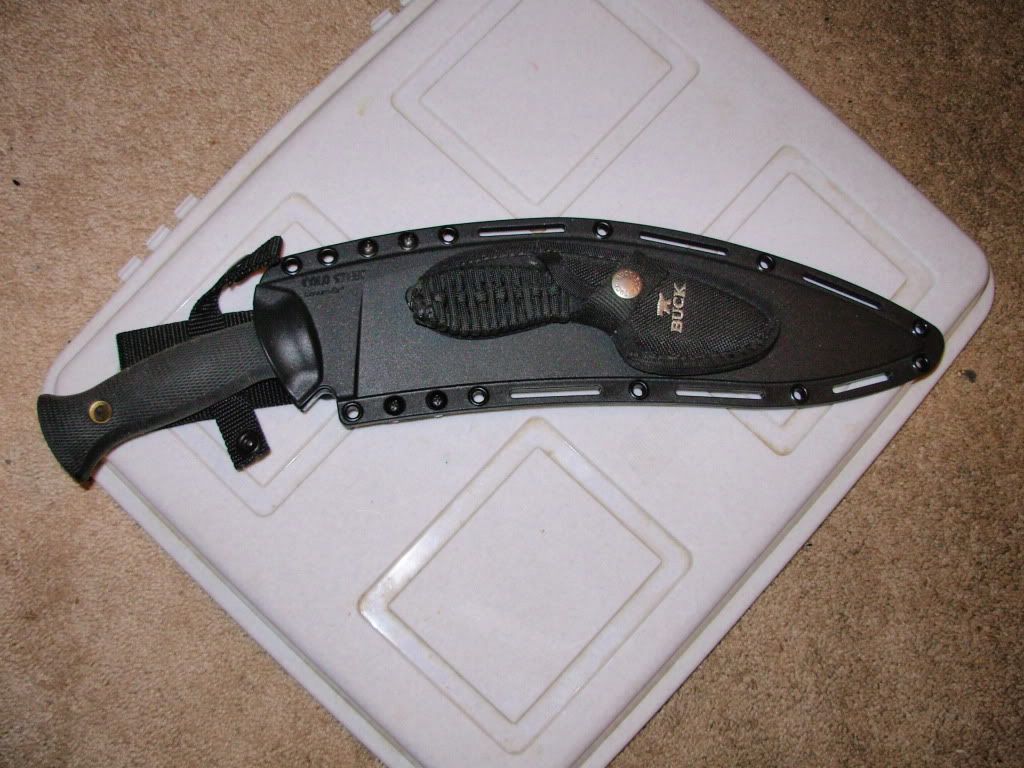
I have one in SK5 It came very sharp, maybe my sharpest big knife. Has a 5/16" spine and will chop with the best of them. Although an awesome chopper, with the flat grind and distal taper it has excellent slicing capabilities and surprising piercing power. I like the Kraton handle, comfortable and secure. The sheath has great retention and is tough as nails, plenty of lashing points. In my opinion and personal experience it is a great all around large camp knife, from shelter building to batoning to food prep. Strap a smaller knife to it and you are ready to go. I had mine Duracoated for rust protection but I kind of wished I didn't the factory finish on the steel is excellent and looks really good.



- Joined
- Aug 29, 2009
- Messages
- 626
That duracoat looks really cool, man.
yes its the coolest I think I have ever seen! where did you have it done if I may ask?

- Joined
- Jun 16, 2003
- Messages
- 20,207
It's a great khukuri. It's very well designed and is a perfect size and weight for general use in the woods. It is one of the blades which does well on heavy and light wood, as well as some machete tasks. So far, the SK5 steel has been superb as well. I HIGHLY advise anyone looking for a modern khuk (or large blade in general) to give this one a really close look. It is an awesome blade and comes with an outstanding sheath. I have the original version without the crazy guard. I personally can't imagine anyone being disappointed with this blade. Good luck.
So how has it turned out when you chopped wood with it?
- Joined
- Oct 14, 2011
- Messages
- 6
The sk5 version i checked out wasnt too hot. The handle was loose near the blade and the edge grind resembled a chizel in some places.
- Joined
- Jun 16, 2003
- Messages
- 20,207
Like an axe, a khukuri meant to chop wood needs a convex edge and sides that are not parallel - to prevent sticking. Otherwise, you have a KLO - a Kukri-Like Object.
My Trailmaster sucks at chopping due to the handle shifting and abrading skin.
My Trailmaster sucks at chopping due to the handle shifting and abrading skin.
I have the CS Gurkha Kukri Plus and its a wonderful knife. It serves as a heavy machete clearing vine, brush and wood. It has chopped through 8" logs and going through smaller ones was a breeze. Part of the reason is the shape of the blade and its weight. You could have the option of going with a lighter knife but you wouldn't have the same mass and momentum in slashing through tropical undergrowth, with the occasional small tree in the way. Using the blade portion closer to the handle, you can use it to do feathersticks, making a sharpened tip or other closer detail work. The thick spine can be used as a hammer or a nutcracker.
One of the distinct difference between this kukri and the other is a lower handle guard. Personally, I don't think that it acts as a fighting guard as claimed since a) you are not going around looking for a fight (I hope you aren't nor does one coming looking for you) and b) if your opponent's blade get so close to necessitate the use of the guard - you are doing something wrong. A use I have for it is tightening ties and ropes without using my finger.
It comes out of factory sharp and needs sharpening only after some substantial use. The curved shape does present some difficulty in doing a standard sharpening, so I typically secure the blade and then run along the edge with a diamond / carbide file in the field. At home, I use a whetstone but it takes a bit more time moving the blade across the curvature.
The handle is made of Kray-Ex and has a tacky feeling to it. There is a hole for a lanyard which I strongly recommend putting one in, for when your hands get sweaty, you are not wearing gloves and you are swinging with full force, the knife can slip out.
The only drawback is that it does not baton wood as easily as a straight spine blade but you adapt to it. Due to its thick spine and blade width, I find that twisting the blade towards the end of the wood to baton, it acts as a fulcrum to tear the wood apart and handles the lateral stress well.
The sheath is Secure-Ex and I must say its one of the best I have seen. It locks in securely and you have a clip belt to attach it to your belt. Tie it down with a belt loop or some paracord and you are good to go.
Specifications (from Cold Steel):
Blade Length: 12"
Overall Length: 17"
Steel: SK-5 High Carbon
Weight: 22.9 oz
Blade Thickness: 5/16"
Handle: 5" Long. Kray-Ex
Sheath: Secure-Ex® Sheath
One of the distinct difference between this kukri and the other is a lower handle guard. Personally, I don't think that it acts as a fighting guard as claimed since a) you are not going around looking for a fight (I hope you aren't nor does one coming looking for you) and b) if your opponent's blade get so close to necessitate the use of the guard - you are doing something wrong. A use I have for it is tightening ties and ropes without using my finger.
It comes out of factory sharp and needs sharpening only after some substantial use. The curved shape does present some difficulty in doing a standard sharpening, so I typically secure the blade and then run along the edge with a diamond / carbide file in the field. At home, I use a whetstone but it takes a bit more time moving the blade across the curvature.
The handle is made of Kray-Ex and has a tacky feeling to it. There is a hole for a lanyard which I strongly recommend putting one in, for when your hands get sweaty, you are not wearing gloves and you are swinging with full force, the knife can slip out.
The only drawback is that it does not baton wood as easily as a straight spine blade but you adapt to it. Due to its thick spine and blade width, I find that twisting the blade towards the end of the wood to baton, it acts as a fulcrum to tear the wood apart and handles the lateral stress well.
The sheath is Secure-Ex and I must say its one of the best I have seen. It locks in securely and you have a clip belt to attach it to your belt. Tie it down with a belt loop or some paracord and you are good to go.
Specifications (from Cold Steel):
Blade Length: 12"
Overall Length: 17"
Steel: SK-5 High Carbon
Weight: 22.9 oz
Blade Thickness: 5/16"
Handle: 5" Long. Kray-Ex
Sheath: Secure-Ex® Sheath

shortwinger
Gold Member
- Joined
- Apr 7, 2010
- Messages
- 1,090
Just like the advertising says, it is simply the best kukri you can buy and it will either match or more than likely out perform any kukri on the market. When you figure in long term, regular hard use you will find virtually no competition left to compare it to. It is light, fast, agile and after you get past the learning curve and get used to the curved blade you will find it does big and small jobs equally well. It has a versatile sheath that allows you to attach a smaller knife (as shown above) if you desire.
Just curious about your comment on advertising. Since virtually no other knife company does any advertising at all and even the really big knife companies can't seem to spare more than a few words of explanation about each model on their websites, just what is it about Cold Steels advertising that bothers people? They do a good job of explaining each blade on the website, pics always available and they add videos of the knife being used hard. They also have a forum where you can ask questions to company people. They push their knives beyond their intended purpose "on film" to demonstrate that if they can take this amount of abuse then you can be sure they will do their job as intended. If you take the time, you can recreate virtually every test and your blade does the same as the one on the video. On top of that Cold Steel also sponsors the number one bow hunting show on TV, Relentless Persuit where game is taken with CS spears and blow guns! When you think about it, they don't have the best or worse advertising, they are the only ones that even try!
Just curious about your comment on advertising. Since virtually no other knife company does any advertising at all and even the really big knife companies can't seem to spare more than a few words of explanation about each model on their websites, just what is it about Cold Steels advertising that bothers people? They do a good job of explaining each blade on the website, pics always available and they add videos of the knife being used hard. They also have a forum where you can ask questions to company people. They push their knives beyond their intended purpose "on film" to demonstrate that if they can take this amount of abuse then you can be sure they will do their job as intended. If you take the time, you can recreate virtually every test and your blade does the same as the one on the video. On top of that Cold Steel also sponsors the number one bow hunting show on TV, Relentless Persuit where game is taken with CS spears and blow guns! When you think about it, they don't have the best or worse advertising, they are the only ones that even try!
- Joined
- Aug 21, 2011
- Messages
- 775
yes its the coolest I think I have ever seen! where did you have it done if I may ask?
Missionspec camo. I think that pattern is called Dune waves or something like that. Also as far as the Kraton handles getting loose, I have quite a few large Cold Steel with Kraton, Recon Scout, Trailmaster, SK5, Master Hunter, Outdoorsman. I have been hoping one of the handles would come loose to give me a reason to cut it off and make a Wood handle, hasn't happened yet.
Last edited:
- Joined
- Aug 21, 2011
- Messages
- 775
The sk5 version i checked out wasnt too hot. The handle was loose near the blade and the edge grind resembled a chizel in some places.
Look out for the counterfeits they are pretty convincing. I have probably 50 different Cold steel knives all have been shaving sharp, never seen a bad edge even on the cheaper knives like the Bushman series and machetes
jdk1
Gold Member
- Joined
- Apr 21, 2010
- Messages
- 2,058
So how has it turned out when you chopped wood with it?
Actually, well. When chopping extremely hard, seasoned oak logs, I felt some shock in my hand. I wrapped the handle in paracord and that helped a lot. I really love the way it turned out. I need to say two things here: first, I've had a CS LTC for many, many years and the (same)handle has been great. I only felt shock with the Gurkha when chopping very hard logs, which is a chore I'd never really do except when testing a new blade and I was hammering this particular blade pretty hard. During normal use, even cutting arm sized limbs from green mesquite trees, the handle works quite well and is very secure. When chopping hard wood, it doesn't throw large chunks as a thick, convex blade would, but it bites very deep and cuts well all the same. In my (limited) experience, a thick blade ideally suited for heavy chopping wouldn't be good for much else. This blade cuts tall weeds well and chops wood well, that's a great combo. It's also tough as can be. More than a few other large blades I own could not handle that same seasoned wood, and others still needed an obtuse edge to keep from waving. The Gurkha came razor sharp and suffered ZERO damage or problems.
Also, the fit and finish on mine, an older black-bladed, made in China version, is superb. The handle is tight and the edge and finish were perfect. It's an outstanding khukuri IMHO. Anyone who likes khuks should give it a try. Take care.
- Joined
- Jun 16, 2003
- Messages
- 20,207
In deciding on the "best" khukuri, is there any consideration that the peoples who invented the khukuri might know something about what their characteristics should be?
As for Cold Steel's advertising, while it is often juvenile and over-the-top, it is no worse than the statements by others invoking the image of the blade as a killing tool, including the Atlanta Cutlery catalogs (
As for Cold Steel's advertising, while it is often juvenile and over-the-top, it is no worse than the statements by others invoking the image of the blade as a killing tool, including the Atlanta Cutlery catalogs (
).slashing, puncture, hook, deadly, weapon, battle axe, war axe, devastating, fighter, deadly penetration, wicked, punches and slices, great slashing design, designed for stabbing, skull crusher pommel, skull head cruncher, deadly underhand stabbing, fierce, brutal, effortless penetration
jdk1
Gold Member
- Joined
- Apr 21, 2010
- Messages
- 2,058
In deciding on the "best" khukuri, is there any consideration that the peoples who invented the khukuri might know something about what their characteristics should be?
().
I won't argue that fact, but I do know what works well for me in my area. The CS Gurkha is an outstanding khukuri for my use and I believe LT did his homework when designing it. Take care.
shortwinger
Gold Member
- Joined
- Apr 7, 2010
- Messages
- 1,090
In deciding on the "best" khukuri, is there any consideration that the peoples who invented the khukuri might know something about what their characteristics should be?
Thomas,
Good question but kind of loaded. Yes the Nepalese should know how to make a good kukri and many do. I have some great traditional kukri from HI, Tora, some military antiques and even from the so called Khukuri Houses. While I love them all I also realize that they are a traditionally hand made tool that by its very nature will need attention from time to time. If you own and really use one of these traditional kukri and live in Nepal then you would expect to have the handle replaced every so often and if the blade chips then you walk it down to you neighborhood kami and he fixes it or replaces it. Not so in much of the western world, we end up with expensive paper weights. To make matters worse we are currently in the middle of a kukri boom where they can not make them fast enough and the workmanship has gone down. Now we end up with much more grinding and not so much hammer work, and the steel quality, handle material quality and the heat treating expertise have gone down. Nepal is also going through some horrible internal problems that is adversly effecting the work force. im not saying you cannot get a good kukri but its getting harder and harder.
The main reason for my "best" comment is that the Thread Title is "cold steel gurka kukri thoughts." If the title was; what is better the traditional Nepalese kukri or the modern made models then I would have commented differently. As far as the modern made kukri the Cold Steel has no real competition from any company, and what there is comes from the CS and Ka-Bar Kukri Machete which is not really a kukri at all. All that being said, I still stand by my comment. If any of you worked on a farm and used this tool regularly, within 60 days you would be convinced that few if any traditional kukri would hang with the CS.
I have learned to love each for what they are and I rarely compare them in an apples to apples way anymore. We no longer compare a car to a horse when the topic is transportation and few people building a house would reach for a hand made phillips screw driver when a cordless drill is handy. Romantic idea but not a reality if the "job" is the focus rather than a love of the tool.
This is assumption and speculation.shortwinger said:To make matters worse we are currently in the middle of a kukri boom where they can not make them fast enough and the workmanship has gone down. Now we end up with much more grinding and not so much hammer work, and the steel quality, handle material quality and the heat treating expertise have gone down. Nepal is also going through some horrible internal problems that is adversly effecting the work force. im not saying you cannot get a good kukri but its getting harder and harder.
I all actuality, the quality of many makers khukuri's has improved over the years. It used to be that you had a hard time finding a quality khukuri that you could chop with and not have it break ( save one, which had an unconditional warranty). It used to be that tourist khukuri were the standard fare by many makers. Fit and finish has improved by all the makers khukuri in the last few years to compete with a certain makers standards of many years.
Of the 3 notable makers of traditional khukuri, only one could be seen as doing the things you speak of and i'm not sure that they are. The top two makers of khukuri, as far as i can see, are not doing anything of the sort. In fact they are doing everything they can to insure quality workmanship and customer satisfaction.
The khukuri are still forged from stock in the traditional manner and some grinding/filing has always been necessary to produce quality product. Even in antiquity, filing or grinding was done to bring forged stock into saleable merchandise and specification.
The steel quality is the same and handle material quality is much the same as it ever was. Certain handle materials have been reduced due to scarcity/availability, but there always have been alternatives.
Heat treating expertise is much the same as it has always been also. The problem lies in the dwindling supplies of the proper coal for heat treating, which is different than that which is used for forging..... By tradition and necessity.
Political strife has been a concern for many years. The problem in nepal lies more in it's infrastructure. With the current regime making it difficult for production due to the electricity in many areas being off for from 14-18 hours a day. Graft, corruption and many checkpoints are worse now than they've ever been, making it more difficult to get shipments out of country. Then the next problem is the ever increasing prices of many international shippers.
Hilarious and over the top marketing aside....shortwinger said:The main reason for my "best" comment is that the Thread Title is "cold steel gurka kukri thoughts." If the title was; what is better the traditional Nepalese kukri or the modern made models then I would have commented differently. As far as the modern made kukri the Cold Steel has no real competition from any company, and what there is comes from the CS and Ka-Bar Kukri Machete which is not really a kukri at all. All that being said, I still stand by my comment. If any of you worked on a farm and used this tool regularly, within 60 days you would be convinced that few if any traditional kukri would hang with the CS.
I have learned to love each for what they are and I rarely compare them in an apples to apples way anymore. We no longer compare a car to a horse when the topic is transportation and few people building a house would reach for a hand made phillips screw driver when a cordless drill is handy. Romantic idea but not a reality if the "job" is the focus rather than a love of the tool.
I had the chance to use a top of the line sandwich steel CS khukuri-like-object a few years ago. I found it to be souless and too light for effective chopping to my standards and disliked wholeheartedly its penchant for sticking in the wood i was chopping. I don't care to spend half my time retrieving my blade from the object being chopped. Add to that its uncomfortable (to me) handle of rubberized plastic and it was a no brainer to get rid of it and stay with the traditionally made khukuri that i care for much more. I also found unecessary shock transmitted thru the handle. Additionally, i found most all the CS khukuri lineup to be a bit overpriced for what you're getting. Why spend 300 to 600+ dollars on one production modern khukuri, when that same amount will get you several traditional khukuri, each for a specific task and do so with unmatched soulfulness and value per dollar spent.
In my considered experince with khukuri, i think its fair to say that many traditionally made khukuri can more than hold their own against the CS khukuri of any sort. As far as Modern production khukuri-like-objects are concerned, i will admit that the CS khukuri is probably at the top of the heap, but it is a quite small pond there. Most other makers are making khukuri machetes, which are not comparable to a real khukuri.
Then we have custom makers of quality modern khukuri, many of which will also likely more than hold their own against the CS product.
Last edited:
shortwinger
Gold Member
- Joined
- Apr 7, 2010
- Messages
- 1,090
Karda,
I too was a bit concerned when I first got my CS Kukri and found it to stick a bit but as I used it more I found that only happened in certain types of wood, usually spongy wet wood. I found that a quick squirt of WD-40 fixes it but since it only happens once and a while I have learned to live with it.
I agree that the traditional kukri can be made as more of a specific purpose driven tool and in the case of my HI Bonecutter I could not imagine a more potent chopper. It is a rare exception in that it has held up to my CS as a work tool for two seasons of regular hard work. The slight hollow forge and the hammer marks on the Bonecutter allow the blade to chop deeply without getting stuck where the machine made CS has more of a uniform flat surface that doesn't allow any air pockets to keep things moving.
Like I said I love them all, modern, traditional and customs. Any of you custom guys want to send me one I will use it hard and do a good review!
I too was a bit concerned when I first got my CS Kukri and found it to stick a bit but as I used it more I found that only happened in certain types of wood, usually spongy wet wood. I found that a quick squirt of WD-40 fixes it but since it only happens once and a while I have learned to live with it.
I agree that the traditional kukri can be made as more of a specific purpose driven tool and in the case of my HI Bonecutter I could not imagine a more potent chopper. It is a rare exception in that it has held up to my CS as a work tool for two seasons of regular hard work. The slight hollow forge and the hammer marks on the Bonecutter allow the blade to chop deeply without getting stuck where the machine made CS has more of a uniform flat surface that doesn't allow any air pockets to keep things moving.
Like I said I love them all, modern, traditional and customs. Any of you custom guys want to send me one I will use it hard and do a good review!