concern about dulling slipjoints

Joined
Nov 26, 2012
Messages
176
I'm just wondering if when you snap a slipjoint knife closed, and the blade hits the metal, can't this lead to dulling/ the knife edge folding over?

 
If the knife is well designed there is either a bladeguard or a pin that prevents the blade from hitting the metal inside the handle. Take a look at some spyderco slipjoints. I believe the grasshopper has such a feature.
 
If the edge hits the backspring, yes. The "kick" is there to prevent that, is the knife is well designed/executed.
 
If you see flat spots on the blade it could be contact. A well designed slip joint should not have this problem
 
Yes, if the knife is well designed and executed, it isn't a problem. Unfortunately among traditionals, well designed and executed is not as common as you'd think. I've come across too many respectable brands that suffer from the edge smacking the back spring when snapped shut, from traditionals to a Spyderco slipit. Occasionally a lockback. I even have a Case that managed to leave the factory with a blade that rests on the back spring at the tip of the blade, clearly visible when closed and audible.

Stop pins are a great idea that don't seem to have been widely adopted. Interestingly, I've seen some well thought out Chinese knives that incorporate the idea that cost only a few $ USD.

While it is an annoyance, this defect doesn't keep me from using a knife. Some people take care to lower the blade gently. I usually cut a small piece of wine cork, wedge it down between the liners/scales, which keeps the blade from impacting the backspring when snapped shut. The Spyderco slipit, btw, was very easy to fix, as they are easily disassembled and have very few parts, allowing me to grind a small notch in the back spring just deep enough so that the blade would not make an impact. Sure, it's a pity to have to work on knives to make them acceptable, but that's pretty much where the state of the manufacturing is these days.
 
Quite a few of my slipjoints have this problem, but I just take a bit of care when closing them.
 
Sure, it's a pity to have to work on knives to make them acceptable, but that's pretty much where the state of the manufacturing is these days.

I agree, and it is something I don't think I should have to do. These days, any brand new defective knife goes back if at all possible. Manufacturers don't pay me for Q/C.

However, I don't mind working on a knife that just needs some attention. I picked up a small Boker Cattleman that had two known defects. The punch wasn't machined well or sharp. Also, the spey blade (clip main, spey, punch no sheepfoot) sat low in the handle and it was hard to get to the nick.

I bought it for next to nothing, so I felt like I had nothing to lose. I took a tiny amount off the kick of the punch, to let it sit a bit deeper in the handle. That exposed the spey blade a bit more. Then I put a piece of that awful blister pack plastic under the kick of the spey. Now it is at the perfect height, easy to open. Then I reshaped and sharpened the punch on my 1" vertical sander and sharpened with my diamond rod. Polished up all my sanding and sharpening marks and I was done.

It is now a really nice little knife and I had fun tuning the fit. I don't think I would have been this bold about grinding and reshaping if it was an expensive knife. But in this case I knew what I was getting so I was fine doing the work.

But I agree with what the others have said. A well made knife shouldn't have this problem. Sometimes a few sharpenings can relieve your problem. Until you get there, try putting something very thin under the kick (wedged in place) until you sharpen a few times. But if the blade has severe over travel problems, you won't be able to sharpen enough off to keep it from hitting the backspring.

If it was me and the knife was new and I felt like I had spent the money to get a properly working knife it would go back to the vendor or to the manufacturer.

Robert
 
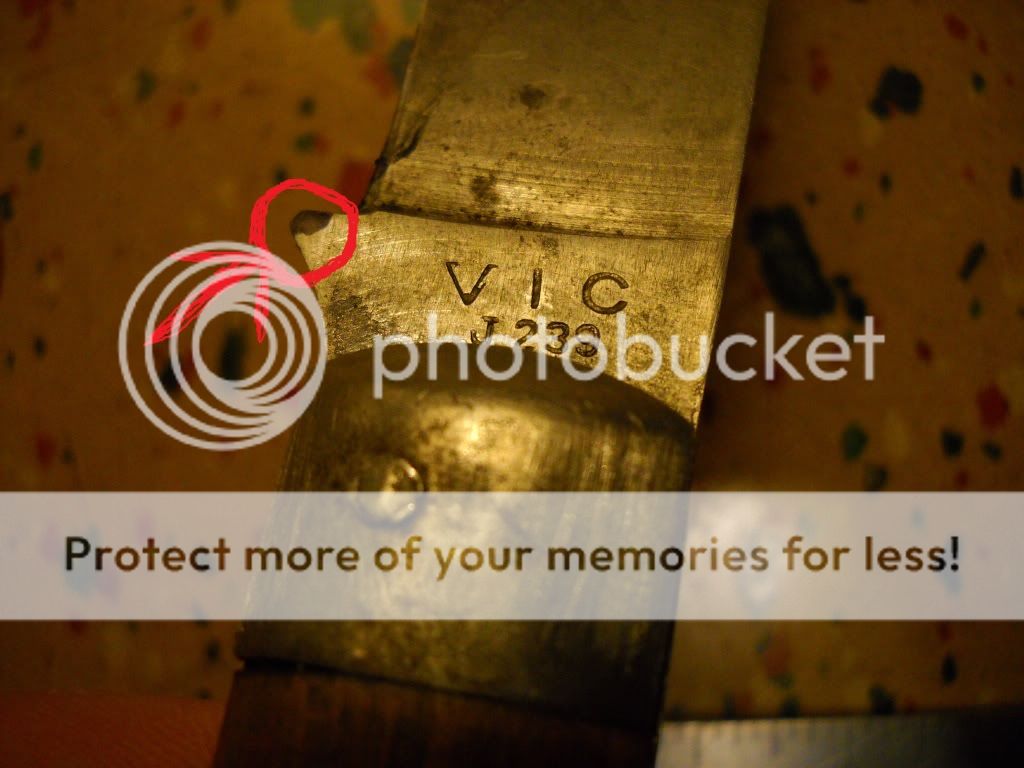
The ricasso has a kick at the top that hits the backspring, preventing the edge from hitting it instead.

Here's a pic:

DSCN0119-1.jpg


Connor
 
It also depend on the tradition the slip-joint comes from. Especially French folder need attention in this department. Many of them are best closed carefully. But, if you know it, you can take care of it or avoid those kinds of slip-joints..
 
Put a strip of leather or cork from a wine bottle at the bottom against the spring, this'll stop it from hitting the backspring. Make sure the leather or cork is a snug fit, it's not the strength of the material that'll stop the blade, its the wedge factor.
 
The "kick" at the heel of the blade should stop closure. When I look at an unfamiliar knife to rate it one of the things I do almost unconciously is to press on the blade while closed and feel how much it closes more before blade contact (if at all).

A good sized kick can help both to snap the blade shut hard if needed and also is a plus if the blade gets over-sharpened later and the tip becomes exposed. You can file the kick a bit to get it to close more.
 
It is common that if a blade is allowed to fully snap shut, the momentum generated causes a bit of flex and a section of the edge hits the spring. Some blade profiles only clear the spring by ~ 1mm when closed. Hence on knives i like i don't let go of the blade until it is nearly closed. One should definitely do this on all Customs.
roland
 
I have run into this problem with used knives. The kick gets mashed down over the years, or someone grinds it down to make a shortened blade fit better in the well.

On knives like the senator and congress patterns, this is amplified by the curved backspring, which makes the blades sit proud to begin with. There is next to no room to play with in getting the blade to sit below the scales, but not too far to contact the spring at the high point.

But overall, most knives if properly made should not have this issue.
 
I have read in a pocket knife repair book that if the kick is too short it can be adjusted by using a punch. I found this out on my first knife when I was a bit eager grinding the kick. Take a pointy punch and tap right in the middle of ConBons arrowed circle (see pic above). Tap lightly then check progress. The metal will slightly expand at the kick and a little goes a long way. I would not do it on an heirloom but it should fix a user. Nathan
 
8255359346_1079a3160b_q.jpg
[/url][/IMG
Here you can see what I am referring too. Pardon the roughness, it was a prototype.
Nathan
 
Last edited:
I have read in a pocket knife repair book that if the kick is too short it can be adjusted by using a punch. I found this out on my first knife when I was a bit eager grinding the kick. Take a pointy punch and tap right in the middle of ConBons arrowed circle (see pic above). Tap lightly then check progress. The metal will slightly expand at the kick and a little goes a long way. I would not do it on an heirloom but it should fix a user. Nathan

Nice ^
 
Back
Top