concern about dulling slipjoints

It also depend on the tradition the slip-joint comes from. Especially French folder need attention in this department. Many of them are best closed carefully. But, if you know it, you can take care of it or avoid those kinds of slip-joints..

True, but many French knives have a blade-stop which acts like a kick.
 
8255359346_1079a3160b_q.jpg
[/url][/IMG
Here you can see what I am refering too. Pardon the roughness, it was a prototype.
Nathan

Nathan - that is a common machinist's technique and works well. I know of one guy for sure that is a prominent traditional knife repair and restoration service provider that uses that technique. And having used that method on a machinist's square, I can tell you for sure that a little tap with the right tool goes a long way!

Instead of using a regular punch, try using a machinist's "prick punch". Not as much point so there isn't as much penetration of the metal. However, this style of punch will spread out the strike zone into something much more shallow and flatter than a hole when you are finished. It will look more like a dimple than a hole, and with a prick punch the results are easier to contol.

Robert

 
Nathan - that is a common machinist's technique and works well. I know of one guy for sure that is a prominent traditional knife repair and restoration service provider that uses that technique. And having used that method on a machinist's square, I can tell you for sure that a little tap with the right tool goes a long way!

Instead of using a regular punch, try using a machinist's "prick punch". Not as much point so there isn't as much penetration of the metal. However, this style of punch will spread out the strike zone into something much more shallow and flatter than a hole when you are finished. It will look more like a dimple than a hole, and with a prick punch the results are easier to contol.

Robert

Don't know why I didn't think of it. It's just peening. When you have a press fit hole for a bearing which is cut oversize and is a slip fit you can just take a punch and go around the inside 3-6 (or so) times. It's probably stronger than locktite. You can make it too tight if you aren't careful.
 
What does the end of a "prick punch" look like ? I have accumulated a few punches over the years, so i may have one.
roland
 
Nathan - that is a common machinist's technique and works well. I know of one guy for sure that is a prominent traditional knife repair and restoration service provider that uses that technique. And having used that method on a machinist's square, I can tell you for sure that a little tap with the right tool goes a long way!

Instead of using a regular punch, try using a machinist's "prick punch". Not as much point so there isn't as much penetration of the metal. However, this style of punch will spread out the strike zone into something much more shallow and flatter than a hole when you are finished. It will look more like a dimple than a hole, and with a prick punch the results are easier to contol.

Robert

I love this forum. Thank you Robert! A dimple would look alot better. Yeah the punch I used probably has a 75 degree tip on it. I will make one with a flatter angle but I hope that next time I remember to go very easy grinding the kick.
Nathan
 
What does the end of a "prick punch" look like ? I have accumulated a few punches over the years, so i may have one.
roland

Roland - I haven't taken the time to learn how to post pictures, but it a very common tool. You probably do have one! Go to Google, up at the top, select "Images", then type in prick punch. I did, and a bunch came up. They almost have very little point, and their nose is almost blunt, 22 - 30 degrees. They come in all sizes. Probably the best size for this use would be a punch that had a 3/8" or 1/2" barrel.

I learned the hard way.... just a tap. If you need to add another tap, the prick punch will easily index on the previous contact point.

Robert
 
Thanks Robert. That was helpful, but i'm still a bit confused as the images i saw were of very pointy punches. I'll go to one of the local tool stores and buy one by name then i will know what they are and have one.
roland
 
A simple wooden match

If the blade hit the inside of the spring, place a wooden match and let the blade hit that instead
 
Thanks Robert. That was helpful, but i'm still a bit confused as the images i saw were of very pointy punches. I'll go to one of the local tool stores and buy one by name then i will know what they are and have one.
roland

OK... many thanks Frank for the super easy tutorial. Following your directions made it pretty easy. I have seen so many attempts that made it look hard I never wanted to try. But... here we go!

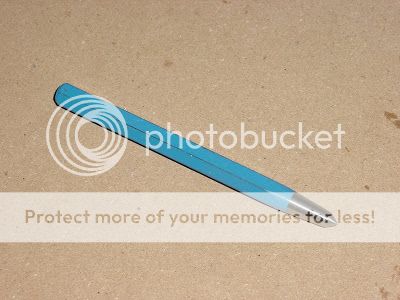
You can see how blunt the nose is on this one. That is a true prick punch, as opposed to a generic centering punch which usually has a longer, slimmer point.
Prickpunch01.jpg


These come with knurled handles, plain handles, and the machinist's versions can be all sizes from really small to large. They are also called center punches by some (and actually are), but that puts them in the larger category with all other center punches that go from needle sharp and very small to larger and more blunt.

Hope that helps, Roland.

Thanks again, Frank.

Robert
 
Back
Top