

- Joined
- Jul 25, 2007
- Messages
- 1,380
I finally built a PID-controlled oven after using a forge for HT'g. I work with 1075 and W-1; I quench in Parks #50.
The forge was too small and too un-even to be ideal, but I took my time and made it work.
I was aware that my grain size was on the large size (from seeing broken throwers), and I'm aware that the main cause of this is over-heating. However, I thought my heat-treat process was under control for the most part.
The first time I used the oven, I was thrown off base.
I initially placed the thermocouple relatively close to the heating elements. Most of the weird things I observed (such as 20° swings in temperature, and blades that were still magnetic after 20 mins at "1480°") ceased after I finally moved the thermocouple to the door, away from the elements.
Besides that, I observed that the steel was what I would call a subdued red, and barely non-magnetic (after 20 mins in a pre-heated 1480° oven). With the forge, I quenched when the steel was a self-luminous bright red; completely non-magnetic.
I also noticed that the quenching was much less violent with the oven than the forge.
Now, I've pretty much concluded that I was simply over-heating the steel in the forge. However, at the time, I suspected that the PID or something else was faulty, so I utilized the two basic tests that were immediately available.
I HT'd some bad blanks and bar (no tempering), broke them to examine the grain, and did the dubious file-skating test.
My standard practice is to remove the steel from the quenchant at 10 to 12 seconds to straighten. Then I let them air cool. I use the flash-point of the oil to estimate 400° or so... my infrared thermometer said it was closer to 300° but it is not a reliable thermometer.
So I did the same thing with the test pieces. I'm not sure if this has a significant tempering effect; nor am I sure if the technique has a "name".
I observed that the W-1 would skate the file 100%, and it would snap cleanly when clamped down and smacked with a hammer.
However, I observed that the 1075 would skate a file to some extent, but not 100%. Also, it would not snap cleanly. It would bend approx 10°, then snap. I confirmed this with several blanks, stopping when my 3-lb hammer blows ripped out the bolts that mount my vise to the wooden workbench.
I really thought that the 1075, despite the lower carbon-content, would snap cleanly and skate a file, without a temper.
The grain looked desirable (as far as I can tell). I am aware that the file test simply tells me if the steel's surface is harder/softer than the file itself.
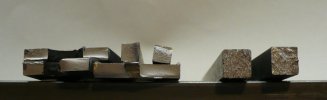
The pic shows broken oven items on the left; a forge item on the right.
So my questions are:
Does it sound like my HT process is decent? In other words, do my observations seem normal, or do they seem like something is still not right?
thanks!
The forge was too small and too un-even to be ideal, but I took my time and made it work.
I was aware that my grain size was on the large size (from seeing broken throwers), and I'm aware that the main cause of this is over-heating. However, I thought my heat-treat process was under control for the most part.
The first time I used the oven, I was thrown off base.
I initially placed the thermocouple relatively close to the heating elements. Most of the weird things I observed (such as 20° swings in temperature, and blades that were still magnetic after 20 mins at "1480°") ceased after I finally moved the thermocouple to the door, away from the elements.
Besides that, I observed that the steel was what I would call a subdued red, and barely non-magnetic (after 20 mins in a pre-heated 1480° oven). With the forge, I quenched when the steel was a self-luminous bright red; completely non-magnetic.
I also noticed that the quenching was much less violent with the oven than the forge.
Now, I've pretty much concluded that I was simply over-heating the steel in the forge. However, at the time, I suspected that the PID or something else was faulty, so I utilized the two basic tests that were immediately available.
I HT'd some bad blanks and bar (no tempering), broke them to examine the grain, and did the dubious file-skating test.
My standard practice is to remove the steel from the quenchant at 10 to 12 seconds to straighten. Then I let them air cool. I use the flash-point of the oil to estimate 400° or so... my infrared thermometer said it was closer to 300° but it is not a reliable thermometer.
So I did the same thing with the test pieces. I'm not sure if this has a significant tempering effect; nor am I sure if the technique has a "name".
I observed that the W-1 would skate the file 100%, and it would snap cleanly when clamped down and smacked with a hammer.
However, I observed that the 1075 would skate a file to some extent, but not 100%. Also, it would not snap cleanly. It would bend approx 10°, then snap. I confirmed this with several blanks, stopping when my 3-lb hammer blows ripped out the bolts that mount my vise to the wooden workbench.
I really thought that the 1075, despite the lower carbon-content, would snap cleanly and skate a file, without a temper.
The grain looked desirable (as far as I can tell). I am aware that the file test simply tells me if the steel's surface is harder/softer than the file itself.
The pic shows broken oven items on the left; a forge item on the right.
So my questions are:
Does it sound like my HT process is decent? In other words, do my observations seem normal, or do they seem like something is still not right?
thanks!

 ...
... it melts at 1475ºF so what I do is put a line of it on my work and when it starts melting like snow it's ready for quenching. I dont do an interupted quench either, though, I put mine in the oil at about a 30º down angle, perfectly straight. you wont get any warpage doing it this way. I hope this helps


 Ask for a copy of the MSDS and if they feel the compound is safe to use in such a manner.