Just thinking out loud here but I am thinking of making a few contact wheels myself but they would be aluminum or steel. I would probably go with steel, just welding in a hub in a ring of heavy wall round tubing, then truing it up on the lathe. But how would strait steel work to grind against?? Anyone bond there own material to contact wheels?? Lol it would probably be cheaper just to buy one if I was going to pay myself wages to make this... I guess I just like making things.

-
The BladeForums.com 2024 Traditional Knife is available! Price is $250 ea (shipped within CONUS).
Order here: https://www.bladeforums.com/help/2024-traditional/
You are using an out of date browser. It may not display this or other websites correctly.
You should upgrade or use an alternative browser.
You should upgrade or use an alternative browser.
contact wheels
- Thread starter john0270
- Start date

- Joined
- Apr 19, 1999
- Messages
- 3,560
If you are going to do it John bore the hub and true up the face and edges so it doesn't wobble or bounce too much. Aluminum or steel makes no difference. As for a rubber coating I have seen contact wheels wrapped in several layers of inner tube and glued between each layer and the wheel face.
Once the rubber "tire" is cured in place lightly true the face with the lathe or a piece of plywood with 50 grit sandpaper glued to it.
PS wrap the rubber so the open end is pointing backwards to the direction of rotation.
I have thought for a long time about making my own wheels but my lathe is WW2 vintage and I am having a lot of difficulty with accuracy. I also have a company at the end of my street that recovers rubber coated wheels.
George
Once the rubber "tire" is cured in place lightly true the face with the lathe or a piece of plywood with 50 grit sandpaper glued to it.
PS wrap the rubber so the open end is pointing backwards to the direction of rotation.
I have thought for a long time about making my own wheels but my lathe is WW2 vintage and I am having a lot of difficulty with accuracy. I also have a company at the end of my street that recovers rubber coated wheels.
George
Oh yeah I would chuck it in an arbor and then true it up no doubt. This could probably be done cheap as heck in larger production runs, I would just get the inner hub laser cut locally out of 1/4" plate, then just use universal weld in hubs, or just machine something to press bearings into. A good band saw should be able to cut 6 or 8" rings within .050" right if its setup right... right?.
Last edited:

- Joined
- Feb 17, 2007
- Messages
- 3,375
You also need to consider balance. These things need to be able to spin pretty fast. Be time and money ahead to buy a Grizzly wheel and machine it for bearings, but as you say some guys just love making stuff. Somewhere I have a small cone that is hollow and has a stand with a point on it, the cone sets on the point and then the outside of the cone has steps on it. It was for balancing mower blades. Like this thing.
http://www.amazon.com/Maxpower-Lawn-Mower-Blade-Balancer/dp/B000FJTVSI
Place the piece on it and it tilts to the heavy side. I used it to balance some disks I made and it worked fine. Was surprised at how much 3/8 plate was out of balance. Instead of drilling for balance I put weight on the light side until it was close and tack welded in place
http://www.amazon.com/Maxpower-Lawn-Mower-Blade-Balancer/dp/B000FJTVSI
Place the piece on it and it tilts to the heavy side. I used it to balance some disks I made and it worked fine. Was surprised at how much 3/8 plate was out of balance. Instead of drilling for balance I put weight on the light side until it was close and tack welded in place
I used to balance fan rotors that weighed 20kg to 20miligram tollerance lol I actualy have a hand balance tool for motor cycle tires that should do it. I have the pipe and centers cut out for a 1" and 2" wide just needs welding(should get done tomorrow), and either a keyed hub or something to press bearings in set in the center. All the surfaces will get trued up in the lathe so it shouldn't be that far out. Oh and last time I checked Grizzly didn't ship to canada.
On the kmg what size is the inner race on the contact wheel(3/4")??? May as well keep it the same.
On the kmg what size is the inner race on the contact wheel(3/4")??? May as well keep it the same.
Last edited:
- Joined
- Feb 17, 2007
- Messages
- 3,375
Kmg bearing have an OD of 1 1/8 inches and a id of 1/2" think they are 3/8 thick. I bored some grizzly wheels and set them up with bearings as well as made a 2" aluminum wheel for a rotating platen
Finaly found some time to do some work on my wheel, I had some serious under cutting going on with the welder that day I was welding to much gap, so it didn't clean up as well as I would have liked but it will work.
If I found a 2x8" wheel with an 80 durometer surface would that work? It's under $50 comes with 1/2" bearings and available through a local supplier.
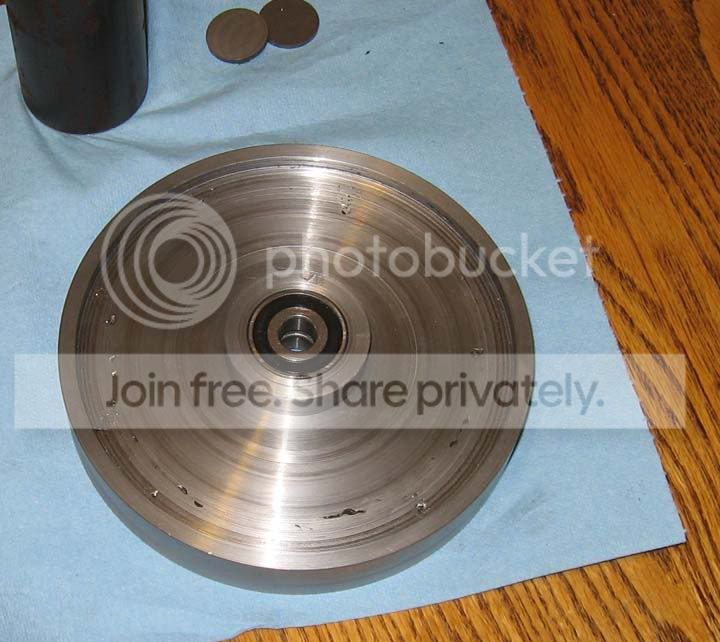
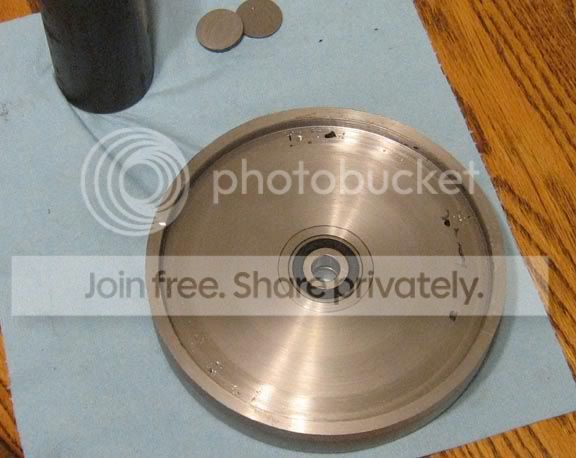
If I found a 2x8" wheel with an 80 durometer surface would that work? It's under $50 comes with 1/2" bearings and available through a local supplier.
- Joined
- Apr 19, 1999
- Messages
- 3,560
John, that wheel is great. All you need now is someone to put a rubber tire on it, about 60 to 80 durometer and 3/4" thick to give you room to re-dress the wheel a couple of times.
I use a company here in Mississauga called Clarke Roller to recover mine when they get damaged or worn out.
George
I use a company here in Mississauga called Clarke Roller to recover mine when they get damaged or worn out.
George