It has been used with great deal of care, it remains in excellent condition throughout!
Everything works like charm and has no issues of any kind cosmetically or function wise.
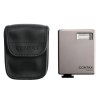
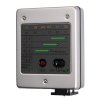
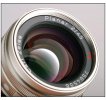
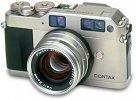
I have G1 body, Plannar Carl Zeiss 2/45mm lens and TLA 140 flash.
I will also include whatever little things that I can locate for this outfit, like: Contax strap, lens cap, Heliopan filter, etc...
$450.00 for the whole outfit shipped overnight CONUS/CANADA.
I will consider reasonable offers and/or trades.
Below is the description and pics that I borrowed:
The G1 body
The Contax G1 is a so-called rangefinder camera. You don't look through the lens but through a separate viewfinder and the focusing is done externally. It measures the distance using triangulation and then the autofocus system sets the lens to the correct distance. The Contax G1 and its larger sister, the Contax G2, are the only autofocus rangefinders with exchangable lenses in small format I know of -- there is no similar camera system one really could compare to. In newsgroups and forums you will find lengthy and often heated discussions comparing the Contaxes to Leicas, Konica Hexars and Hasselblad X-Pans, but in their details all of these cameras are quite different. I will come back to that later.
Each camera system has its limitations and you will only become happy with a certain type of camera if you know about them and accept them. There are some things you simply cannot do with an rangefinder. Rangefinder cameras (=RFs) are very convenient for wide angle lenses and normal lenses -- often much better than SLRs. Focussing with these 'short' lenses usually is much more accurate on a RF. But the longer the lenses get, the more the RFs are outperformed by SLRs. The longest lens for the Contax Gs is a 90mm lens, for Leicas you can buy 135mm lenses but that's about as long as it gets. There are no 200mm or 300mm lenses for RFs and if you need such long telephoto lenses a RF is not the right type of camera for you. Another thing which is totaly impossible with a RF (simply as you don't look through the lens but through a viewfinder which is several centimetres beside it) is macro photography. You also cannot see if your lens flares under adverse light conditions (which is usually not the problem of Zeiss lenses) and you cannot judge the effect of a polarization filter. The use of filters in general is no problem as the light metering is done through the lens (=TTL) and therefore takes automatically the intensity loss into account.
The Contax G1 is a very well built camera and it feels quite solid. It's probably the most comfortable camera to hold in hands I ever touched. For the right hand, there are some perfectly shaped rubber parts which make it extremely easy to hold the camera with only one hand. If you lift it up for the first time you'll probably be surprised that it is heavier than it looks like. The surface is made of titanium and although I didn't handle it with exceptional care it didn't get any serious scratches yet. The ergonomics are perfect: for every function (apart from some custom settings which I usually don't change at all) there is a separate knob or wheel, and everything has only one function. If I compare this to my Canon EOS where I have to click with tiny plastic buttons through menues until I arrive again at the beginning I indeed prefer the straight-forward design of the Contax.
The Contax offers aperture priority or manual mode. I usually use it in aperture priority. Then you can select the f-stop at the lens and the camera will select the appropriate shutter speed (between 16s and 1/2000s) to achieve correct exposure. The exposure can easily be corrected in the range of +2 to -2 EV in 1/3 EV increments with the left one of the two wheels. Below the wheel, there is a small lever which allows to activate automatic bracketing of +/-0.5 EV or +/-1 EV: the camera will take three exposures, one with the determined light meter reading and in addition one under- and one overexposed (by 0.5 or 1 EV). Expecially if you shoot slide film this is convenient. Sometimes the light meter gets mislead (like every light meter, e.g. if you have a lot of snow in your picture and it tries to compensate it to 12.5% or 18% grey) -- then you have to intervene. The TTL-light metering system of the Contax Gs is extremely simple, much simpler than the matrix-/multizone-/whatever-systems modern SLRs use. I actually prefer this system as I always know exactly what it does or tries to do (once I understood it). With some experience you will get perfect results and even if you just blindly trust it, most of your pictures will be not so bad.
The metal bayonet of the lens mount is a bit 'fiddly' and I never got entirely comfortable with it. Don't get me wrong, it is very solid and the lens locks with a positive click. But to attach the lens I still have to look at it, even after doing it several hundred times. With my Canon EOS I could do it blindfolded, but with the Contax I still have to check if the lens is well aligned before I turn the lens barrel to lock it into place. It's not such a big deal. Only with the wide angle lenses (like the 28mm Biogon lens) you have to be really careful as the rear lens element stands out by a few centimeters and can be easily damaged by banging it against the edge of the metal lens mount!
The Contax Gs have automatic film advance. The G1 advances film with up to 2 fps (frames per second), the bigger G2 with up to 4 fps. At the end it will automatically rewind the film. When approaching the end of a film you actually have to pay a bit attention or you risk that the last picture will be just on the end of the film roll (and therefore incomplete). The camera allows you to take pictures until the film transport mechanism feels some resistance and starts rewinding the film. It doesn't stop you after e.g. the 36th frame, you can perhaps take a 37th but at the latest the 38th picture will be incomplete. That's not a big deal: look from time to time at the little LCD counter and if you reach the 37th picture just force the camera to rewind the film. And be warned: rewinding the film is a noisy process! This is one of the main reservations Leica users have against the Contax Gs. Better make sure that the rewind doesn't happen if you take the camera to a theatre or concert! At least not, if you sit next to someone with a Leica. On the other hand it's pretty fast and you can quickly remove the film canister, drop in a new one and will be ready again in about 30 seconds. I doubt the Leica fan next to you can beat this.
The Carl Zeiss lenses for the Contax G
Look around on the web and read some reviews to get an impression what people think about these lenses. You will read lots of complaints about the Contax autofocus, the whirring noises the camera makes, the dim viewfinder and its appetite for expensive batteries. But almost everyone will agree that the Zeiss lenses for this camera system are outstanding. People will discuss which lenses are better: Carl Zeiss, Leica or the top lenses of Canon and Nikon. Nobody will ever seriously try to compare these lenses to Tokina or Tamron lenses. Most photographers will agree that, although there is much room for improvements on the Contax G1 and G2 bodies, the Zeiss lenses are as good as small format photography can get. People who use both Leica and Zeiss will talk about tiny differences but I never read that somebody seriously doubted the optical performance of the Zeiss lenses. The handling of the lenses is of course very different, the Zeiss lenses being autofocus lenses while the Leica lenses are manually focused. Even experienced photographers say that they usually cannot objectively distinguish photos they took with Zeiss glass from those taken with their Leica lenses.
So, when I bought my first Zeiss lens (which was the Planar 2/45) my expectations were high. They were surpassed by far, when I saw the first results. I thought I knew what a sharp picture looks like. Well, I have to admit: I didn't. I took for example a picture of a village viewed from a hill nearby. Hell, I could even count individual tiles on the roofs of the houses! I realized that I had never used a really good lens before.
Unlike (most) SLR AF lenses, the AF motor is not located in the lens itself but in the camera body. On the bayonet mount of the body is sort of a 'screwdriver', which fits into a 'screw' on the lens. When you focus, this screwdriver will transmit the force to the lens and move it into position. After changing lenses you'll hear a 'click' the first time you focus. Don't worry, it's just the screwdriver catching the screw.
The Carl Zeiss Planar 2/45 lens
The 45mm Planar is the 'normal' lens in the Zeiss line-up for the Contax Gs. Some reviews on the web claim that this is also the best lens -- I cannot confirm that as I'm not able to see a clear superiority over the other two lenses I own, they are all very good. To my own surprise that is the lens I grab usually if I take only one lens with me. I discovered that one can do a lot with only this one single normal lens. It is (together with the Planar 2/35 which I don't own) the fastest lens available for the Contax G system, which is (compared e.g. to the Leica M system with its f/1.4 and even f/1.0 (!) lenses) not that fast. I would be happy if Contax would offer at least one really fast lens, e.g. a Planar 1.4/45, but they don't -- therefore, if you need fast lenses, the Contax G system is probably not the right choice for you. But it's of course much better than e.g. the Hasselblad X-Pan with its f4/45mm lens, although I'm now comparing apples with oranges as the X-Pan lenses are in fact medium format lenses. If you accept the limitation of f/2 the Zeiss Planar 2/45 is an outstanding piece of glass which delivers absolutely staggering sharpness and vibrant colours.
The TLA 140 flash
I rarely use flash at all with the Contax G1. Actually I bought this flash unit only because I got it for a very reasonable price secondhand, but in mint condition. Once I had it, I found it quite useful. This cute little thing is so tiny!! It is very flat, only about 2cm, and very light (80g without battery, it requires one 3V CR123A), so you can easily drop it into your shirt or jacket pocket and have a flash with you -- just in case you might need it! With a guidenumber of 14 (ISO100/m) it is relatively weak, but I found it more useful than expected, especially when used as fill-in flash. The Contax Gs together with the TLA flashs are capable of TTL flash metering, but they cannot keep up with the sophisticated and comfortable flash systems modern SLRs use (like e.g. the up-to-date EOS models). The Contax G1/G2 being an aperture priority camera you first have to select a reasonable f-stop (there is a small table on the back of the flash unit). If you stop down too much your picture will be underexposed despite of the flash as the flash unit simply is not strong enough. The second thing to keep in mind is that this flash is not capable of high-speed synchronization, the highest X-sync shutterspeed with the G1 is 1/100s, the G2 is able to synchronize up to 1/200s. This can be problematic if you try to use the flash for fill-in outside in bright daylight. In this case you have to use the Auto Exposure Lock (AEL) the camera offers and stop down enough to stay below 1/100s resp. 1/200s. But if you take into account these limitations, the TTL flash metering works quite satisfactory. With the TLA 140 in the hotshoe the flash bulb is about 11cm away from the centre of the lens. I assume this is the reason why I absolutely never saw any red-eye effect on my pictures. The Contax Gs will confirm after the exposure if the amount of light was sufficient for correct exposure with a blinking lightning bolt symbol in the viewfinder (the same one which also indicates that the flash is ready).
Everything works like charm and has no issues of any kind cosmetically or function wise.
I have G1 body, Plannar Carl Zeiss 2/45mm lens and TLA 140 flash.
I will also include whatever little things that I can locate for this outfit, like: Contax strap, lens cap, Heliopan filter, etc...
$450.00 for the whole outfit shipped overnight CONUS/CANADA.
I will consider reasonable offers and/or trades.
Below is the description and pics that I borrowed:
The G1 body
The Contax G1 is a so-called rangefinder camera. You don't look through the lens but through a separate viewfinder and the focusing is done externally. It measures the distance using triangulation and then the autofocus system sets the lens to the correct distance. The Contax G1 and its larger sister, the Contax G2, are the only autofocus rangefinders with exchangable lenses in small format I know of -- there is no similar camera system one really could compare to. In newsgroups and forums you will find lengthy and often heated discussions comparing the Contaxes to Leicas, Konica Hexars and Hasselblad X-Pans, but in their details all of these cameras are quite different. I will come back to that later.
Each camera system has its limitations and you will only become happy with a certain type of camera if you know about them and accept them. There are some things you simply cannot do with an rangefinder. Rangefinder cameras (=RFs) are very convenient for wide angle lenses and normal lenses -- often much better than SLRs. Focussing with these 'short' lenses usually is much more accurate on a RF. But the longer the lenses get, the more the RFs are outperformed by SLRs. The longest lens for the Contax Gs is a 90mm lens, for Leicas you can buy 135mm lenses but that's about as long as it gets. There are no 200mm or 300mm lenses for RFs and if you need such long telephoto lenses a RF is not the right type of camera for you. Another thing which is totaly impossible with a RF (simply as you don't look through the lens but through a viewfinder which is several centimetres beside it) is macro photography. You also cannot see if your lens flares under adverse light conditions (which is usually not the problem of Zeiss lenses) and you cannot judge the effect of a polarization filter. The use of filters in general is no problem as the light metering is done through the lens (=TTL) and therefore takes automatically the intensity loss into account.
The Contax G1 is a very well built camera and it feels quite solid. It's probably the most comfortable camera to hold in hands I ever touched. For the right hand, there are some perfectly shaped rubber parts which make it extremely easy to hold the camera with only one hand. If you lift it up for the first time you'll probably be surprised that it is heavier than it looks like. The surface is made of titanium and although I didn't handle it with exceptional care it didn't get any serious scratches yet. The ergonomics are perfect: for every function (apart from some custom settings which I usually don't change at all) there is a separate knob or wheel, and everything has only one function. If I compare this to my Canon EOS where I have to click with tiny plastic buttons through menues until I arrive again at the beginning I indeed prefer the straight-forward design of the Contax.
The Contax offers aperture priority or manual mode. I usually use it in aperture priority. Then you can select the f-stop at the lens and the camera will select the appropriate shutter speed (between 16s and 1/2000s) to achieve correct exposure. The exposure can easily be corrected in the range of +2 to -2 EV in 1/3 EV increments with the left one of the two wheels. Below the wheel, there is a small lever which allows to activate automatic bracketing of +/-0.5 EV or +/-1 EV: the camera will take three exposures, one with the determined light meter reading and in addition one under- and one overexposed (by 0.5 or 1 EV). Expecially if you shoot slide film this is convenient. Sometimes the light meter gets mislead (like every light meter, e.g. if you have a lot of snow in your picture and it tries to compensate it to 12.5% or 18% grey) -- then you have to intervene. The TTL-light metering system of the Contax Gs is extremely simple, much simpler than the matrix-/multizone-/whatever-systems modern SLRs use. I actually prefer this system as I always know exactly what it does or tries to do (once I understood it). With some experience you will get perfect results and even if you just blindly trust it, most of your pictures will be not so bad.
The metal bayonet of the lens mount is a bit 'fiddly' and I never got entirely comfortable with it. Don't get me wrong, it is very solid and the lens locks with a positive click. But to attach the lens I still have to look at it, even after doing it several hundred times. With my Canon EOS I could do it blindfolded, but with the Contax I still have to check if the lens is well aligned before I turn the lens barrel to lock it into place. It's not such a big deal. Only with the wide angle lenses (like the 28mm Biogon lens) you have to be really careful as the rear lens element stands out by a few centimeters and can be easily damaged by banging it against the edge of the metal lens mount!
The Contax Gs have automatic film advance. The G1 advances film with up to 2 fps (frames per second), the bigger G2 with up to 4 fps. At the end it will automatically rewind the film. When approaching the end of a film you actually have to pay a bit attention or you risk that the last picture will be just on the end of the film roll (and therefore incomplete). The camera allows you to take pictures until the film transport mechanism feels some resistance and starts rewinding the film. It doesn't stop you after e.g. the 36th frame, you can perhaps take a 37th but at the latest the 38th picture will be incomplete. That's not a big deal: look from time to time at the little LCD counter and if you reach the 37th picture just force the camera to rewind the film. And be warned: rewinding the film is a noisy process! This is one of the main reservations Leica users have against the Contax Gs. Better make sure that the rewind doesn't happen if you take the camera to a theatre or concert! At least not, if you sit next to someone with a Leica. On the other hand it's pretty fast and you can quickly remove the film canister, drop in a new one and will be ready again in about 30 seconds. I doubt the Leica fan next to you can beat this.
The Carl Zeiss lenses for the Contax G
Look around on the web and read some reviews to get an impression what people think about these lenses. You will read lots of complaints about the Contax autofocus, the whirring noises the camera makes, the dim viewfinder and its appetite for expensive batteries. But almost everyone will agree that the Zeiss lenses for this camera system are outstanding. People will discuss which lenses are better: Carl Zeiss, Leica or the top lenses of Canon and Nikon. Nobody will ever seriously try to compare these lenses to Tokina or Tamron lenses. Most photographers will agree that, although there is much room for improvements on the Contax G1 and G2 bodies, the Zeiss lenses are as good as small format photography can get. People who use both Leica and Zeiss will talk about tiny differences but I never read that somebody seriously doubted the optical performance of the Zeiss lenses. The handling of the lenses is of course very different, the Zeiss lenses being autofocus lenses while the Leica lenses are manually focused. Even experienced photographers say that they usually cannot objectively distinguish photos they took with Zeiss glass from those taken with their Leica lenses.
So, when I bought my first Zeiss lens (which was the Planar 2/45) my expectations were high. They were surpassed by far, when I saw the first results. I thought I knew what a sharp picture looks like. Well, I have to admit: I didn't. I took for example a picture of a village viewed from a hill nearby. Hell, I could even count individual tiles on the roofs of the houses! I realized that I had never used a really good lens before.
Unlike (most) SLR AF lenses, the AF motor is not located in the lens itself but in the camera body. On the bayonet mount of the body is sort of a 'screwdriver', which fits into a 'screw' on the lens. When you focus, this screwdriver will transmit the force to the lens and move it into position. After changing lenses you'll hear a 'click' the first time you focus. Don't worry, it's just the screwdriver catching the screw.
The Carl Zeiss Planar 2/45 lens
The 45mm Planar is the 'normal' lens in the Zeiss line-up for the Contax Gs. Some reviews on the web claim that this is also the best lens -- I cannot confirm that as I'm not able to see a clear superiority over the other two lenses I own, they are all very good. To my own surprise that is the lens I grab usually if I take only one lens with me. I discovered that one can do a lot with only this one single normal lens. It is (together with the Planar 2/35 which I don't own) the fastest lens available for the Contax G system, which is (compared e.g. to the Leica M system with its f/1.4 and even f/1.0 (!) lenses) not that fast. I would be happy if Contax would offer at least one really fast lens, e.g. a Planar 1.4/45, but they don't -- therefore, if you need fast lenses, the Contax G system is probably not the right choice for you. But it's of course much better than e.g. the Hasselblad X-Pan with its f4/45mm lens, although I'm now comparing apples with oranges as the X-Pan lenses are in fact medium format lenses. If you accept the limitation of f/2 the Zeiss Planar 2/45 is an outstanding piece of glass which delivers absolutely staggering sharpness and vibrant colours.
The TLA 140 flash
I rarely use flash at all with the Contax G1. Actually I bought this flash unit only because I got it for a very reasonable price secondhand, but in mint condition. Once I had it, I found it quite useful. This cute little thing is so tiny!! It is very flat, only about 2cm, and very light (80g without battery, it requires one 3V CR123A), so you can easily drop it into your shirt or jacket pocket and have a flash with you -- just in case you might need it! With a guidenumber of 14 (ISO100/m) it is relatively weak, but I found it more useful than expected, especially when used as fill-in flash. The Contax Gs together with the TLA flashs are capable of TTL flash metering, but they cannot keep up with the sophisticated and comfortable flash systems modern SLRs use (like e.g. the up-to-date EOS models). The Contax G1/G2 being an aperture priority camera you first have to select a reasonable f-stop (there is a small table on the back of the flash unit). If you stop down too much your picture will be underexposed despite of the flash as the flash unit simply is not strong enough. The second thing to keep in mind is that this flash is not capable of high-speed synchronization, the highest X-sync shutterspeed with the G1 is 1/100s, the G2 is able to synchronize up to 1/200s. This can be problematic if you try to use the flash for fill-in outside in bright daylight. In this case you have to use the Auto Exposure Lock (AEL) the camera offers and stop down enough to stay below 1/100s resp. 1/200s. But if you take into account these limitations, the TTL flash metering works quite satisfactory. With the TLA 140 in the hotshoe the flash bulb is about 11cm away from the centre of the lens. I assume this is the reason why I absolutely never saw any red-eye effect on my pictures. The Contax Gs will confirm after the exposure if the amount of light was sufficient for correct exposure with a blinking lightning bolt symbol in the viewfinder (the same one which also indicates that the flash is ready).