contour a handle?

Joined
Jun 8, 2005
Messages
288
So i am going to try my hand at knife making from scratch. I ordered some steel and its on its way. Right now I am working on drawing up the knife. I am thinking about having some handle contour in the width of the handle. How do you decide where good spots to place contour in the width are?
 
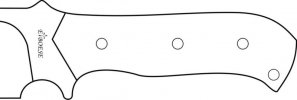
Look at your hand, open and close it. Get some PlayDough (don't laugh) and roll it into a ball. Put it in your palm and squeeze it until it squishes out. Look at it's shape. Not scientific, just simple ergonomics. The swell is center, contouring down at the finger choil and where your pinky lay, then maybe a flare at the butt to keep the knife secured in your grip.
 
This is a Busse inspired chopper but it should give you a good idea.
attachment.php
 

Attachments

  • Handle.jpg
    Handle.jpg
    12 KB · Views: 325
No Playdough? tear up some newspapers and make paper mache', or if you want, just soak some shredded newspaper and squeeze that.
 
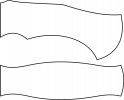
The newspaper and play dough are really good ideas. Ill give them a try. I have the contour down on the side like you posted in the picture, I'm just trying to figure out how to put contour into the width of the handle (sorry I know this isn't very clear, but I cant think of any other way to describe it)
 
Last edited:
How 'bout this?
attachment.php
 

Attachments

  • Handle 2.jpg
    Handle 2.jpg
    16.1 KB · Views: 313
Modeling clay is even better yet. You can make as many versions as you want. The clay is stiffer than playdough and has a longer shelf life. It can be a really cool study. Once I stumble onto an idea that seems to have potential I usually model it out in three sizes: a three finger mini, a basic full hand size and a whopper chopper type size. It can be quite illuminating.
 
I like the "playdough"/clay/mache' idea...... What about making the paper mache' with epoxy, placing the gob onto a blank that would approximate the tang of the knife that you're working on.

Just wrap the soft, uncured putty with cling wrap and grab and squeze (coat the "tang" with a release agent that would allow the halves to be removed after cure).

Drill the pin holes, add spacers, etc. before glue up to the knife tang, then fine sand and finish.

This, I think would be a form of "block" micarta that could be made/molded in choice of color(s) and should be as durable as the epoxy used.

I like the idea... What do I have that I could use for this project. I just might try it myself. :D

Jim L.
 
I think everyone has had that idea at some point or another :foot: Try this, take a knife and cut several different things, note how you hold it. You'll notice your grip shifts as you cut, thus severely limiting the utility of that idea. It'd be pretty cool if it actually worked that way though :D
 
I actually like to use random wood. play-doh will give you a feeling for where the hand squeezes and things fit, but working directly with wood can give you several good lessons in how to acheive various shapes, the importance of rounding, and such.
 
I like the "playdough"/clay/mache' idea...... What about making the paper mache' with epoxy, placing the gob onto a blank that would approximate the tang of the knife that you're working on.

Just wrap the soft, uncured putty with cling wrap and grab and squeze (coat the "tang" with a release agent that would allow the halves to be removed after cure).

Drill the pin holes, add spacers, etc. before glue up to the knife tang, then fine sand and finish.

This, I think would be a form of "block" micarta that could be made/molded in choice of color(s) and should be as durable as the epoxy used.

I like the idea... What do I have that I could use for this project. I just might try it myself. :D

Jim L.

I've actually been thinking about how this would work for making a phenolic handle directly on a hideen tang knife. you could sawtooth the tang so that is would be a good mechanical adhesion.

I wouldn't try to shape the handle that way, I'd just press it in, but it's something I've thought about. I think you'd have to have the guard pressure fitted first, and possibly oversized to match the block form
 
Back
Top