controlling blade colorization from heat treat

daizee

Knifemaker / Craftsman / Service Provider
Joined
Dec 30, 2009
Messages
11,173
Hi All,

I've found quite a lot of people like the pretty heat treat colors on A2 and other steels, and I like to preserve them on some types of blades such as kirdashi and stick-tang bench knives.

In that context, I have two questions:

1) when using a kiln and foil heat treat, does anyone know how to consistently maximize the 'cool factor' in the colors? My current working hypothesis is that higher cooling speed produces more vivid rainbows due to variations in the surface cooling speed. Plate quenching seems to help, but I don't have enough well-controlled samples

2) If I get a big batch order and outsource a batch to one of the pro heat-treating shops, what will the surface look like when it comes back? Does anyone have pictures from Bos or Peters' A2 heat-treat batches?

Thanks!

Below are a couple images of the kind of thing I'm looking for.
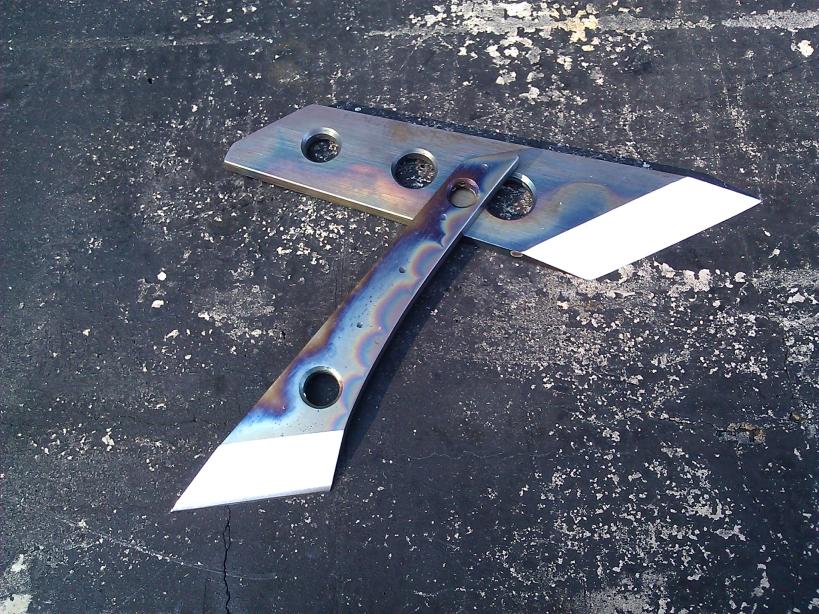
IMG_20120804_165004-small.jpg


IMG_20140113_233522-small.jpg
 
Honestly, I don't understand the appeal. To my eye it just looks like the blade was badly over-heated in final grinding and the temper got blown out. (I realize that's not actually the case, it just looks that way.) Then again a lot of makers get good money for crudely-forged blades covered with pits and hammer marks, and people love 'em, so what do I know... *shrug*

The problem with heat-coloring on steel is that the oxides you're seeing are extremely thin and have basically no wear-resistance. It's going to wear off with use and leave a knife looking like it simply wasn't finished.

I would think various oils/contamination would make for different colors and patterns... whether or not you want to be heating stuff like that up inside your kiln is up to you. Sounds like a bad idea to me...

My batches come back from Peters with pretty uniform color. I'll dig up a pic if you like... it's not very exciting.
 
Honestly, I don't understand the appeal. To my eye it just looks like the blade was badly over-heated in final grinding and the temper got blown out. (I realize that's not actually the case, it just looks that way.) Then again a lot of makers get good money for crudely-forged blades covered with pits and hammer marks, and people love 'em, so what do I know... *shrug*

The problem with heat-coloring on steel is that the oxides you're seeing are extremely thin and have basically no wear-resistance. It's going to wear off with use and leave a knife looking like it simply wasn't finished.

I would think various oils/contamination would make for different colors and patterns... whether or not you want to be heating stuff like that up inside your kiln is up to you. Sounds like a bad idea to me...

My batches come back from Peters with pretty uniform color. I'll dig up a pic if you like... it's not very exciting.

Heheh, I hear ya, JT.
Though most customers don't know anything about working metal, so they don't have any preconceptions about what those colors could mean and bring a completely different perspective to their... shopping. And polishing it off is work, especially when you can't easily do a single continuous brush stroke without a special fixture. Every single non-metalworker I've shown one of these to goes bug-eyed when they see the colors.

The oxide layer is surprisingly durable. Yes, it will wear over time and show use, particularly where the kydex divot drags on the surface (on these with my sheath design), but then regular knives show use too. And these days 'authenticity' is all the rage. Personally, I think stainless is a better choice for unscaled 'dashi, and I don't mind those oxide layers either - but they're not so dramatic. But I've been asked about A2 with the fancy colors specifically.

I've only played a TINY bit with various contaminants. It all goes in foil packets, so there's little risk to the kiln.
If you've got pix of a Peters batch, I'd love to see. Batchability may affect my pricing for a potential job, or whether I take it at all.

-Daizee
 
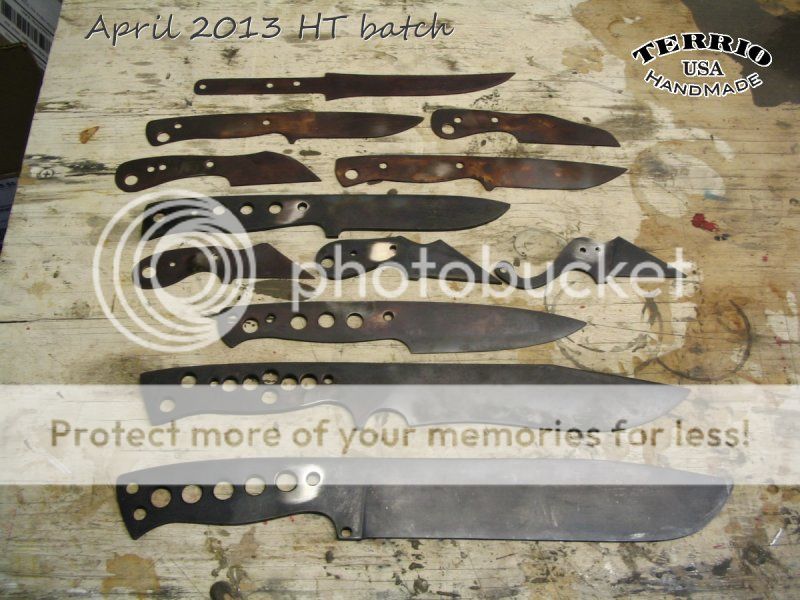
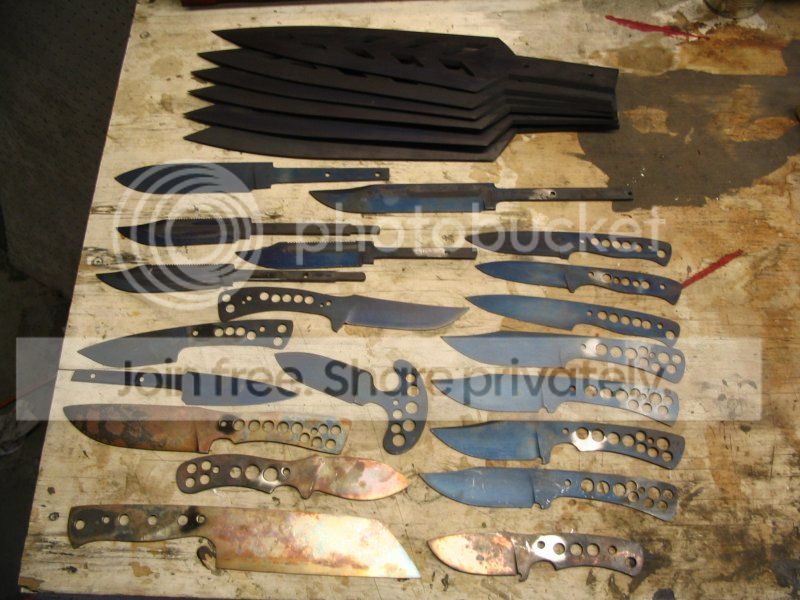
The blue/black blades are oil-hardened steels (O1 and 1095), the bronze ones are air-quenched (CPM-3V, Elmax and CPM-154).

AprHTbatch_zps2a07ff2d.jpg


1204002_zpsd56e9508.jpg
 
OMG, is that a stack of SPEARS??

Thanks for the pic, JT.


-Daizee
 
Any attempt to leave the surface oxides will tell a knowing observer two things:
1) The color is only temporary, and will be gone soon. It is only a few microns thick.
2) The very fact that it is there shows the blade has not been properly finished.


#1 is mostly a matter of taste. Some people like scale, decarb, hammer dents, and HT colors left on a blade. Personally, I think it looks like a half finished blade, but there is a market for "Brut de Forge".
#2 is more important. It shows that some steps were skipped in finishing the blade. While the maker almost always says. "I meant to leave that there because it looks cool." What it says to me is, "I was in too much of a rush to do it properly." or, "My sanding sucks, so I don't bother."
 
foil wrapped blade. the better you wrap the blade the less color you will have and if you were so inclined you coudl leave gaps in the foil to alow extra air around the blade as points you wanted
it has nothing to do with quench its the start of decarb (well not really decarb but oxidizing )

i did a blade way back jsut to see if it could be done in purple. here is the trick temper temp needs to be 1000f and you have to temper in foil. you also need to fins a way to get rid of the oxygen in the pack at the tempture you want. in my case i picked a bit of wood with a high burn point
 
You're welcome. Told you it wasn't very exciting, lol. Well, except for the spear-heads. :p

Did you get the order for all 300 or are you just sub-contracting for that half-dozen there? :D

Any attempt to leave the surface oxides will tell a knowing observer two things:
#1 is mostly a matter of taste. Some people like scale, decarb, hammer dents, and HT colors left on a blade. Personally, I think it looks like a half finished blade, but there is a market for "Brut de Forge".
#2 is more important. It shows that some steps were skipped in finishing the blade. While the maker almost always says. "I meant to leave that there because it looks cool." What it says to me is, "I was in too much of a rush to do it properly." or, "My sanding sucks, so I don't bother."

Hi Stacy, I figured you'd comment since I know you don't like it. :)
I am specifically getting requests to leave the colors on, whether or not I like it (I often do). For sub-$100 pocket toys, I can't be hand-sanding anything, certainly not after heat-treat. One could say the same about belt vs. hand finishes. Personally 90% of my blades get hand-sanded. I'm working on a set or line of modestly priced models that will have no hand sanding except for the bevel. I think the oxide layers look fine on scale-less blades. On full-tangs with scales it would be a mess. The stick-tang example above was for funsies and practice - that was a scrap knife. So it's true, I *am* in a rush as demand is high and production rate low. And some customers prefer the colors - even more so after you tell them that it's a side-effect of the heat treatment process (and it will wear, etc. etc.). So far I've often flat sanded before heat-treat, but not after. When there is lots of mill scale, I usually leave it alone (moving towards all p-ground generally). I'm no Nick Wheeler, but I think my hand-standing stands on its own at my current market level, so I'm not concerned about that sort of judgement.

foil wrapped blade. the better you wrap the blade the less color you will have and if you were so inclined you coudl leave gaps in the foil to alow extra air around the blade as points you wanted
it has nothing to do with quench its the start of decarb (well not really decarb but oxidizing )

i did a blade way back jsut to see if it could be done in purple. here is the trick temper temp needs to be 1000f and you have to temper in foil. you also need to fins a way to get rid of the oxygen in the pack at the tempture you want. in my case i picked a bit of wood with a high burn point

Hmmm, ok. Lots to think about. I have used various techniques with foil, but not systematically with colors in mind. Including: bare steel, no oxidizer. bare steel with sawdust. bare steel with a small bit of paper, steel with a VERY light coating of talc (to prevent foil stickage). Occasionally there is a pinhole in the packet and air gets in and produces a sooty burn on the surface. It doesn't go very deep, but it certainly isn't pretty. I've always tempered outside the packet.
 
The colors you are looking for are/were often created on the firearms industry through a process called "case color hardening" I don't know if that process would work for this application, but it might be worth researching...
 
I like hammer marks, scale and what not left on the FLATS of a blade, but only when the rest of the work (bevels, scales or handle, etc) are finished to a high level of f&f.

There's a difference between un/under finished, and the effect being used as a design form.

I can't see the oxides being durable at all. You say that they are so I must defer to my inexperience.

If I wanted that effect, especially in a kiridashi, I'd probably opt for 6AL4V titanium and buy a carbidizer to apply a proper edge.

All of that said, I applaud your search for a unique angle. The finish doesn't appeal to me, but that doesn't matter one bit if it appeals to someone else. ;)
 
I like hammer marks, scale and what not left on the FLATS of a blade, but only when the rest of the work (bevels, scales or handle, etc) are finished to a high level of f&f.

Good point, most of the makers (at least around here) do indeed put the usual care into properly finishing their bevels, etc when they leave the flats "brut de forge".
 
I think the colors look great and are certainly not a sign of an unfinished blade. I am often tempted to leave them on when they come out looking cool... one thing that has led to hesitation is that a mild acid like vinegar can remove them instantly... I was soaking some high carbon blades in vinegar when I discovered this.

I sill like the look and consider leaving some of the color effect in a lower wear area.

These S7 blades came out looking cool! They were in a stainless pouch during austenitizing but not temper.


I also think the colors are cool, but would not leave them on any knife I make. I thought about it once... and then thought better of it.
 
My blades from Bos come back looking untouched. Occasionally a slight tint of yellow/straw here and there.

These colors look pretty awesome to me. I may have to play with this.

Which would mean doing all grinding before HT :(
 
Back
Top