Convex Grind Using Files.

Cypress Creek Knives

CCK
Knifemaker / Craftsman / Service Provider
Joined
Dec 15, 2010
Messages
646
I know there is a recent thread about convex grinding using belt sanders, but I do not have the right equipment to do that. I was wondering if anyone has tried using files to put a full convex grind on a knife. I couldn't find any information on this. All information is appreciated. Thanks.
 
K... I'm probably no expert, and would never claim to be, but yes, you do. I've been making knives for well over 20 years, and with a smooth hand you can definitely make convex blades with files. just imagine the cross section you are looking for and make it happen. I started making them this way years ago by intending on making flat grinds... and not having the equipment, so I ended up with convex a bit by accident.
 
Bronyblacksmith, do yo have any tips? And do you freehand it like rustyrazor mentioned?
 
I make most of my knives with files hacksaw and sandpaper i start with a 45 degree angle and file the first grind in to the edge line of the blade and then i do a drawfile motion untill i have the grind line set to the mark on the steel i make with a caliper after i reach that point i file from edge to spin to set the convex i use a rocking motion with my wrist.

After i am done with the files i wrap sandpaper around a flat stick that is flexible so i can follow the grind left by the files i start with 100grit paper and go to 220-360 then i heat treat after the heat treat i start with 320grit freehand and i go to 400 then i acid etch.
 
Last edited:
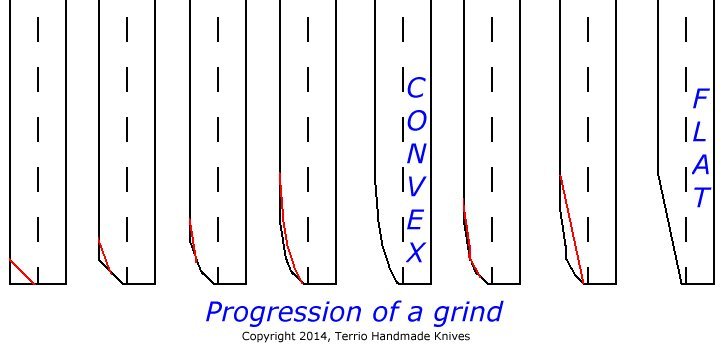
The technique is really the same whether you use a belt grinder or files, or whether you want a convex or full-flat or sabre grind. Start with a 45 to set the edge thickness. Then
make another plane on the apex of that grind line. Continue in the same manner until you have a series of facets that reach as high on the blade as you want. Either blend them together into a smooth curve for a convex grind, or bring them all into a plane for a flat grind.
 
Last edited:
Not to scale, and simplified for the sake of clarity...

tumblr_n2se6iemYr1t96crwo1_1280.jpg
 
Thanks james terrio, that method is what I originally considered. I'm going to have to try that out. I'll have to practice with some scrap steel because I don't want to mess my knife up.
 
Notice how in James' diagram he cut the bevels so that there is still a small distance between the bevel and the center line. That was not done by accident.That's what you want when you are done with the primary grind.
 
tryppr is correct... leave a little extra "meat on the bone" when setting your bevels... once they're established at the proper angle/curvature relative to the center of the bar, it's easy to thin them down. :thumbup:
 
Thanks james terrio, that method is what I originally considered. I'm going to have to try that out. I'll have to practice with some scrap steel because I don't want to mess my knife up.

I am not a fan of practicing on junk steel. Use good cutlery steel and take your time. You're much more likely to wind up with a good blade worth finishing :)
 
Okay, thanks for the advice. I will work on my knife over the weekend. I will post my results soon.
 
I am not a fan of practicing on junk steel. Use good cutlery steel and take your time. You're much more likely to wind up with a good blade worth finishing :)

couldn't agree more. start with junk steel and no matter how good you do it, you still have junk. at least if you mess up using a good piece of steel, you can still make a slightly smaller knife out of good steel.
 
yeah like James said. I also used a file guide to keep the grindlines even when I did some recently and make sure you do your best to mark the center line before you start. and like they said if you are going to try this do it for real.
 
Back
Top