
-
The BladeForums.com 2024 Traditional Knife is available! Price is $250 ea (shipped within CONUS).
Order here: https://www.bladeforums.com/help/2024-traditional/
You are using an out of date browser. It may not display this or other websites correctly.
You should upgrade or use an alternative browser.
You should upgrade or use an alternative browser.
Corrosion Resistance Of D2 Steel
- Thread starter Alacran
- Start date

- Joined
- Jun 29, 2002
- Messages
- 4,131
I use my 806D2 for about everything, but I make sure to keep it clean. I haven't had a bit of rust yet!
D2 isn't very corrosion resistant, I think, might wanna check on www.crucible.com. It's a tool steel and I think it is not the best choice for seagoing crowds.
It's really named a semi-stainless steel. Not even just a stainless steel like ats-34 or 154cm, and neither are ideal for saltwater.
I personally haven't taken my Maxx out to sea yet, but as for rusting it hasn't been too bad. I'm a large guy that sweats a little more than most, so after a long day working outside, I have seen some spots that come right off with a little rubbing with a tuff cloth, nothing worse than any of my other knives, but it will rust on you.
As for my two cents worth, I would leave the Maxx at home. Every knife that I have taken on a day fishing trip on the ocean has needed a good deal of rust removal.
I personally haven't taken my Maxx out to sea yet, but as for rusting it hasn't been too bad. I'm a large guy that sweats a little more than most, so after a long day working outside, I have seen some spots that come right off with a little rubbing with a tuff cloth, nothing worse than any of my other knives, but it will rust on you.
As for my two cents worth, I would leave the Maxx at home. Every knife that I have taken on a day fishing trip on the ocean has needed a good deal of rust removal.

ARtsig1
Banned
- Joined
- Jul 20, 2000
- Messages
- 3,692
D2 steel is barely stain resistant at 12.00% chromium. The modified D2 that Camillus is using has the chromium upped to 12.50% which makes it a little bit more resistant. Another thing that will help the Cuda MAXX is the stonewash finish which actually seals the pores of the steel. At any rate in and around a saltwater enviroment I would use the Sentry Marine cloth and wipe it down on a regular basis. Be sure to pay attention to the pivot area since you can't wipe it down.
- Joined
- Apr 29, 2002
- Messages
- 1,273
Try 420HC, it's a very rust-resistant steel, used in many "cheap" knives. Sometimes I don't even wipe it down after using it, I just throw the knife in water and dry off what I can. Hasn't rusted yet. However the edge needs frequent steeling/sharpening.
You can also consider Talonite and Titanium knives.
You can also consider Talonite and Titanium knives.

- Joined
- Jan 5, 2001
- Messages
- 2,726
Originally posted by Alacran
Anybody care to give an opinion as to what the best type of stainless steel resists seaspray?
The best choice would be one of the non-steel cobalt alloys like Talonite or Stellite. They simply do not rust. The downside is that they are quite pricey. Take a look at the non-custom Talonite options like the Camillus Talon and Mini-Talon.
The only production Talonite folder I can think of is the Camillus EDC and I would worry about the stainless steel frame rusting under seagoing conditions.
--Bob Q
Uncoated D-2 rusts pretty darn easy. I have several Dozier knives and I have to make sure if they get wet they get dried off and oiled well. They rust real quick otherwise. I would say no other knife rusts as fast. Even 1095 carbon steel seemingly rusts slower. I know that Aus8 and VG-10 seem to be pretty rust resistant. The most rust resistant of all is the steel used on Swiss Army knives. It also dulls the quickest.
Alacran,
Try one of these cobalt knives by david boye. No iron so they won't rust, and I've heard they cut like mad.
check this thread for comments:
http://www.bladeforums.com/forums/showthread.php?s=&threadid=228495
and you can get one here:
http://www.boyeknives.com/
Hope this helps
Try one of these cobalt knives by david boye. No iron so they won't rust, and I've heard they cut like mad.
check this thread for comments:
http://www.bladeforums.com/forums/showthread.php?s=&threadid=228495
and you can get one here:
http://www.boyeknives.com/
Hope this helps

- Joined
- May 17, 2002
- Messages
- 5,757
VG-10 is a pretty good steel which seems to be very corrosion resistant, at least when coated. There was a test in a German knife magazine a couple of months ago where a coated Fällkniven A1 (with a VG-10 blade) held up great in salt water spray.
My experience with D2 is mainly with Dozier mades. For many years now these are the blades I actually carry and use on a regular basis. I rarely use them in a marine environment. But the very few occassions that I' ve seen some staining on these blades is where I' ve used them for an extended time on foodstuff. Even then a simple wash with soap and water will prevent any further corrosion. Some occasional hand buffing with Flitz metal polish does the trick of removing the stains.
Concerning ocean use, a higher chromium content stainless would probably be a better choice. But keep in mind that all of your blades, regardless of steel type must be well maintained in order for it to serve you well. So rinse, wipe and let dry.
The various titanium offerings on the market would be corrosion proof enough. Mission knives come to mind. These are probably less costly than stellite, talonite, and dendritic cobalt.
Nakano
Concerning ocean use, a higher chromium content stainless would probably be a better choice. But keep in mind that all of your blades, regardless of steel type must be well maintained in order for it to serve you well. So rinse, wipe and let dry.
The various titanium offerings on the market would be corrosion proof enough. Mission knives come to mind. These are probably less costly than stellite, talonite, and dendritic cobalt.
Nakano

- Joined
- Jul 9, 1999
- Messages
- 3,316
D-2, when done right, is moderately stain resistant. I've experienced light staining when working with D-2 around food stuff and out in moist environments. I've not yet seen any outright rust on my own D-2 knife and the Dozier's that I own.
If you are looking for maximum stain resistance in a regular type of cutlery steel, the 440 series is really the way to go. You'll find mainly 440-a and 440-c in the mainstream factory offerings. Many handmade knifemakers, myself included, use 440-c. It is a very good cutlery grade steel when you want good edge holding and great corrosion resistance.
Randall Made Knives uses 440-b as it's stainless and they forge it to boot. I don't own a Randall, but I've yet to hear anything bad about them.
The 440 series has between 17-18% Chromium in their make-up. As far as I know, this is pretty much at the top of the heap for stainless steels that have Iron as the bulk of their make-up.
If you go with the real exotics like Talonite, Stellite and Boye's dendritic Cobalt, you'll find the bulk of their make-up is Cobalt which is probably as corrsion proof as you can get.
Of course, flint knives don't corrode either now that I think of it. It holds a damn good edge too.
If you are looking for maximum stain resistance in a regular type of cutlery steel, the 440 series is really the way to go. You'll find mainly 440-a and 440-c in the mainstream factory offerings. Many handmade knifemakers, myself included, use 440-c. It is a very good cutlery grade steel when you want good edge holding and great corrosion resistance.
Randall Made Knives uses 440-b as it's stainless and they forge it to boot.
I don't own a Randall, but I've yet to hear anything bad about them.The 440 series has between 17-18% Chromium in their make-up. As far as I know, this is pretty much at the top of the heap for stainless steels that have Iron as the bulk of their make-up.
If you go with the real exotics like Talonite, Stellite and Boye's dendritic Cobalt, you'll find the bulk of their make-up is Cobalt which is probably as corrsion proof as you can get.
Of course, flint knives don't corrode either now that I think of it. It holds a damn good edge too.
- Joined
- Nov 28, 2010
- Messages
- 596
I have an Arclite in D2 that I want to cordwrap with paracord, but want to wet the paracord afterwards so it shrinks down tighter. Is this likely to rust the handle?
Edited to add: I also want to get an Izula and treat the same way. Would this be an issue there? Or would it be OK as long as I keep the water away from the edge?
Edited to add: I also want to get an Izula and treat the same way. Would this be an issue there? Or would it be OK as long as I keep the water away from the edge?
Last edited:
420 is more rust resistant than 440
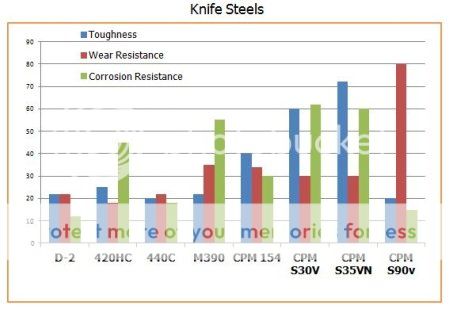
Chart from this site http://www.simplytoolsteel.com/steel-comparison-charts.html

Chart from this site http://www.simplytoolsteel.com/steel-comparison-charts.html

- Joined
- Sep 7, 2006
- Messages
- 6,211
I would recommend a stonewashed S30V blade like the Ritter Grip for sea-faring adventures. I also use a lanolin based spray to prevent corrosion on tool steel blades with excellent results.
