Could this be a Native American Cave?

Joined
Jul 12, 2008
Messages
62
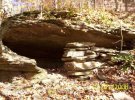
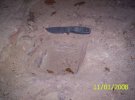
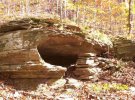
On a hillside above my parents house there is a cave of sorts that was carved/dug out of a large rock back into the mountain. It is approx 3' tall x 12' wide x 5' deep(front to back). Inside on the floor off to one side is a square indention carved out in the rock about 10" x 10" and about 4 to 5 inches deep. This indention is clearly man-made. There are rocks piled up at the entrance leaving only a small opening to crawl back into. This is not a big cave, more like a place to get into and lie down out of the elements. Nearby at the same level of the hill there are 2 other places where it looks like someone started to carve another cave but stopped after a couple feet. Over the years our neighbors have found numerous arrowheads while plowing their garden. This is located in SE Kentucky. I have found the creek that runs through our property on an old map (early 1800's) in a museum in Frankfort so the area was at least recognized then.
Has anyone heard of anything like this? The exact dimensions might be a little different as I am describing this from memory and I haven't seen it in about 10 years...I know that a picture is worth a thousand words but I just don't have any...I'll try to get some in the next couple weeks...Thanks...

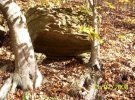
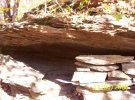
I was able to get some pics Saturday..The third pic is a smaller "cave-like" hole that is just to the right of the "cave"(if standing facing the hillside)..The square hole in the floor is on the left side looking into the "cave"(RAT-3 for scale)...
 

Attachments
  • 100_0782.jpg
    100_0782.jpg
    90.7 KB · Views: 71
  • 100_0783.jpg
    100_0783.jpg
    86.6 KB · Views: 58
  • 100_0785.jpg
    100_0785.jpg
    95.5 KB · Views: 37
  • 100_0787.JPG
    100_0787.JPG
    76 KB · Views: 50
  • 100_0791.JPG
    100_0791.JPG
    41.6 KB · Views: 90
Last edited:
If you find any arrowheads around the cave, you should be able to take them to at least your local community college. Should be an archaelogy or anthropology professor there who could help you out. If your parents don't want visitors, I would start at the library.
 
NEATO. I hope to see pics!
 
There are "arrowheads" everywhere. Artifacts in a neighbor's field would not be relevant to determining the age of the 'cave'. However, prehistoric artifacts in the cave, or directly below the cave, would be an indication. And historic artifacts in the 'cave' wouldn't necessarily mean the feature is not of prehistoric origin; many features are re-used by newer cultures.

Sure would like to see a picture. I was an archaeologist for several years in Arkansas, and did find a prehistoric man-made 'cave' once - in a bluff where native Americans had quarried novaculite.

Or the cave on your parents' property could be historic. Early settlers making a dugout for food storage, or mining.

Also, I have to wonder if the overall 'cave' isn't simply a natural feature with human modifications. Most natural overhangs and caves have been used as shelters at some point in the past. That would be easy to determine if visiting the location in person. For instance, angular walls with excavation marks that would be good evidence in support of human construction. Smooth rounded walls that lack excavation markings would be evidence of a natural feature.

I'd also point out that many times I've found structural archaeological features that gave no indication whatsoever of who did the work or when. With no associated artifacts, the 'cave' could forever remain a mystery. I have also encountered several "archaeological" features that I suspected were the remnants of kids' play forts, either modern or historic.

FYI: Most prehistoric projectile points are much too large to have been used as arrow tips - the term "arrowhead" is usually misused.
 
There is a good chance this area has been used by native americans if your neighbors found the arrowheads. I suggest you start by doing some research. Look up what sort of tribes were in your area and what type of shelters they lived in. Make sure to explore the cave carefully for any sort of markings, but be mindful it could be history, so don't wreck anything.
 
I'm just a little ways across the line in Va. Around here we call 'em "rock houses". Indians & Long Hunters camped in them. As late as the Depression I know of a few families lived in them long term. Have stayed in them myself.
Uplander
 
I would be spending a night in the cave for sure, maybe the "spirits" will let you in on their secrets. Make sure there's no bears around first!
 
seeing as it is in Kentucky, maybe its an old moonshine hiding spot:D just kidding, i am from KY too, although i lived up north in campbell county.

 
seeing as it is in Kentucky, maybe its an old moonshine hiding spot just kidding,
Not kidding at all, working in Arkansas we found many still sites from the prohibition period. They would be down in the hollows or streambeds though, not on an exposed rock bluff.
 
Thanks everyone for the interest and replies! I will try to get some pics this Saturday.

Coaldigger...I am indeed a fellow Hillbilly:D...I live in Hazard and work in Hindman...

Bob W...Sounds like you really know your stuff!!...Thanks for the information! To the best of my recollection the walls are smooth and free of marks(although my untrained eye probably wouldn't know the difference)...There are actually no other exposed rocks near the "cave". It is located about 1/4 the way up the hill on a point facing west/southwest. It really looks like an elliptical "pocket" of rock that was hollowed out with a square carved in the floor. The whole area is interesting in that it is a confulence of 3 major hollows and 2 creeks. Uplander's description of a "rock house" seems to fit it best and over the years that's been everyone's opinion as to what it is but we could be totally wrong. No one (to my knowledge) has ever dug around near it and I really don't want to disturb the area..

Thanks again and stay tuned for pics....
 
Sounds like a place my relatives had in NE Tennessee, Scott and Campbell Countys.

Check for copper coils, charcoal, kerosene, etc. Could be an old moonshiners setup.

(Kerosene gives a little 'bite' to the shine.)
 
Did it have a note in it like this :D

DSC_3668sml.jpg


This was in a cave I found last weekend. But this cave was clearly a naturally occurring structure though. Can't wait to see your pics :D
 
I would try and find out what tribe(s) were in the area
Then do some research on that tribe

The projectile points are broken down into eras:
* Cascade point
* Clovis point
* Folsom point
* Plano point

http://en.wikipedia.org/wiki/Burnet_Cave

http://en.wikipedia.org/wiki/Projectile_point

We need pics of the cave!!! :eek:
***********************************
when I was about 9 years old my father took me to a place near Osier, Colorado
My father found arrowheads there when he was a kid
I'm think it may have been some battleground?
I found about 5 arrowheads
I lost them over the years :mad:
I know where the spot is
I may go back there and look around someday........
 
The projectile points are broken down into eras:
* Cascade point
* Clovis point
* Folsom point
* Plano point
More specifically, projectile points (thanks for not calling them "arrowheads" ;) ), are classified by age, then by type. Additionally, type classifications are regional; identical points are often known by different names in different areas.

From old to new:
Paleolithic (Clovis, Folsom)
Transitional (Dalton)
Archaic (most numerous)
Woodland (trending towards smaller projectile points as technology changes)
Protohistoric (period of first contact between Native Americans and Europeans, use of metal for projectile points)
Historic (from the time of earliest European settlement to 50 years ago)

(sue me if I forgot someone's favorite era :) )
 
Check for copper coils, charcoal, kerosene, etc. Could be an old moonshiners setup.
Not entirely impossible, but unlikely. Keeping stills hidden was the key to their profit. If a still was located on an exposed bluff face, the smoke would have quickly given away the location.
 
Pictures please!

It sounds like the cave(s) may have been used by early natives and then by settlers as some sort of cold store/root cellar. The way you describe how the cave has a "square" cut and also "smooth" walls makes me feel that later "white man" found it used steel tools to modify it.
 
Back
Top