I think that im going to get the craftsmen 2 by 42 inch one. I was wondering if the platen can be taken off? like the harbor freight 1 inch one .I want o be able to do convex edges. I had thought the craftsmen was discontinued, atleast thats what the sales guy said. now i find it on sears.com. Im going to get that, and probely get 1200 grit 1 inch belts

-
The BladeForums.com 2024 Traditional Knife is available! Price is $250 ea (shipped within CONUS).
Order here: https://www.bladeforums.com/help/2024-traditional/
You are using an out of date browser. It may not display this or other websites correctly.
You should upgrade or use an alternative browser.
You should upgrade or use an alternative browser.
craftsmen 2 by 42 grinder?
- Thread starter nc527
- Start date

- Joined
- Oct 6, 2008
- Messages
- 4,076
Yup, the platen can be easily removed. Or adjusted away from the belt to make room for a ceramic or hardened-steel platen. (I really need to do that.)
I took the side cover off and cut away the upper guard; this allows me to use the slack portion of the belt between the upper idler roller and the platen, for convex bevels/edges. And use the upper idler as a contact wheel for rough grinding (profiles, mainly). The disk sander part runs reasonably true.
It's a good starter grinder, in my opinion. Far better than the 4x36 I started with. I got mine on sale for about $100. Shop around locally; I've seen Delta and Harbor Freight grinders that appear to be the same machine with different paint/labels. I intend to use mine until it burns out or I can afford a KMG/Bader etc.
Folks here recommend buying better belts than what's available at Sears or HF. TruGrit has a pretty decent selection.
I've read that the cost of the name-brand belts is more than offset by the fact that they cut better and last longer.
It runs pretty fast; not so good for wood (tends to scorch it) or finer grits (easy to make a goof real quick).
Have fun!
I took the side cover off and cut away the upper guard; this allows me to use the slack portion of the belt between the upper idler roller and the platen, for convex bevels/edges. And use the upper idler as a contact wheel for rough grinding (profiles, mainly). The disk sander part runs reasonably true.
It's a good starter grinder, in my opinion. Far better than the 4x36 I started with. I got mine on sale for about $100. Shop around locally; I've seen Delta and Harbor Freight grinders that appear to be the same machine with different paint/labels. I intend to use mine until it burns out or I can afford a KMG/Bader etc.
Folks here recommend buying better belts than what's available at Sears or HF. TruGrit has a pretty decent selection.
I've read that the cost of the name-brand belts is more than offset by the fact that they cut better and last longer.
It runs pretty fast; not so good for wood (tends to scorch it) or finer grits (easy to make a goof real quick).
Have fun!
Last edited:
- Joined
- Oct 6, 2008
- Messages
- 4,076
Shop around for the 2" model. You won't regret it.
James pretty much nailed it. It is best available online, and they'll ship it to your local store. I haven't taken off quite as much of mine as James has, but you can toss 90% of the stuff around the belt. Trugrit for the belts. Get some 36, 50, and 120 norton ceramic, and a 160 and 400 gator, and some klingspor 220's and you'll be good to go.

- Joined
- Jun 16, 2008
- Messages
- 3,415
Here is how I attached a ceramic plate on my 2x42 and it is still going strong.
http://www.bladeforums.com/forums/showthread.php?t=599568
http://www.bladeforums.com/forums/showthread.php?t=599568

- Joined
- Jul 25, 2007
- Messages
- 1,380
I've never seen a Sears store carry the grinder. You should be able to have the .com ship it to your local store for pick-up.
- Joined
- Oct 6, 2008
- Messages
- 4,076
I must be spoiled; I got mine at the Sears in the mall downtown. No matter though, the website says they'll send one to your local outlet for pickup.

- Joined
- Apr 14, 2007
- Messages
- 2,738
the website says they'll send one to your local outlet for pickup.
....that's how I got mine......
Question, is the slack on these when the platen is backed off, good enough for a full convex grind, or should the belt be a bit firmer?
oops.....James, I think you may have answered my question in your post #2 of this thread.
Any chance of a picture of what the guard that you cut away looks like now?
Last edited:
- Joined
- Oct 6, 2008
- Messages
- 4,076
The slack portion between the platen and contact wheel works fine for a mild full-convex. YMMV depending on the belts you use. Removing the platen completely might make it too floppy. I don't know, try it. 
I can't upload pics right now, but I'll try to describe it without confusing myself...
First, I removed the side plate completely. It's just held on by 2 thumbscrews.
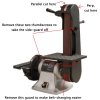
I used a Dremel with a fiber cut-off wheel. Two cuts: 1 running parallel to the belt path, about 1/4" to the left of the contact wheel. The other cut is perpendicular to the belt path, at about the 1 o'clock position as you look at the contact wheel from the side. The cut-off wheel was a little too wide to get the cuts to meet without digging past where I wanted them to be, so I just got them as close as I could and broke the remaining 1/8" or so by hand. I suppose you could drill a 1/4" hole in that corner, cut towards the hole and it would look better. You could also cut more of the guard away, say back to the 3 o'clock position, but that didn't seem necessary.
That's it. It almost takes longer to describe than to do it. Just be careful not to slip and put a big ding in the contact wheel, that would be a drag.
The contact wheel works much faster than the platen for profiling, and saves wear and tear on the platen as well.
Two things I forgot to put in the diagram: I removed the handle on top because it was getting in the way. You can just grab the round thingy with your hand to take tension off for changing belts. I took the table off the belt portion and just use the disc sander or my "calibrated eyeball" for squaring things.
I mounted mine on the very right end of my bench, so the belt portion hangs over the edge. With a bucket of water under it. This saves a lot of cleanup time and helps prevent setting things on fire.
I can't upload pics right now, but I'll try to describe it without confusing myself...
First, I removed the side plate completely. It's just held on by 2 thumbscrews.
I used a Dremel with a fiber cut-off wheel. Two cuts: 1 running parallel to the belt path, about 1/4" to the left of the contact wheel. The other cut is perpendicular to the belt path, at about the 1 o'clock position as you look at the contact wheel from the side. The cut-off wheel was a little too wide to get the cuts to meet without digging past where I wanted them to be, so I just got them as close as I could and broke the remaining 1/8" or so by hand. I suppose you could drill a 1/4" hole in that corner, cut towards the hole and it would look better. You could also cut more of the guard away, say back to the 3 o'clock position, but that didn't seem necessary.
That's it. It almost takes longer to describe than to do it. Just be careful not to slip and put a big ding in the contact wheel, that would be a drag.
The contact wheel works much faster than the platen for profiling, and saves wear and tear on the platen as well.
Two things I forgot to put in the diagram: I removed the handle on top because it was getting in the way. You can just grab the round thingy with your hand to take tension off for changing belts. I took the table off the belt portion and just use the disc sander or my "calibrated eyeball" for squaring things.
I mounted mine on the very right end of my bench, so the belt portion hangs over the edge. With a bucket of water under it. This saves a lot of cleanup time and helps prevent setting things on fire.
Attachments
Last edited:
- Joined
- Oct 6, 2008
- Messages
- 4,076
No problem, bud! I hope I helped in some small way.