Crawford Etcher - Blown Fuses

Status
Not open for further replies.
Joined
Apr 23, 2008
Messages
234
A few days back I received my stencils from Ernie Grospitch, so I decided to go ahead and finish up my Crawford etcher. I built it exactly as shown on Chris' webpage HERE using the exact part numbers from Radioshack. I wired it up to 12V output per THIS ONE-LINE.

My problem is that I keep blowing the 1-amp 250volt fuses when I flip the power switch on. The LED will come on for approx. 5-10 seconds, then will go out once the fuse is blown. I have done this multiple times, and have checked the wiring repeatedly.

As a test, I removed all connections from the load side of the transformer. I still blow the fuse. Anyone have any ideas? Should I increase the fuse size to either 1.5amps or 2amps to match the transformer rating?

Erin.
 
Normaly this would indicate a short in the wiring. you need to trace out the wiring and make sure that they arent crossed acording to the schematic. since the transformer isolates the low voltage side from the fused side, I would check the power to the transformer first. A bigger fuse will not solve the problem. More than likely it will be in the switch or light wiring.
 
Yep, same thing happened to me. I can't remember where I made a mistake though. Like Rusty said, go through the wiring again.

Good luck.

Patrice
 
Thanks Rusty, but it looks like the light and the switch are OK. I just plugged my ohm-meter onto the 120V winding of the transformer, however, and it appears that there is no resistance... i.e. short circuit. I mean... I'm no electrician, but shouldn't the ohm-meter measure some resistance between the 120 leads on the transformer? Maybe got a bum transformer.

Erin
 
you wont get much resistance through a transformer reading the same side like power in side and power out side, after all it is just a long wire wrapped up, next to anohter long wire wrapped up. check the wires to the case/frame on the transformer to check for a short. how about a pic or 2 so we can see?
 
A picture is a great idea Rusty. Below is a photo that I just took.

Please ignore all the wires on the left side of the box... that's all the 12/24V wiring and is not connected. Note that the (2) yellow and (1) black low voltage wires are capped with wire-nuts and not touching.

Please let me know if I can clarify anything about the photo.

I went to my local Radioshack about an hour ago and was able to exchange the transformer (the only thing that I could come up with was a bad transformer). The old transformer was riveted to the box and the frame ground was crimped to the transformer chassis by the rivet. In this photo, the ground wire is just wrapped around the new transformer's chassis tab. With new transformer the fuses still blow after several seconds.

3558362362_85fa08f184_b.jpg


Rusty... doesn't there HAVE to be some resistance in the circuit. IF the 120v coil of the transformer has minimal resistance (R ~ 0 ohms) and the switch (when closed) has zero resistance then the TOTAL resistance of the 120v circuit on the source side of the transformer is essentially zero. If I remember ohms law correctly, voltage equals current times resistance... or restructuring things, current equals voltage over resistance. If resistance is very small (approaching zero), then current has to be very large... and thus, a blown fuse makes sense. That is why I assumed that the transformer had to have some resistance...

Of course, maybe I'm simplifying the issue. Rather than pure resistance, the 120v coil should have inductive impedance. Anyway, I'm at a loss.:(

Anyone else use this one-line to build their etcher?

Erin
 
I just built one of these and your wiring looks correct. Have you removed the LED from the circuit and tested to see if the fuse still blows? If it does, then I'd bypass the switch and see what happens. Something is shorting out somewhere. In fact, the only two things that could cause a short with what you have wired is either the LED or the switch.

Edit ..

Erase that switch part, it is in series, same as the fuse holder. I have the ground (green wire) connected to the transformer case on mine and it works just fine.

Allen
 
Last edited:
this may sound silly but i believe i did the same thing.

Disconnect the green ground wire to the transformer, put in a new fuse and try again without the green wire connected.
 
I just built one of these and your wiring looks correct. Have you removed the LED from the circuit and tested to see if the fuse still blows? If it does, then I'd bypass the switch and see what happens. Something is shorting out somewhere. In fact, the only two things that could cause a short with what you have wired is either the LED or the switch.

Allen

Allen,

I have already tested the circuit without the LED. Same thing. The switch can't be a problem because it IS a short circuit. That's what a switch does... when it's open it's an open circuit, when it's closed it's a short circuit. That's what it's supposed to do. :D

Erin
 
this may sound silly but i believe i did the same thing.

Disconnect the green ground wire to the transformer, put in a new fuse and try again without the green wire connected.

It does sound kinda silly... but at this point I'm willing to give anything a shot. :p I'll let you know how it works out.

Erin
 
Thanks for the suggestion beginner930... but it didn't work. I've managed to burn through 11 fuses... got only one left.:grumpy:

Any other ideas?

Erin
 
Allen,

I have already tested the circuit without the LED. Same thing. The switch can't be a problem because it IS a short circuit. That's what a switch does... when it's open it's an open circuit, when it's closed it's a short circuit. That's what it's supposed to do. :D

Erin

Yes, I changed my post after about two seconds thought. Just a DUH moment.:confused:

Allen
 
Either your fuse is not rated to carry the load presented by the transformer, or the transformer is bad. The primary side is wired correctly in the picture and with the wires capped off on the secondary side, there is nothing else (excepting the power light that you have already ruled out) that could cause the fuse to blow.
 
Yes the transformer will have an inductive impeadance that kind of acts like resistance, but that would be mesured in henery's not ohms. and you have to get into trig to do all of those calculations, we can do that but its not called for.

You have checked the incomming voltage to make sure it is correct? should be no more than 125v AC

disconnect the transformer and check the resistance from both (but one at a time)of the leads comming into the transformer to the case/frame of the transformer. red lead on the wire, black on the case.
 
Last edited:
Thanks Rusty. I did test all the transformer leads to ground. No shorts... resistance looks good. Like I said, this is my second transformer from Radioshack (I thought that it might be the problem yesterday, and they were kind enough to exchange it for free... turns out it's not the problem).

I also did check the incoming voltage. Looks good.

I just did another check of the entire 120V side of the system by measuring the resistance between the hot and neutral spades of the plug, through the circuit.
When the switch is off, the circuit is OPEN, and there is infinite resistance... which is to be expected. When the the switch is on, the circuit is closed (short), and there is approx. zero resistance... as also would be expected from the wiring diagram (because there is no resistive load).

Again, in a purely resistive circuit, Voltage is equal to current times resistance... which means current equals voltage divided by resistance. If the voltage is 120V and the resistance (as measured) is sufficiently small that it looks like zero, then the current should be VERY large... way bigger than the 1-amp the fuse is rated for. Now the transformer does not have much of a resistance, but it should have a significant inductive impedance.

Been a long time since I graduated, but I think the inductive impedance should act to curtail the current flow somewhat. All I know is I keep blowing 1amp fuses. The transformer is rated at 2amps, so I'm going to try to step up to a 2amp fuse for protection. This should ensure that my transformer is protected at least.

I'll let everyone know how it works out. Thanks.

Erin
 
I have a couple of questions, is there a flouresent light or another electrical motor(refrigerator or such) on the circuit your pluged into? Im just guessing here lol

Have you checked the power wires where you striped them sometimes you can nick the neutral and line in and have a short and not notice it.

Can you unplug it and check the resistance at the plug trough the whole etcher with switch on and with it off?

This is just ODD I have built more than 10 of these the last few with a selector switch for 12 or 24v use and have never had this happen.
 
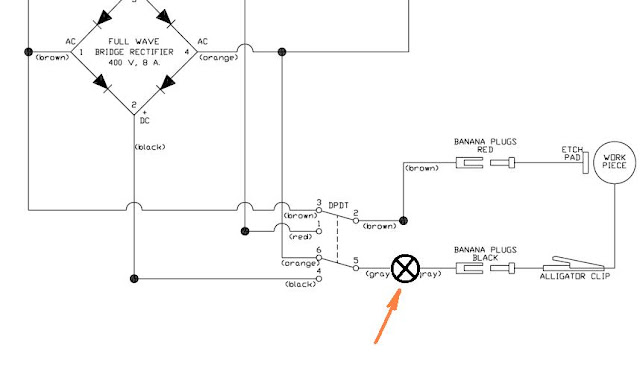
People, I am an elecrician. Just conect electric bulb according to your output voltage and in case of shortcut the bulb will became to glow, and the process will continue. I added a bulb on mine and it is working fine. It works!

You cannot avoid the shortcuts while etching. Profesional etching equipment has a resistors, but with a bulb, you will see when you are pushing too hard. If the bulb glows - the process is stoped. elecricity must float through the acid, not the electrode, that touches the blade through the cloth.
Bulb%20wiring.JPG
 
I have a couple of questions, is there a flouresent light or another electrical motor(refrigerator or such) on the circuit your pluged into? Im just guessing here lol

I don't think so. I have the circuits for the entire house mapped out in AutoCAD... I'll have to log out of Linux and boot into Windows to open the CAD file and find out. (there may be a small lamp with CFLs installed plugged into the same circuit... but I doubt that those CFL ballasts would cause enough harmonics to blow a simple transformer circuit. I could be wrong.)

Have you checked the power wires where you striped them sometimes you can nick the neutral and line in and have a short and not notice it.

The wires appear to be good.

Can you unplug it and check the resistance at the plug trough the whole etcher with switch on and with it off?

Already did this... see my last post.
When the switch is off, the circuit is OPEN, and there is infinite resistance... which is to be expected. When the the switch is on, the circuit is closed (short), and there is approx. zero resistance... as also would be expected from the wiring diagram (because there is no resistive load).

This is just ODD I have built more than 10 of these the last few with a selector switch for 12 or 24v use and have never had this happen.

Yeah... I feel like I am doing something obviously wrong. But I have dissected the thing a number of times, replaced the transformer (and the LED for that matter), and still have the problem.
 
People, I am an elecrician. Just conect electric bulb according to your output voltage and in case of shortcut the bulb will became to glow, and the process will continue. I added a bulb on mine and it is working fine. It works!

knifemaniac,

Your idea for a bulb on the low-voltage side of the transformer is a good one. Unfortunately, right now it appears that I am troubleshooting a problem on the 120V side of the transformer. I am blowing fuses with the low-voltage side completely disconnected.

Erin
 
Erin, change the transformer. Sometimes when transformers works in a shortcut mode, which etching is - the insulating cover of the loops burns out and when you load the system - sparks occurs between the loops inside the traf. Change the transformer, and if it works - add the bulb.
 
Status
Not open for further replies.
Back
Top