Creating knife handle from raw wood?

Infi-del

Gold Member
Joined
Apr 6, 2009
Messages
3,572
Hey all. I have a few questions about making a knife handle from a piece of raw wood. On my mother's property there is this HUGE maple tree. I think it's just a regular sugar maple. Has medium sized leaves and turns an awesome amber orange color in the fall. It's a beautiful tree. My father planted it around 25 to 30 years ago. And just 3 years ago I planted an October Glory Maple just beside it. Anyway, a large branch has grown its way into the drive way. To the point, now, it's starting to hit people's cars when they try to leave the house. So I must prune that branch back. Rather than put it in the brush pile to be burned I had the idea of what if I could have it turned into handle material for either one of my current blades, or even a custom I might have one of our fine makers here make. Perhaps like a large Laconico Kephart. Or maybe put it on my Busse AK-47 sword. I know maple is pretty wood. I just think it would be a way to remember my father and take a piece of that tree with me where ever I go. Here are a few questions I have about doing so.

1. Is regular maple strong enough to be handle material when stabalized?
2. Do I even need to stabalize it?
3. Is wood taken from a branch approximately 5" in diameter going to be good handle wood or must it be trunk wood?
4. Once I have the raw wood is there someone I can send it to to prepare it for handle material (Someone who will plane it, stabalize it, and kiln dry it if need be)?
5. Must the piece be perfectly straight or can I take what I need from the whole piece? In other words must I use the heart of the wood only or can all of it be used?


I'd appreciate any advise folks. Thanks.
 
my understanding is that wood is wood, no matter where in the tree it comes from, and once it is stabilized (either through aging or kiln drying) behaves identically.
 
I think it depends on what size branch you have to work with,

It would need to be dried then stabilized or dried and sealed after its built (linseed, poly, etc.)

I am sure it would work, just keep you expectations realistic, your not likely to find exhibition grade wood wacking off a branch in the front yard ! But I think we can all see the value in what your wanting to do !
 
Because knife handles are so small, some of the rules of thumb for choosing appropriate lumber for making furniture can be ignored.

That said, a 5" diameter branch isn't going to be your best candidate for scale material. Branch wood is under a lot of bending stress just hanging out there in the breeze. They tend to warp in the direction opposite of the way gravity was working on it and they can do things that you might not expect, or want.

If you're talking 1/4" slabs pinned and epoxied to a blade blank, you shouldn't have trouble, but a one piece handle might give you more trouble in the long run.

I'd take a look in the wood piles of your friends, family and neighbors. The wood there will be from larger pieces, seasoned and free or nearly so. There's a ton of amazing wood bucked and split in people's yards as we speak.

I'm not familiar with the necessity of stabilizing, but many knife handles, tomahawk handles and gunstocks have been made from maple in the past and have stood the test of time. Just a thought. Also, Sugar Maple is one of the hardest maples. Bigleaf and Silver are much less dense.

One last thing, I completely understand your wanting to use wood that means something to you. My folks had two 75+ year old Black Walnut trees taken out of their yard and instead of letting it go up in smoke, I had the trunks sawn into lumber. Years have passed and I'm now working with it, making various furniture projects that I'll pass down with the knowledge that there's some history to these pieces that go beyond my making them.
 
One last thing, I completely understand your wanting to use wood that means something to you. My folks had two 75+ year old Black Walnut trees taken out of their yard and instead of letting it go up in smoke, I had the trunks sawn into lumber. Years have passed and I'm now working with it, making various furniture projects that I'll pass down with the knowledge that there's some history to these pieces that go beyond my making them.

That's why I wanted to use this particular piece for a knife handle. And yes I will do two scales pinned to a blank and not a solid handle piece. I wasn't going to cut the branch down to use as knife material. I have to cut it down just to maintain my Mom's property. But I thought why burn it in the brush pile. That tree sorta means something to me. So a knife handle would rock.

Does anyone know where I can send it to have it prepared into handle slabs? Is there such a place that does this sort of work?
 
You might take a look in the makers section. There are probably a couple people that could do it but there is one fellow who's screen name is 'Burl Source' (I think :o) who cuts his own wood for scales to sell and knows what needs to be done. Try contacting him and he could probably help you out if you explain what you want. A flat rate shipping box should get plenty of wood to him to make into scales. Maybe a picture of the branch could tell him the best section to send. The biggest problem is that if it dries too quick it can crack and most wood used for things like that dry out on their own, many times with the ends painted to slow drying, for a couple years. Worth a shot asking though.
 
If I were doing this I would take at least 3 sections 8" to 10" long. 5" diameter strikes me as rather thick. Would be inclined to stay around 3" +/- (unless you have monster hands :) Strip the bark. A little curve could be very nice on a knife handle especially if the grain was visible in the final piece. Best time of year to harvest your pieces is late fall after the running sap has mostly stilled in advance of winter. Throw these guys in warm room, best not too close to a heat source. Just allow air to circulate around them and let them do what they will. Next summer split your billets (sections) in half preferably with a hammer & wedge rather than with a table saw. That table saw could hurt you bad especially for this application. Band saw is another good option. Tie your split pieces back together with something to space the two halves apart about 1/4" +/- . Then if you can forget them for a couple of years or 3 that would be best. By then they will have done whatever splitting or checking that they would ever do. Pick your best sample or two. Chop off each ends so that you have the best 5" then send them off to your favorite knife maker.

This will make a very cool memento, but don't get all freaked out about the process. Don't make it so precious that it isn't fun. That's why I encourage you to take more than a few sections. You might find that within a year these are ready to go. Professional handle guys will probably offer even better info. Good luck.

RayseM. • Furniture, cabinet maker, boat builder by trade. Sadly, I only use knives- don't make them.:(
 
Getting into this a little late, but I've made handle slabs out of bigleaf maple, common up here in wettern WA. It's pretty, especially if it has a little quilt or ribbon to the grain, but there's a lot of straight, boring looking wood that doesn't show any figure.

Rayse has the right idea about letting it dry slowly, however I'm often too impatient to let nature take it's course. Right now I've got about a 5" branch off a tree belonging to my sister's neighbor, and I want to make a knife for him and present it in about 2 or 3 weeks.

I quartersaw my small slabs, maybe 1"x1/4" thick and dry them out in the microwave. Cut a lot more than you need, because some of them are going to go to h*ll on you. One trick I've found is, depending on your microwave, give them 10 or 15 seconds at a time, letting them cool down in between. Then, if you have a vacuum packer, suck them down and leave them overnight and microwave them again tomorrow.

A moisture meter is handy for estimating dryness, but you can do that also with an accurate scale. Weigh a green sample that easily measures a cubic inch and is the same thickness as you want your scales to be (in my case, with 1/4" scales, a 1"x4" piece equals 1 cubic inch). Then microwave it, weighing it each time, until it doesn't lose any weight any more (don't catch it on fire, seriously - it'll char first). When you know the wet and dry density, it's easy to figure out the moisture content at any stage.

Generally speaking, I try to get the wood to about 12% for shaping the scales and assembling the knife. If you peen your pins, be careful about getting it too dry, especially if the pin goes parallel to the grain (like your scales are showing their end grain aspect). Cracking a scale during final assembly is enough to make a grown man cry like a little girl (but with experience, you can epoxy a crack so most people won't notice it).

Anyway, good luck, and show us what you come up with.

Parker
 
Couple things I forgot to mention in last night's post. One is, cut your blanks thicker than the finished size by about 1/8" each way, so if they warp or deform you can still get what you want out of them.

Other thing is, wrap them in a paper towel or dishcloth when microwaving them. This soaks up the surface moisture so they can't reabsorb it.

Parker
 
Does anyone know where I can send it to have it prepared into handle slabs? Is there such a place that does this sort of work?

Here's a nice tutorial on home stabilizing wood. I haven't tried his method yet, but have all the materials ready to go, just trying to find the time.

Most of my scales have been made from a piece of Pecan with an awesome burl figure.
 
a lot of great comments here.
If you are looking to do this "now" then the tree you speak of may not be able to supply the scales in a timely fashion. Certainly, in time it will provide material for you. Where to send it? I am sure that there is a local that can process it to a point where you can safely airdry the wood. Gotta be well over the size you want, but a decent woodworker will know that.
There is a LOT of drop off around that you can get from hobbyists to high end craftsmen that will satisfy your needs just by asking.

Good luck!!
 
I'd recommend that you cut the branch into sections about 1' long, strip the bark, wax the ends and let them sit in your garage for the next few years. That should get them air dried enough to start to work with. The microwave method may work if you're in a hurry, but you'll get better recovery if you dry slowly. Even when I buy dry lumber, I let it acclimate to my shop for several months before use. I minimizes the chance of spontaneously broken scale later on.

Cutting scales to size is pretty easy. Like PB said, you can pretty much ignore conventional lumber milling techniques (like planing). Just get the branches into blocks and split the blocks with a saw. A table or bandsaw would work well, but you could do this entirely by hand. The rest can be done with a drill, rasps and sandpaper. Finish with a penetrating oil and a wax if you prefer. Sugar maple is nice and hard and good for use in knife handles.
 
just a thought but the warping and such will not be a problem splitting on the other hand will try cutting into 10''-15'' peices store in a cool dry place for a year to dry then cut into over sized peices for scales or blanks good luck!
 
Phillip D: The microwave method may work if you're in a hurry, but you'll get better recovery if you dry slowly. Even when I buy dry lumber, I let it acclimate to my shop for several months before use. I minimizes the chance of spontaneously broken scale later on.

This is very true for wood in big chunks, and it's the more conventional way to do things. Believe me, I've got wood in my rafters that's been there since the mid-80s, waiting for that special project to come along. However, I get the idea that the OP wants to make handles that remind him of his father soon, not in 2 or 3 years. The fact is, even with straight air drying (no supplemental heat or ventilation, stickered in ambient conditions) small pieces dry quicker than big ones.

I've run a sawmill off and on for a few years, and one big reason for seasoning logs is that milling dry logs gives you maximum yield. You only lose the kerf, and you can see where the big checks and sap rings are and mill around them. In fact, a buddy of mine chainsaws a kerf down his saw logs before decking up so that all the shrinkage happens there. One big check, so to speak, instead of many smaller ones all around the log.

But the op's situation is not standard for the wood industry, and if he's willing to put up with a higher than normal waste rate, he can use some wood right now (if he handles it right). It sounds like this branch has plenty of scales in it - why not wax the end grain on some and set it by, and slice up other to play with. Worst case, you end up burning it anyway in smaller pieces.

Parker
 
I'd recommend that you cut the branch into sections about 1' long, strip the bark, wax the ends and let them sit in your garage for the next few years. That should get them air dried enough to start to work with.

Good advice from Phillip.

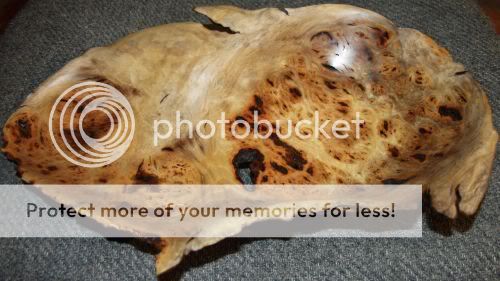
Sometimes we will microwave green burl here for our gallery pieces. Green wood is easier to carve to shape for a bowl. Then we microwave it to force distortion and enlarge cracks for a more free form tortured look. (Not what you want to accomplish.)
b001-1.jpg


I have tried microwaving slightly oversized green wood blocks without success. You might have better luck than me. I would let the wood air dry for at least a few months and then try a few hours in the oven at a low temp if you really want to use the wood quickly. Best thing to do though is give it a year per inch of thickness to air dry.
 
Back
Top