IMO, a platen radius has nothing to do with the "red" area, or rather, it doesn't help at all. This is a tiny transition area from the beginning of the "bevel" transitioning to the flat above and behind. To me, the important part here, is set up previous to your final pass at the grinder. If you get this right at the grinder, you'll have no probs keeping it hand sanding. This area is insanely difficult to fix with hand work, because you're approaching zero SFPM of abrasive action at you come to a stop in the plunge area. A little wonky wrist action and a hole lot of elbow greese can help, or you can try imitating the perpendicular cutting action of a belt (but usually it's easier to screw this up more), but mostly, the trick is getting it right on the grinder.
For *me*, I like nice square sharp corners on my platen. This does *not* keep you from getting real long swooping plunges if that's what you're going for, contrary to popular belief, since you achieve that simply by the variable resistance, primarily, of your belt hanging off the side of the platen, and as long as you don't lever off the corner of the platen, the cushion of the belt backer, and spanning the rest of the platen, should make the corner cut the same as the face, during a standard pass.
On the other hand, the square corners help you getting into this "red" area with a belt, "walking" your plunges back, for a more acute transition.
My method personally, and I'll admit I like sharper, more defined plunges than are popular currently, but are exceedingly difficult to pull off with the super thin folder blades I typically make, is to make sure and get the entirety of my plunge area "defined" at course grit, with 95% of the vertical grind height in this area, and a sharp bevel to flat transition. I know this sounds like it'll leave hellish course grit scratches (I do this at 80 grit typically, because I like a stiff belt that will cut on the edge, so I can push the plunges on both sides so they're equal, top and bottom, and properly aligned), but if you have a nice well defined, solidly defined plunge "foundation" to work on, you can easily get in this are with an 800 grit belt and clean every little scratch up, leaving a tiny amount of room at the top, you can actually jump from 80 or 120, to a fresh 800 grit Awuko belt (800 grit j-weight), getting comfortably riding on your flats and then "push" the plunges into the corner with a belt that's rolled "just enough", to cut the full inside radius of the plunges. With only your guide hand pushing the plunge into the corner of the platen, with such a fine belt, nothing else on the blade will cut with any significant amount of metal removal, but you can sit there riding the plunge for a minute or two, and get every scratch out of the plunge, leaving behind a perfect radius at the inside, and the top red area.
This technique will allow really fine (3/32-1/8 approx) radiuses in the red area, that look exquisite. I use one new 800 grit belt for this, and after that it's pretty well toast. After you ride the plunge, (and sometimes you need to "cheat" the blade into the corner of the plunge by tipping into the platen corner/plunge just a pinch to really get inside that radius) take a solid drawing pass out of the plunge, then go to the other side.
This is an advanced technique, but I've shown a number of masters this, that still cursed doing plunge refinement, that are using it, and amazed. After this, you go back to the next grit past where you stopped with course belts, and *stay out of the plunges* entirely. Work your way back up to 400 or 800 grit, you'll only need to do a couple passes per side at 220 and 400, just to refine and remove lower grit scratches. This of course is critical to do only with a brand new belt.
If things don't look quite perfect, then you can take another 800 grit belt, and make a couple more full passes per side.
However, the most important thing here, is to not track your 800 grit belt when cleaning up plunges, so far that it can wrap up over the plunge shoulders, which will happen, and will burn them out and look like absolute crap. In my case, it's usually no more than 1/8" over the edge.
This works well with larger knives also, but you'll quickly see how critical getting the plunge area inside radius perfect on each side is. In this case it actually helps me to take a Trizact Gator belt, that I've carefully radiused one edge of the way I like it, and use that to "refine the plunge" with, before jumping to 800, I use the coursest trizact I have, and I flip the belt over, when I switch plunges, as it's impossible to get both sides of the belt corner exactly the same radius. I don't track this belt over the edge, I leave it centered, and only use the edge of the belt to "cut the plunge".
With really thick blades, it's easier to file the plunges or use a 120-220 grit j-flex belt rolled over the edge to do the plunge refinement, and then jump to 800.


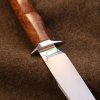


 i do not attempt that area until i get to 220 grit. the 220 takes off less metal and i get 4 or 5 passes to shape it. with an 80 or 120 i can screw it all up in one pass across the belt and there is no turning back. i hang a jflex belt about 1/8" off the platen and that helps make a curve. i do not make the final shape with 220, i get it close, and finish the rest of the bevel. then i do the final shape @ 400, because you get more passes than the 220. i found that even if i got them perfect with the 220, i could still screw them up with the 400 so i find it best to leave more metal there until final shaping.

