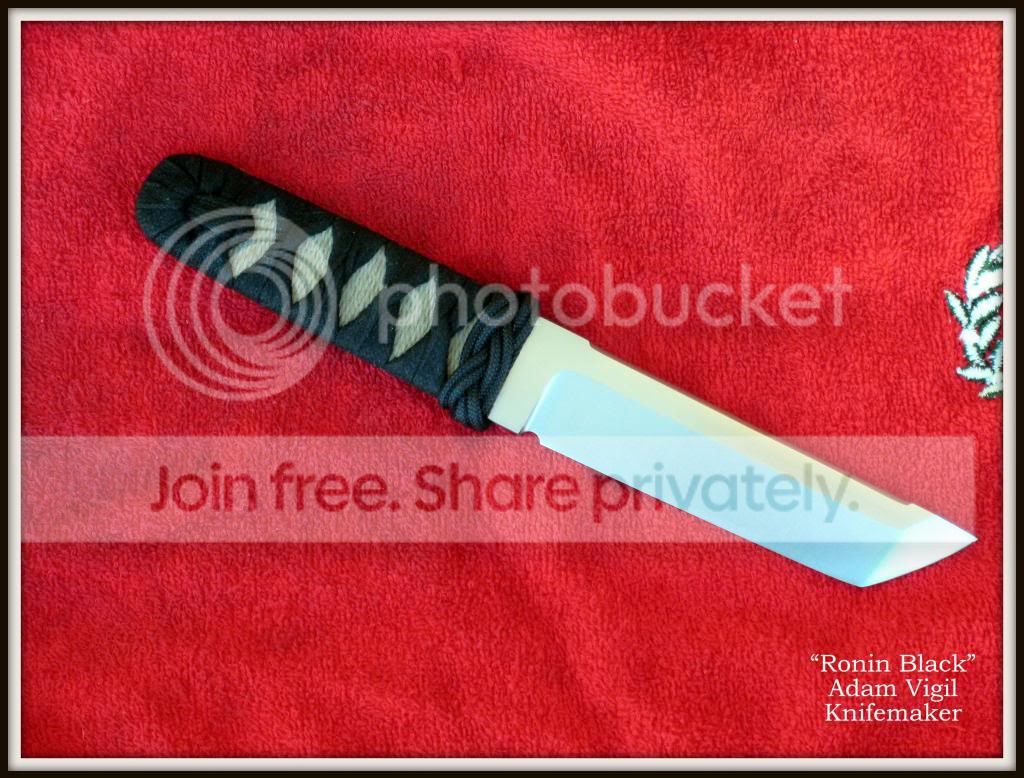
I posted these pictures in another thread but didn't specifically ask for a critique and subsequently didn't get any. Y'all are either way too polite or I need to stop hangin' around 0hedge. I humbly seek your help to make these better.
Experience:
I've ground 6 blades (after practicing on a half dozen wood and scrap steel), have a 48" Coote, a vice, files and 20 sq ft of shop space...in the corner of my garage...next to the fridge... a temptingly bad combination for sure.
If I should edit to one topic, please advise.
I do feel the need to repeat myself from the other thread but again, thanks to all of you who've offered advice and guided me along the way. This all started with me starin at piece of plate sayin now what!
So
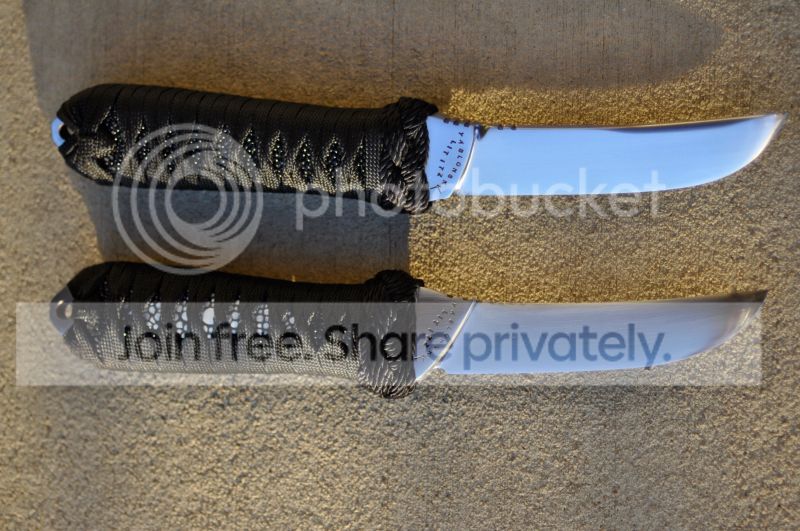
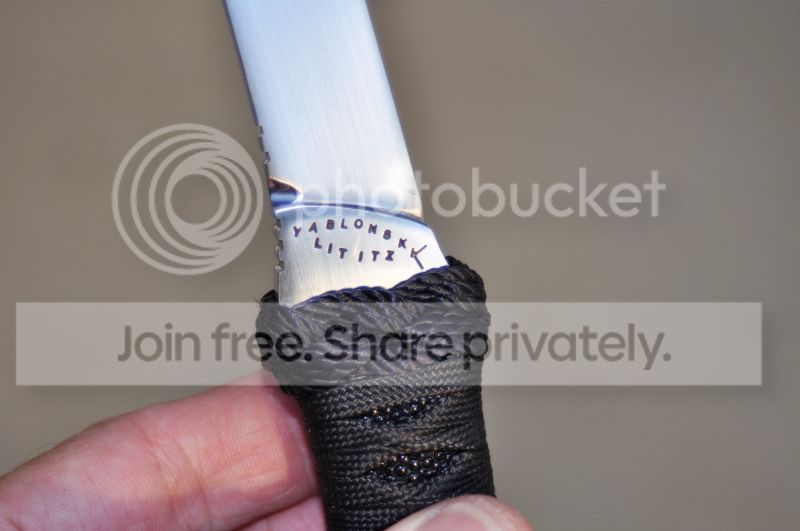
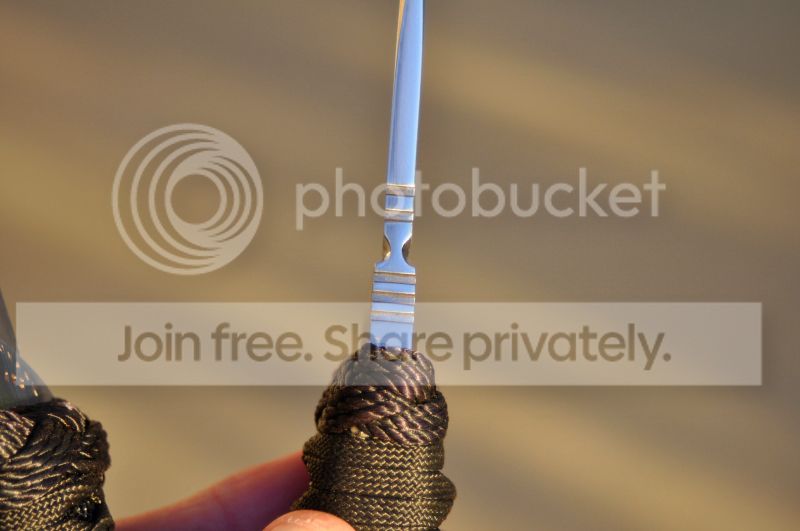
1. My biggest concern is the integral bolster/habaki transition to the blade and potential points of weakness. My goal was to have the look of handle-guard-habaki-blade. My impressionist rendition was butt-handle-turkshead-integral bolster-blade. I didnt want there to be an additional plunge line per se but I don't want the blade to snap from a weak point. To my limited knowledge, this is relative to several variables given the steel type CPM3v: normalization before hardening, overall hardness, geometry any others? (I used Peters and they follow the recipe and get to 60HRC) so what are the tradeoffs? How 'far' can I expect to push the geometry envelope and retain artistic impression? A slight radius at the transition of habaki to blade? Ok - How big does that radius NEED to be. I would prefer it to be as small as possible but not sure how to quantify it.
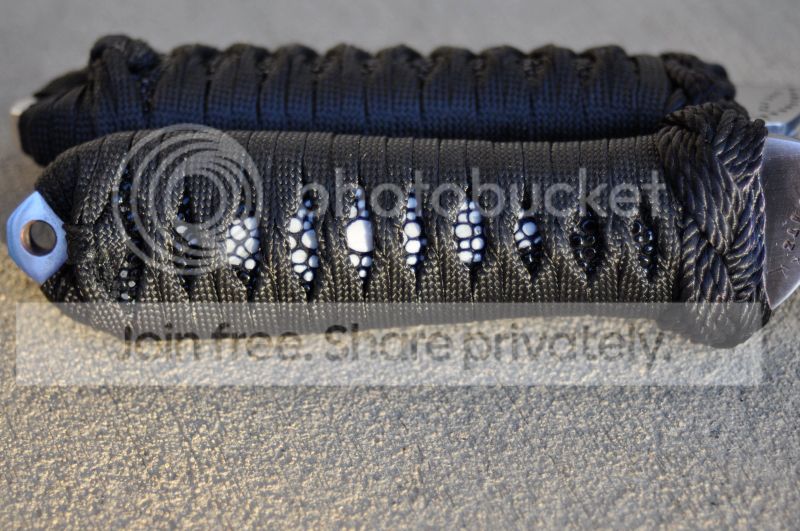
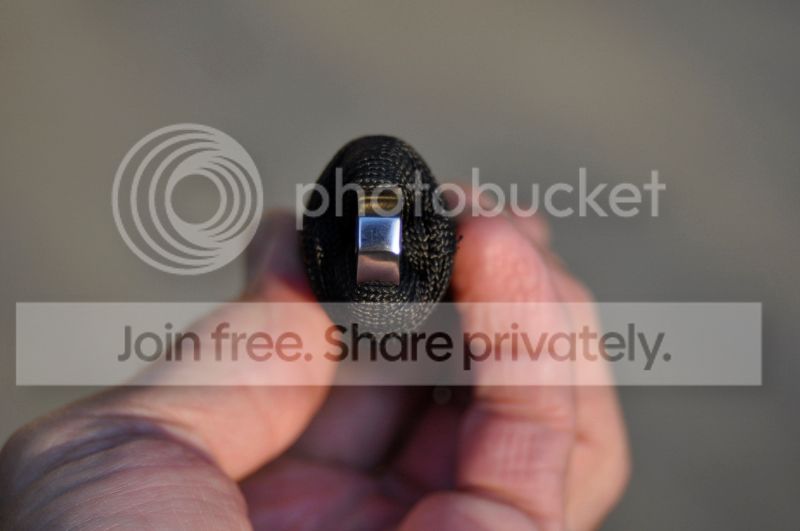
2. How do you ensure the moisture barrier at the turkshead and butt areas? (Make sure it's soaked with epoxy?) They are, but I don't have enough experience to know if there is truly a moisture barrier at those two points after epoxy has been applied.
3. If you see other design flaws that could improve performance please do point them out.
4. Stacy if you read this, would it be asking too much to categorize these designs? I hear it may be presumptuous to call them tantos. Maybe picotanto or pockatana as suggested by another forumite.
1st 6 pics are:
Steel - CPM3V to 400 grit - Peters HT to a requested 60 rockwell.
OAL - ~8.5"
Goal = Flat grind - that turned into a slight convex grind
Blade Length - 3.875"
Width - .8125 - spine to edge
Thick - .1875 at it thickest, slight taper toward the point.
Wt: 5oz, the other 5.5oz
Integral bolster and butt all from 1/4" stock
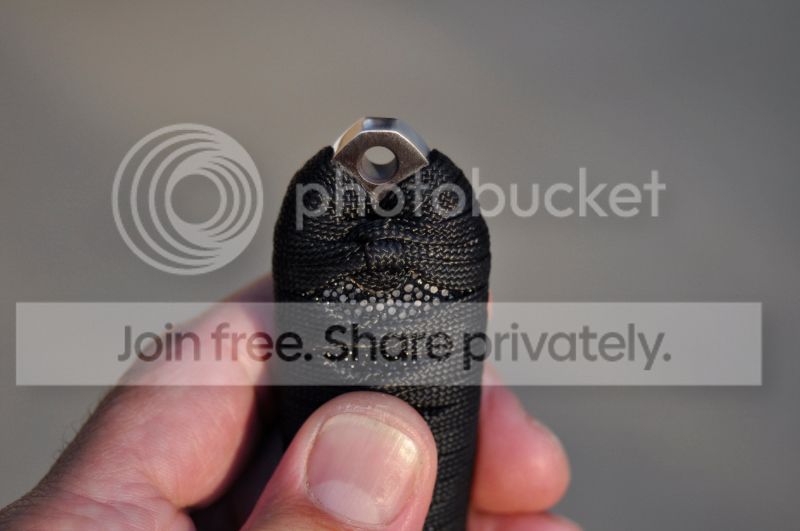
Epoxy resin (ESP155 marine/several simultaneous applications) was painted onto .25" nylon lace wrap, handle is backed with leather and heavy nylon waxed thread (same as used for the turkshead) to bulk up the handle before laminating with stingray.
Weight was reduced in the handle during the waterjet process (outsourced) by including a series of holes and then thinning the handle (files and grinding) to .1875 as well, leaving a .25" butt and bolster.
The knives haven't been sharpened yet. There are little scratches near the edge that I believe will come out in the convex edge sharpening phase.
The last 5 pictures are WIP. They show the thinning and shaping of the handle (that were done to the smaller knives as well) ready to accept leather and cord.
Their dimensions:
OAL - 9.75"
Width spine to edge - 1"
Blade Length - ~4.625
Thickness - .375 to .4375 - again from .25" CPM3V but the bolster/habaki is the same on all of them.


Experience:
I've ground 6 blades (after practicing on a half dozen wood and scrap steel), have a 48" Coote, a vice, files and 20 sq ft of shop space...in the corner of my garage...next to the fridge... a temptingly bad combination for sure.
If I should edit to one topic, please advise.
I do feel the need to repeat myself from the other thread but again, thanks to all of you who've offered advice and guided me along the way. This all started with me starin at piece of plate sayin now what!
So
1. My biggest concern is the integral bolster/habaki transition to the blade and potential points of weakness. My goal was to have the look of handle-guard-habaki-blade. My impressionist rendition was butt-handle-turkshead-integral bolster-blade. I didnt want there to be an additional plunge line per se but I don't want the blade to snap from a weak point. To my limited knowledge, this is relative to several variables given the steel type CPM3v: normalization before hardening, overall hardness, geometry any others? (I used Peters and they follow the recipe and get to 60HRC) so what are the tradeoffs? How 'far' can I expect to push the geometry envelope and retain artistic impression? A slight radius at the transition of habaki to blade? Ok - How big does that radius NEED to be. I would prefer it to be as small as possible but not sure how to quantify it.
2. How do you ensure the moisture barrier at the turkshead and butt areas? (Make sure it's soaked with epoxy?) They are, but I don't have enough experience to know if there is truly a moisture barrier at those two points after epoxy has been applied.
3. If you see other design flaws that could improve performance please do point them out.
4. Stacy if you read this, would it be asking too much to categorize these designs? I hear it may be presumptuous to call them tantos. Maybe picotanto or pockatana as suggested by another forumite.
1st 6 pics are:
Steel - CPM3V to 400 grit - Peters HT to a requested 60 rockwell.
OAL - ~8.5"
Goal = Flat grind - that turned into a slight convex grind
Blade Length - 3.875"
Width - .8125 - spine to edge
Thick - .1875 at it thickest, slight taper toward the point.
Wt: 5oz, the other 5.5oz
Integral bolster and butt all from 1/4" stock
Epoxy resin (ESP155 marine/several simultaneous applications) was painted onto .25" nylon lace wrap, handle is backed with leather and heavy nylon waxed thread (same as used for the turkshead) to bulk up the handle before laminating with stingray.
Weight was reduced in the handle during the waterjet process (outsourced) by including a series of holes and then thinning the handle (files and grinding) to .1875 as well, leaving a .25" butt and bolster.
The knives haven't been sharpened yet. There are little scratches near the edge that I believe will come out in the convex edge sharpening phase.
The last 5 pictures are WIP. They show the thinning and shaping of the handle (that were done to the smaller knives as well) ready to accept leather and cord.
Their dimensions:
OAL - 9.75"
Width spine to edge - 1"
Blade Length - ~4.625
Thickness - .375 to .4375 - again from .25" CPM3V but the bolster/habaki is the same on all of them.