critique please. leather carving

Joined
Jun 30, 2004
Messages
376
first attempt at leather carving.. I have minimal tools but did the best with what I had. curious on what you all think.


2b4dd3e4026c711bb65f7745f8efc6ce.jpg
 
Pretty great job for a first try. A little more work around the edges of the forms where they overlap to get more separation would help. It would give it more dimension and keep it from looking flat.
 
I have started carving leather recently . from my limited experience I think you did a great job.
 
Awesome! Not that I'd get it looking that good, but having artistic experience only two things stand out, the back leaf needs some shading especially where it meets at the bottom and the leaf stems are a bit thick, a little depth on the front edge and a fine line on the back edge using the inner edge of the stem as the outermost. If that makes sense. Like I said though, I'd be very happy to have produced this myself and think you should definitely be happy, for a first try this is beyond a good job!
 
Very nice Jerrid. Ya did a great job on your bevelling. Many beginners have trouble keeping their curved lines curved when bevelling and you did very well at this, (inside curves of the leaves particularly). An oak leaf pattern benefits greatly from a petal lifter. Its kind of a specialized beveller. Use it on all the small curves of the leaves. This really "pops' the leaves and gives more depth and 3dness. Forgot your veins on the bottom right leaf and on the top left leaf on the left side some of em. The other two leaves look the best because of the veining. Try to be consistent on this cause it really makes a difference. those two leaves are really, really good. Next time your looking at stamps try to find a beveller that is quite tall. Then use it on the veins laying the whole face forward onto the leather. This gives you a very wide bevel (from the vein forward) that adds a lot of texture to the leaf. I've been doing leather work professionally for well over 25 years and I can gurandang tee ya my first carving was not this good. Ya might come and hang out with us some over at Sheaths and Such here on BF. Lots of good info and help there.
 
thanks for all the compliments and insightful feedback.

A little more work around the edges of the forms where they overlap to get more separation would help. It would give it more dimension and keep it from looking flat.

Thanks. I agree.

, the back leaf needs some shading especially where it meets at the bottom and the leaf stems are a bit thick, a little depth on the front edge and a fine line on the back edge using the inner edge of the stem as the outermost. If that makes sense.

ahh.. nice tip on the stems. I'll give that a try. I'm pretty sure I understand what you mean. Basically create depth

An oak leaf pattern benefits greatly from a petal lifter. Its kind of a specialized beveller. Use it on all the small curves of the leaves. This really "pops' the leaves and gives more depth and 3dness. Forgot your veins on the bottom right leaf and on the top left leaf on the left side some of em. The other two leaves look the best because of the veining. Try to be consistent on this cause it really makes a difference. those two leaves are really, really good. Next time your looking at stamps try to find a beveller that is quite tall. Then use it on the veins laying the whole face forward onto the leather. This gives you a very wide bevel (from the vein forward) that adds a lot of texture to the leaf.

Thanks for the tips.. I noticed the missing veins too.. LOL. I added many that were not on the pattern however completely missed the lower leaf and the rolled over leaf parts. they would have looked way better.

I did most of my beveling and undercutting with a crafttool B60.
 
that pic looks like something is covered up with leaves and acorns.....Oh--maybe that's the plan!!
 
That looks great, Jerid.

As pointed out, the veining is missing on the two minor leaves. Try to optically "raise" the high spots and "lower" the low spots to give depth and 3D curvature to the leaves. Otherwise they can look like pressed leaves in a book. Light and shadow are how you make a leaf curl back on itself and look like it would hold a big drop of water if it rained. Use shapers, cams, veiners, and bevelers to do this. A well polished curved burnisher is a very handy tool. Also, add small knife and tool marks to the leaves and any other features to give them realism. Little tears, scrapes, and dents are what makes natural objects look natural.
Don't just use the patterns, but try and learn what detailing makes things "POP". These tiny tooling and cuts are what separates a good project from a stunning project.

Finally, simple is sometimes better than complex. Know when to quit adding things. I have done carvings that went past their prime and ended up too busy. I should have quit earlier.

The only other thing that caught my eye immediately was the shape of the acorns. The nut should be much more rounded and end in a little tit, not a pointed triangle.
 
Quick tip on the acorn. Tandy makes an acorn stamp. Stamp that where you want your acorns. Then bevel around the stamping. Gives ya a consistent, uniform acorn, with much better depth than the stamping. Quick and easy.
 
Quick tip on the acorn. Tandy makes an acorn stamp. Stamp that where you want your acorns. Then bevel around the stamping. Gives ya a consistent, uniform acorn, with much better depth than the stamping. Quick and easy.
thanks. I thought the guys at tandy were just trying to sell me another stamp.. LOL. after doing them freehand I think it may be a good investment.
 
Oh, if it were just that simple ... you need three different sizes of acorn stamps ... and a complete set of 12 bevel tools ... and cams in six sizes ... and at least four sizes of veiners ........ then we move on to the multitude of background tools and at least three different ruby blade swivel knives with ball bearings.
 
And ya need to get em all from Barry King, look at his site, vastly better tools. Just kidding but they are much better tools. Stacy I'm disapointed sir! Ruby blades, very pedestrian sir, very pedestiran. Ya need a wee dram of Ardbeg to contemplate such. Seriously Jerrid carving is an art form and I've found the best way for a lot of folks to really get their head around it is to see some real good carving. I live and come from a culture where leather carving is appreciated and more the norm than not. I'm literally outside grinding knives right now wearing a fully carved belt with a custom 3 piece silver buckle set. Its everyday stuff for us. Find good carving and really study it.

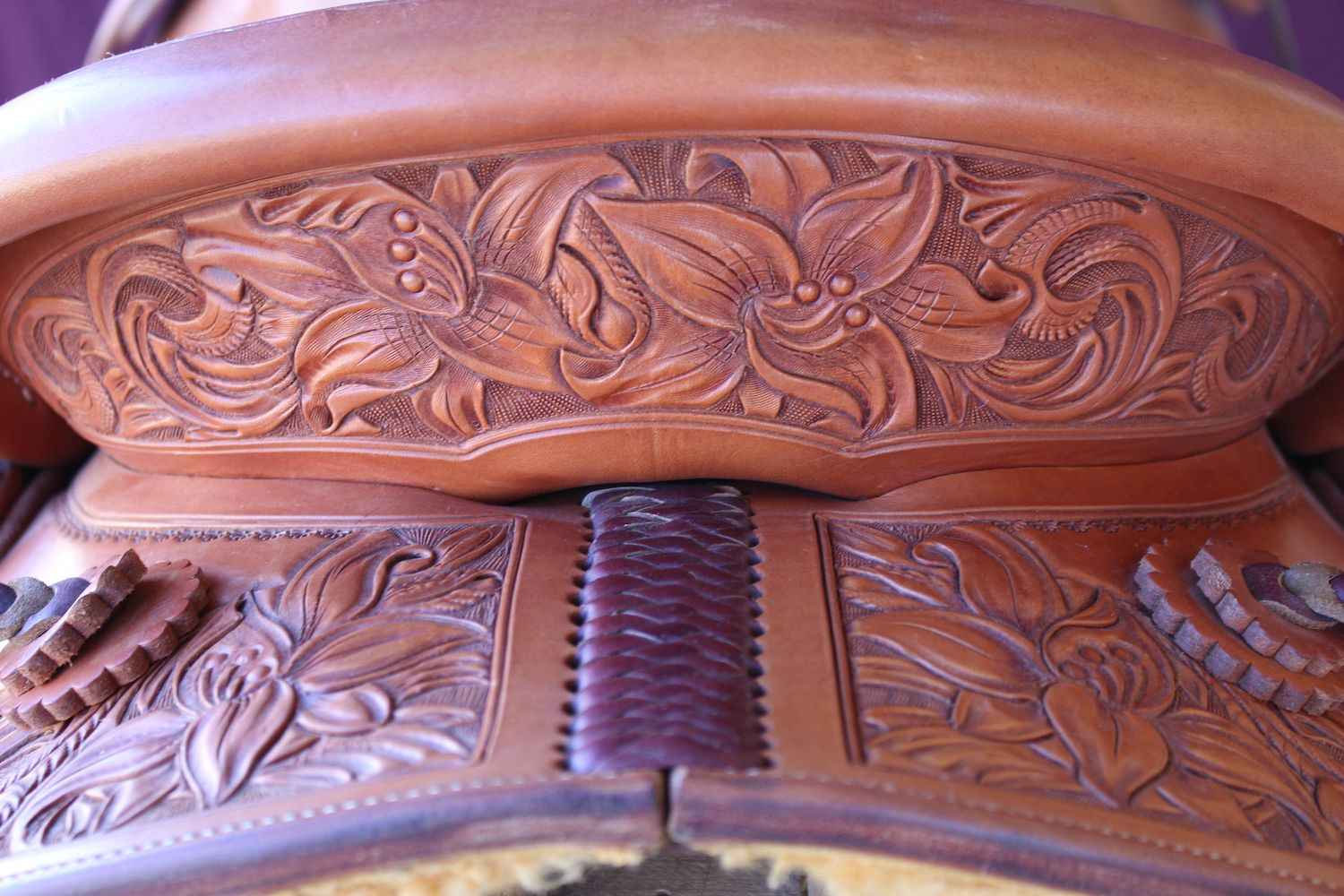
This is the cantle of one of my wife's saddles. It was made by John Willemsma. Carving really doesn't get any better than his:

KVjSBaV.jpg


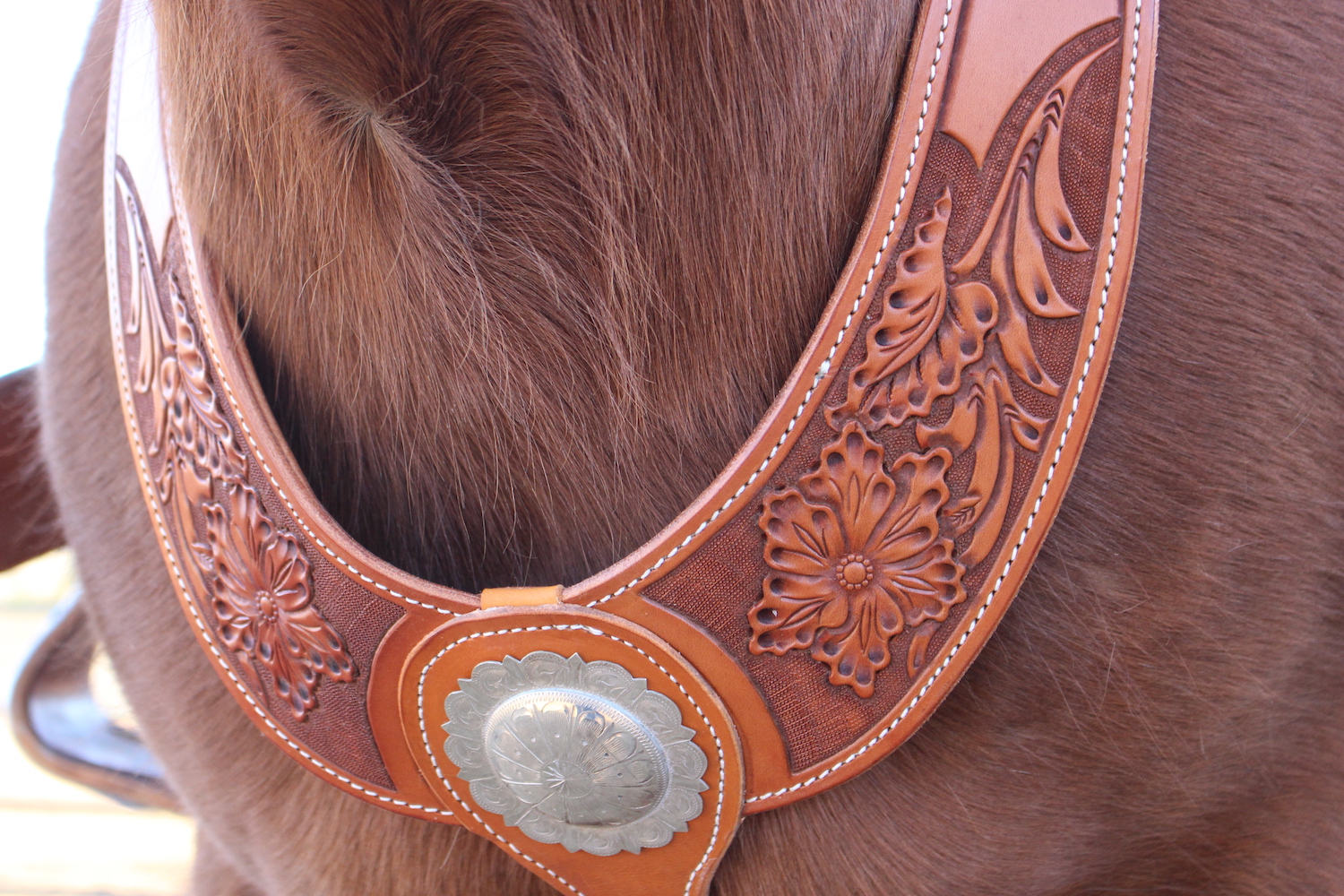
This is a martingale/choker we made for my son, a working cowboy. My wife did the tooling on here and I did the construction. She's only been tooling a couple of years but is very advanced as you can see. I think her secret is that she has spent a lot of time studying true master's work like the saddle above.

TWFLTjO.jpg


While neither of these are oak leaves, the concepts remain the same. On the point of the leaves, particularly on the martingale you can see the difference that petal lifter makes.
 
Last edited:
Perfect examples of what I was saying about shading and lines making a 2D object really look 3D. A well applied pear shader can transform a carving job from nice to spectacular. Work the rolled sections with a shader and they darken and take on even more depth. A few properly places cross-hatch cuts can add depth and shadow. A properly spaced row of curved veiner marks can roll up a leaf/fern or calix.
 
Back
Top