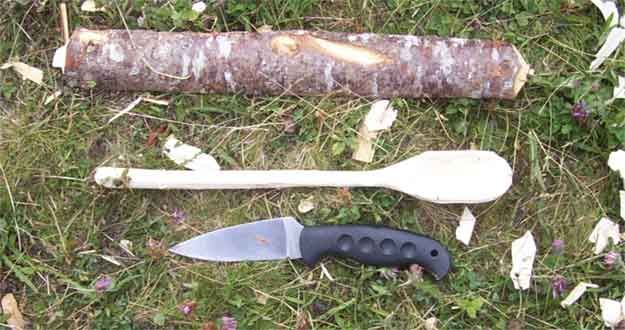
Crooked knife, hatchet, whittling and other interesting stuff.

Joined
Apr 3, 2006
Messages
1,465
Here's a pic showing a few of the things I have been playing with lately.

We have a very big pot we use to cook up fruit for preserving etc, but all the wooden spoons we have can disappear in it. Consequently there was a need for bigger wooden spoons. I split a couple of slabs from a willow branch and roughed them to shape with a hatchet. I then dug out my home made crooked knife and hollowed out the bowls of the spoons. The convex surfaces and handles were shaped with a small fixed blade knife.... I even bored the holes through the handles with the knife. When these are fully dry I will smooth them up a bit, using sandpaper if necessary.

I heard of someone being poisoned by using our native kowhai wood to make a spoon which was used to stir food. So I am always careful to use only known non-poisonous wood for any cooking implement.

The fatter triangular arrowhead is one I made from the base of a bottle. The nicer long arrowhead is made of obsidian. This one was made by my buddy Matt Edwards...he lives in the USA.

CrookedKnifeEtc.jpg


The big hatchet is one I made up from an old head that a buddy found. The handle is kanuka wood. I cut a bit off the head to give it a more pleasing shape.

The little tomahawk is one that I made (as described in another post).

The pocket knife with the white handle is a nice-looking old timer. Not an expensive knife, but nice nevertheless. My sister found this in a car she bought once.

The smaller pocket knife belonged to my uncle Ralph. I remember him cutting off lambs tails with it on his farm. When I was about five years old I was with him while he was working on the lambs. He turned away and I picked up the knife and cut myself. He thought he had done it and I didn't do anything to dispel his illusions seeing that I wanted to remain blameless. In latter years I told him that it was me that did it, but he didn't believe me .... thinking probably that I just wanted to make him feel better. Poor bloke, he was a hell of a sensitive caring man and he must have felt awful. It is a German knife with the marks K55K but the last k is reversed (I cant print it on this keyboard). It is also marked "HY Kaufmann and Sons Germany". It may be related to the Mercator knife described in another recent thread.'

The clay bowl was made and fired in my back yard. We have special clean air rules in my neighborhood now which makes it fairly unnaceptable to light fires outdoors so I havent done any more pottery, but it is good fun.

The hank of grey cord is some amazing stuff. I think the brand name is Dynex. Its nominal size is 6 millimetre, and its un-knotted breaking load is over two tonnes!!! It is far stronger than is required, but I like to carry it in case I want to set a snare for a big animal.

The thinner black braided cord is the stuff I have used to snare many possums. I am constantly working on trying to find a better way to support the snare and hold it open in the set position...so that it will close easily and not look too obtrusive. I've caught many possums, but I still have snares that get disturbed without catching anything. Maybe I will be disappointed to not have the challenge any more when I finally solve it.
 
coote I like the blade on the crooked knife . It must take a good edge . I had a nice willow log I was shaping . Someone walked off with it . Too bad I was going to try and make a bowl with the wood .
 
Hmmmm.... we've made a few bowls in the back yard. You can make them just by getting a bit of clay and squishing and pinching it into shape. You can also get a suitably shaped existing bowl of some sort, place clingwrap over it, then use it as a mould to press clay on to the outside of it. Another method is to get some long ropes of clay and wind them around to form a pot shape, then mould the ropes together with your fingers.

Any clay to be fired in simple fire, should have plenty of "grog" added to it... something like crushed baked pottery, or maybe seashells or sand. This makes it a bit more resistant to cracking from thermal shock (both during the firing process, and later if you use them for cooking).

After the bowls are made they have to be air dried. If you try to fire pottery with moisture trapped inside you are likely to have a disaster.

The bowls are placed upside down on some heat-resistant stones to fire them. A fire is built around the pots at some distance from them. The fire is gradually built up and moved toward the pots to allow a gradual climb in temperature. Eventually the fire is built right over the pots and allowed to die down. At this stage it could be a good idea to throw a whole lot of green leafy material over the coals to hold the heat in as long as possible and to ensure a slow cool-down period. It is best to cover the fire before the pots are exposed through the pile of embers.

There is some pretty good information on the 'net about primitive pottery. I think paleoplanet has a forum dedicated to it.

These pots are not as strongly fused together compared to kiln-fired pots. But if you treat them carefully you can cook in them, although they are a bit porous and tend to soak up liquid. Perhaps if you cook something starchy or fatty in them you might manage to block the minute pores and slow down the leakage.

The blade on the crooked knife was made from an old file. I think I have more to learn about making and using these things. I do know that they can slip and cut you pretty badly as you are pulling it towards you. You have to be very careful.

Should the bevel of a crooked knife be on the inside or the outside of the curve? Why?
 
The only thing I can see with the crooked knife would be to use your wrist with a short motion and don,t pull using your whole arm . That would seem safer to me . I don,t know if its a good technique for carving .

I guess keeping them sharp as can be may seem like stepping in to the noose . Its supposed to make it less likely for you to cut yourself .

These are things you proabably learned a long time ago . They are just the couple of things I know of .
--------------------------------------------------------------------------
I like your simple method of firing clay . Could the need to add grog be a symptom of the purity of the original clay ? I wonder if the method of seasoning iron cookware wood work for porous clay bowls ?

There is a little bit of clay soil where I live . I am afraid the fertility of our soil is just too high for there to be much clay around . I have seen one bank of a stream that had some almost white clay . It was during an archery tournament . If I ever shoot there again I,ll try your method .
 
The best guideline I know of for selecting wood for eating utensils is to use wood from a fruit tree, such as apple or plum, or from a tree with a sweet sap, such as maple or birch. Pine is safe and easy to work, but you might get a bit of pitch taste from it.
 
Nice work on the spoons. With flint arrowheads, typically what is the expected shooting lifetime, assuming you hit what you are shooting at.

-Cliff
 
Is the clay natural or an commerical product? I've only identified/seen one clay deposit in a stream-bed and that was in Connecticut years ago. How often do you guys find clay?
 
Speaking of spoons, large spoon with the Temperance, which also got the wood (felled, bucked, split) :


This isn't an ideal knife for such work, could use more chopping ability to get the wood and a smaller blade does better at the carving, but choked up on the tip it does ok. Getting the hollow started is the hard part. After some sanding :


The working end up close :


This is a soup spoon, mixing spoons are easier as they are flatter.

-Cliff
 
Thanks, crook knives are great for carving, I just cut that hollow out with the tip of the temperance which isn't as efficient. Plus your wrist is in a much more comfortable position when using a crook knife.

-Cliff
 
I have read so many times that a sharp knife is a lot safer than a blunt one. From my own experience I would have to disagree....all knives are dangerous and a sharp one will cut you deeper every time....but every incident that I recall where I cut myself with a knife or a hatchet I have to admit that I was using it unwisely. I am a heck of a lot more thoughtful nowadays. I think you are right Kevin about using the wrist rather than the arm for some crooked knife work.

I actually find it quite difficult to do some things with a crooked knife. It may well be because my blade configuration is not ideal.

With axes I have come to the conclusion that when chopping downwards it is always best to keep the handle lower than the head if at all possible. That way if you miss or if the axe glances off what you are chopping it should hopefully hit the ground before it hits you.

That is a nice symmetrical spoon Cliff.

How long do flint arrowheads last? I haven't used them yet so I don't know. But I have heard that they can take quite a bit of punishment. I would doubt, however, that they would survive hitting a bit of stony ground.

Enthusiasts have said that flint arrowheads are deadly sharp and they can give you better results than a steel head. I am not sure that I would generally agree. I have never seen what I would call a sharp stone head. I know that in theory, a flaked edge of obsidian is sharper than you can hope to get a typical bit of steel...evidently it is has been used in eye surgery for this reason. But that is theory, and it wouldn't take long to crumble the edge of a bit of obsidian. Still... I hope to hunt with an all-primitive rig some day just to see what happens. Animals have been killed with sharp sticks so a stone point should work if it has enough force behind it. My bows and arrows are very primitive, but I still use home-made steel heads and synthetic strings.

The clay used for the bowl in the picture would have been obtained from a commercial source. However my Missus is a potter and she has made pots from clay that we have gathered ourselves. I think anything is worth a try.
 
coote said:
I would doubt, however, that they would survive hitting a bit of stony ground.

I was thinking more of contacts in bone in animals. What is a rough time frame to make one? I keep meaning to try a small knife from a piece of glass, there is no local flint.

The spoon is decent, in the close up shot you can see the the top is ok but the bottom is too rounded. I wasn't paying close enough attention when I was carving the hollow.

-Cliff
 
Hopefully I will have a first hand report for you one day regarding what happens when a flint or glass head meets bone. Evidently some folks do hunt with them. I have asked similar questions in the past and have not yet received an answer that I would call satisfactory. Mind you, when any arrow hits dense bone there could be a problem.

Aren't there some photos around showing ancient stone points embedded in bone? Maybe the one I am thinking of is an atlatl point. And didn't Otzi the ice man have a stone point embedded in his upper body? (This was the dude they found up on the Alps in Europe... he was fairly well preserved through being dried out.... and he had some interesting artifacts with him).

I am a very inexperienced knapper. The biggest challenge is finding or making a nice thin flake to turn into a knife or arrowhead. It is easy to break up a bit of flint or glass, but getting a big enough blank that is not too thick is the tricky bit. Once you have that the rest isn't too difficult in my opinion. I am guessing now, but if I had a nice flake of glass and nothing went wrong I could probably have a useable arrowhead within half an hour. Maybe less.

I haven't shot many animals with my home-made bow and arrows. But most of them were shot with arrows tipped with some relatively soft stainless steel trade points that I made. One day I shot an arrow right through a goat...although I don't think I hit any bone bigger than a rib.

But if you want to know about knapping, it would be best to ask elsewhere. Nearly every other knapper knows more than me.

Paleoplanet is an excellent place to visit for inspiration and getting your questions answered. Here is the link:

http://b16.ezboard.com/bpaleoplanet69529
 
Knapping looked so easy when I first investigated it...then I found out just how frustrating it can be. I agree though that with some practice, I'm sure I could repeatably create useable "sharp thingys" - not beautiful works of art, but sharp enough to hurt.

One piece of advice - I learned the hard way. When you start to flake, you end up shooting little pieces of glass shards all over the place. So I'd suggest you do it on a large tarp that could be used to collect all those miniscule pieces of glass that would just love to end up in the ball of your barefoot foot at 3:00 am in the morning, in the middle of a bathroom run.

I'm definately not an expert, and truly wouldn't even consider myself an apprentice, but it was fun to fiddle with.
 
kel_aa said:
Is the clay natural or an commerical product? I've only identified/seen one clay deposit in a stream-bed and that was in Connecticut years ago. How often do you guys find clay?

kel_aa,

I don't know where in Ontario you are, but here in and around Hamilton, we have tons of red clay.

Getting the hollow started is the hard part.

When I make wooden spoons, instead of carving out the bowl, I burn it out by placing live coals on the wood where I want the bowl to be and with a hollow stem, like Phragmites, I blow at the base of the coal to help spread the burning to the spoon. With a bit of practise, you can direct where the burning occurs. After it chars a bit, you scrape the char out with sharp stone, and then start over. When you get to the thickness you want, you can further refine the finish with Horsetail (Equisetum spp.) or a piece of leather and sand.

What is a rough time frame to make one?

As a flint knapper, I suck, but a buddy of mine can turn out a piece of art (arrowhead) in about 10 -15 minutes. Me too, some day.............:o

One piece of advice - I learned the hard way. When you start to flake, you end up shooting little pieces of glass shards all over the place. So I'd suggest you do it on a large tarp that could be used to collect all those miniscule pieces of glass that would just love to end up in the ball of your barefoot foot at 3:00 am in the morning, in the middle of a bathroom run.

One other piece of advice - don't knap indoors! When knapping or percussion flaking silica bearing rock, the dust given off can severely damage your lungs over time - silicosis. It's like breathing in little microscopic knives.

I agree with coote - more knapping information than you'll know what to do with at Paleo Planet.

Doc
 
As in most things there are no absolutes . I think the theory behind keeping your tools as sharp as possible is that if the knife is dull you will force harder and then something can slip .

I agree that it is inescapable logic that if you will cut yourself with a sharp knife you will cut yourself more than with a dull one . I think the idea is as long as you stay within the safe limits of your tool you will be less likely to cut yourself with a sharp tool .

As you say common sense must always be used .
I think it is also almost a given that if you use blades as much as we do accidents occasionaly happen .

I know you didn,t get a response as to how the crooked blade is sharpened . If you don,t get a response I,ll try to get a look at one and tell you .
 
DOC-CANADA said:
When I make wooden spoons, instead of carving out the bowl, I burn it out ...

I have done that as well but found it *slow* compared to cutting out the hollow.

-Cliff
 
Kevin the grey said:
I know you didn,t get a response as to how the crooked blade is sharpened . If you don,t get a response I,ll try to get a look at one and tell you .

The ones I've seen had the bevel on the inside of the curve. So it works like a chisel or plane.
 
Before I made my crooked knife I checked out pictures of them on the internet. Most of them, as far as I could tell, were bevelled on the inside of the curve....Like GibsonFan says.

When I use a chisel or a drawknife I like to have the bevel against the work... I feel I have more control that way. But this idea may have just come about through me not paying enough attention in woodworking class when I was 11 years old. Anyway I figured that I'd have more control of my crooked knife if the bevel was on the outside. When I sharpened it last time I started to grind/hone the majority off the steel off on the inside of the curve. I will see what happens.

I have found that I would like two crooked knives.... a left hand and a right hand version. I find that I want to hold the object being carved in a certain way, but the sharp edge of the knife is on the "wrong side". I could possibly get around this by sharpening both sides of the blade, but this might weaken it too much.
 
Back
Top