Culturally and Nationally sigificant knives?

Yeah right! I think you're believing too much Cold Steel sales literature. Aside from a brief period when they were used to cut heads off of killed enemies, tantos are as common as bowie knives are in every US household.

Knives that can be found in every Japanese home would be a Santoku knife in the kitchen and a kiridashi in the tool box.

If we want to go with knives made significant through movies, then the wakisashi would be it.

I'm not exactly certain what points you are making but I will attempt to address them.
Firstly I was well aware of Japanese cutlery well before Cold Steel was incorporated in 1980/81. So I doubt if I have been influenced by Lynn Thompson's marketing of the Tanto-styled knife.

Secondly, Tantos (literally "Short Sword") were used to remove the head of an enemy leader on the battlefield only until 1600. After the Tokugawa shogunate was established with no wars, only Katanas were used in beheading of criminals or as Kaishaku to assist in a Seppuku.
The Tanto, in particular the shortest version usually called a Kaiken, was carried by commoners because only the Samurai class were permitted to carry the Dai-Sho (big-small) set of Katana and Wakizashi. At least legally. Ronin of course still carried despite not being employed. As a result the Tanto was pretty well distributed and was the most common "stabbing weapon" among commoners. At the time, the only kitchen knife was usually a Nakiri which is not suited as a weapon.

Thirdly, The most common knife that can be found in a Japanese home today would indeed be a Santoku, a hybrid design of a Gyuto and Nakiri. However, that isn't what the OP was asking. As for a Kiridashi, the only people who have them in Japan today are craftsmen who use them for their profession or hobbies. You will not find one in a typical household. A Higonokami is more likely to be found.

Finally, The Wakizashi is hardly significant nationally when compared to the full sized Katana. There is no one in the entire world who would not recognize the Nihon-To, commonly called a "Samurai Sword" and has been seen in countless movies and TV shows. But of course a Katana is a sword. The Wakizashi played a secondary role for the most part, and with a length of about 2 ft I am not sure if everyone would consider it a "knife".

The OP did not ask what type of knife is most commonly found in a given country. He asked for knives of significance nationally and culturally, and that leaves the Tanto, regardless of fitting or size, which is recognized as Japanese in origin, has had an enormous influence on knives globally, and therefore fits the bill.
 
Last edited:
Well, before I get corrected by another Finn (that always knows better than another) I'd chime in with the Puukko.

Puukkos are sort of like national treasure, just like sauna. Puukko is also synonym for knife in general (although puukko is knife, not all knives are puukkos).
Puukko reflects Finnish mentality; purely functional as tool, practical for hand and aesthetically minimalistic without bells and whistles.
Puukkos are no brainers as major birthday gifts or such events and they are highly appreciated.
Puukko can be legally worn with traditional national outfits.
Puukko can be worn in the military as only non-issued item.
 
Well, before I get corrected by another Finn (that always knows better than another) I'd chime in with the Puukko.

Puukkos are sort of like national treasure, just like sauna. Puukko is also synonym for knife in general (although puukko is knife, not all knives are puukkos).
Puukko reflects Finnish mentality; purely functional as tool, practical for hand and aesthetically minimalistic without bells and whistles.
Puukkos are no brainers as major birthday gifts or such events and they are highly appreciated.
Puukko can be legally worn with traditional national outfits.
Puukko can be worn in the military as only non-issued item.


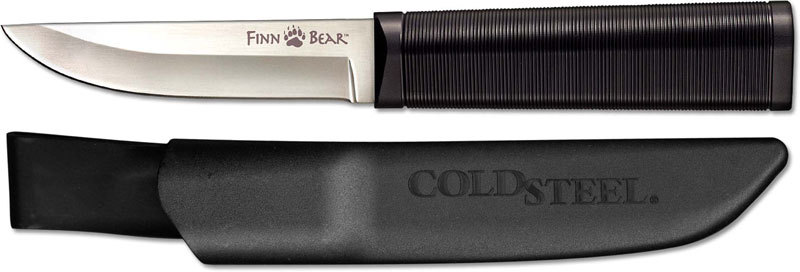
The CS Finn Bear can sometimes be found for $9.99. It has a hollow ground, edged on both sides of the blade, while the traditional puukkos are edged on one side only.

CS-20PC.jpg
 
However, it should be excluded as a military weapon as in the OP.

Just about everything on this thread has been carried or issued as a “military weapon” why would you single out the Kabar? What is more natural than a military issuing / or soldiers procuring whatever is most popular in civilian use.

n2s
 
The CS Finn Bear can sometimes be found for $9.99. It has a hollow ground, edged on both sides of the blade, while the traditional puukkos are edged on one side only.

CS-20PC.jpg

If you mean chisel grind you are wrong. Traditionally they are ”zero/scandi grind”.
 
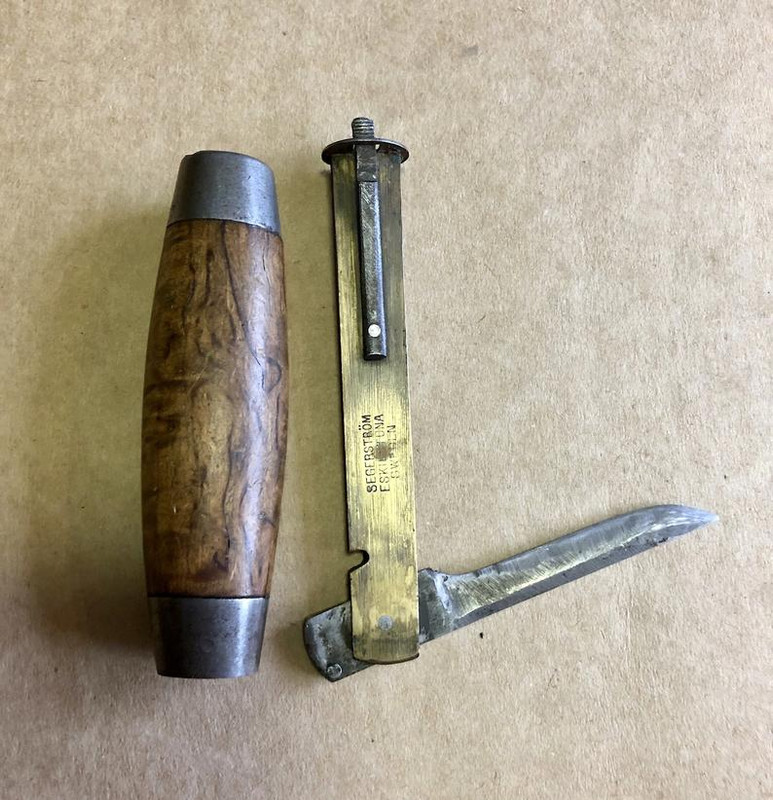
I’m not sure how significant these are, but I’ve wanted a barrel knife since first seeing one on here. Swedish, correct?

 
Last edited:
Just about everything on this thread has been carried or issued as a “military weapon” why would you single out the Kabar? What is more natural than a military issuing / or soldiers procuring whatever is most popular in civilian use.

n2s
Existing civilian designs used as expedient weapons (that could be just about anything and everything ever made) and knives designed to meet military specifications with use as a combat weapon the primary design intent are two completely different things. The Union Cutlery 1219C2 / US Navy Utility Knife, Mark 2 / USMC Mark 2 Combat Knife was designed to be a military combat knife first and foremost, and only after WW2 did it become a civilian knife.
 
THE KNIFE that says "U.S.A." is the Buck 110

lhvSzmE.jpg


GPKG6v4.jpg


And more recently, Leatherman multi-tools

1cDzGW7.jpg
 
Not really. A typical Scandi grind is a short flat bevel, like this
ZRuV7uL.jpg


The leuku has a scandi grind
4rGqsAj.jpg


Puukkot have more of a flat saber grind with a secondary micro bevel
6CPRWht.jpg

Ib7teEF.jpg

I don’t know what the exact term is in english because we just say ”puukko grind” but puukko does not traditionally have micro bevel. Maybe your production ones do.
 
France: Opinel, Douk Douk
Switzerland: Victorinox.
Sweden: Mora
Finland: Puukko
USA: Buck 110, Barlow; Bowie; Stockman/Cattle Knife; Trapper; The "One Armed" blade, used on the Barlow, and a few other patterns.
England: Lambsfoot
Italy: Stiletto
Scotland: Sgian Dubh
New Zealand: Svord

There is another French knife, starts with "Lag" but I can't spell it.
 
Last edited:
France: Opinel, Douk Douk
Switzerland: Mora and Victorinox.
Finland: Puukko
USA: Buck 110, Barlow; Bowie; Stockman/Cattle Knife; Trapper; The "One Armed" blade, used on the Barlow, and a few other patterns.
England: Lambsfoot
Italy: Stiletto
Scotland: Sgian Dubh
New Zealand: Svord

There is another French knife, starts with "Lag" but I can't spell it.

Thanks for the great list! Mora knives (MoraKniv) are made in Sweden...
 
Australia has the Boomerang, of course. Since our Aboriginals never discovered metal, thats as close as we got.
 
Back
Top