Curved Bolsters

PEU

Gaucho Knifemaker
Joined
Aug 6, 2006
Messages
1,182
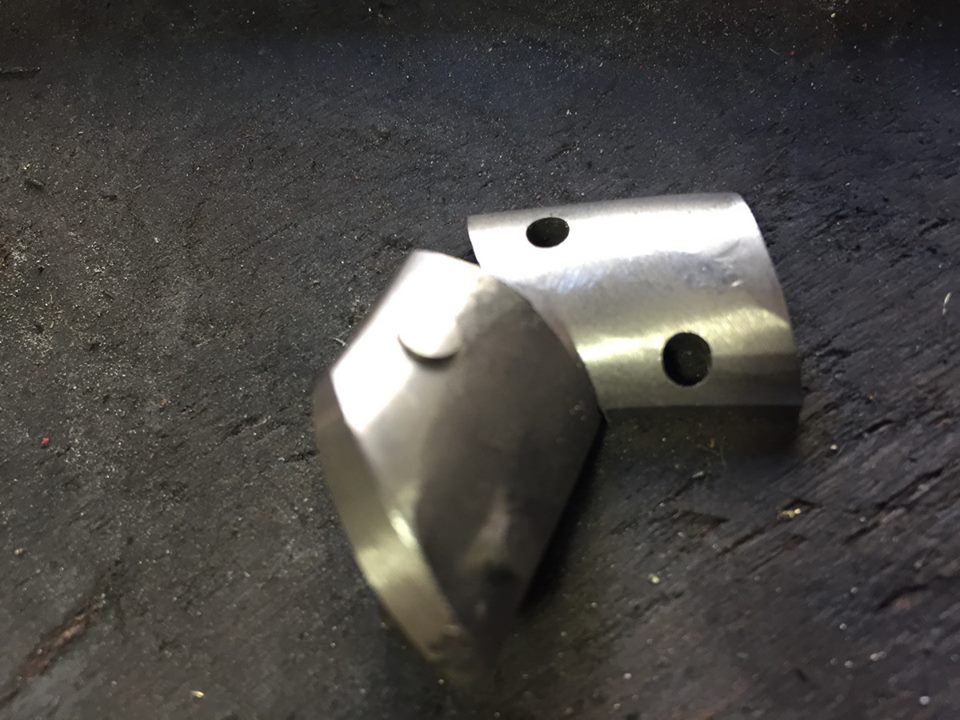
Today I got frustrated with a curved stainless bolster, flat ones are frustration free, but when they are curved I have a 50% success rate, some end ok, some come to say hello when they are almost finished :)


Here is an example:
9lbBYMn.jpg


I normally taper the holes with a larger drill, peen and then beat the hell out of it, but when its curved all my hammering gets grinded in the curvature and I end with straight pins that love to reappear...


What do you guys suggest?

I use 3mm 304 stainless pins and bolsters (almost 1/8") I tought about tappering a 4mm drill so the hole is tappered all the way to the tang.


Suggestions?


Pablo
 
i have found if i flux the holes and pins before peening they fill up and disappear more often.
 
You can taper with the drill press when the boster surface at the hole is fairly flat and round.
If your holes rims are elliptical due to the slope you can chamfer with a needle file or whatever...you only need a little taper to lock the bolster and let the pin disappear...you could even use a small chisel and hammer to cut the slope.
Another very good (best) option is using a 2° tapered reamer....it will allow for a lot of slope in the bolster...in this case leave the 304 and use 410; the 304 will work harden too much for a long taper to fill properly.
Anyway the example in the picture is a bit extreme and should be redesigned IMHO...even if you would put a nice chamfer, when you pin you'll distort the pin on one side, skewing the ensamble.
 
Last edited:
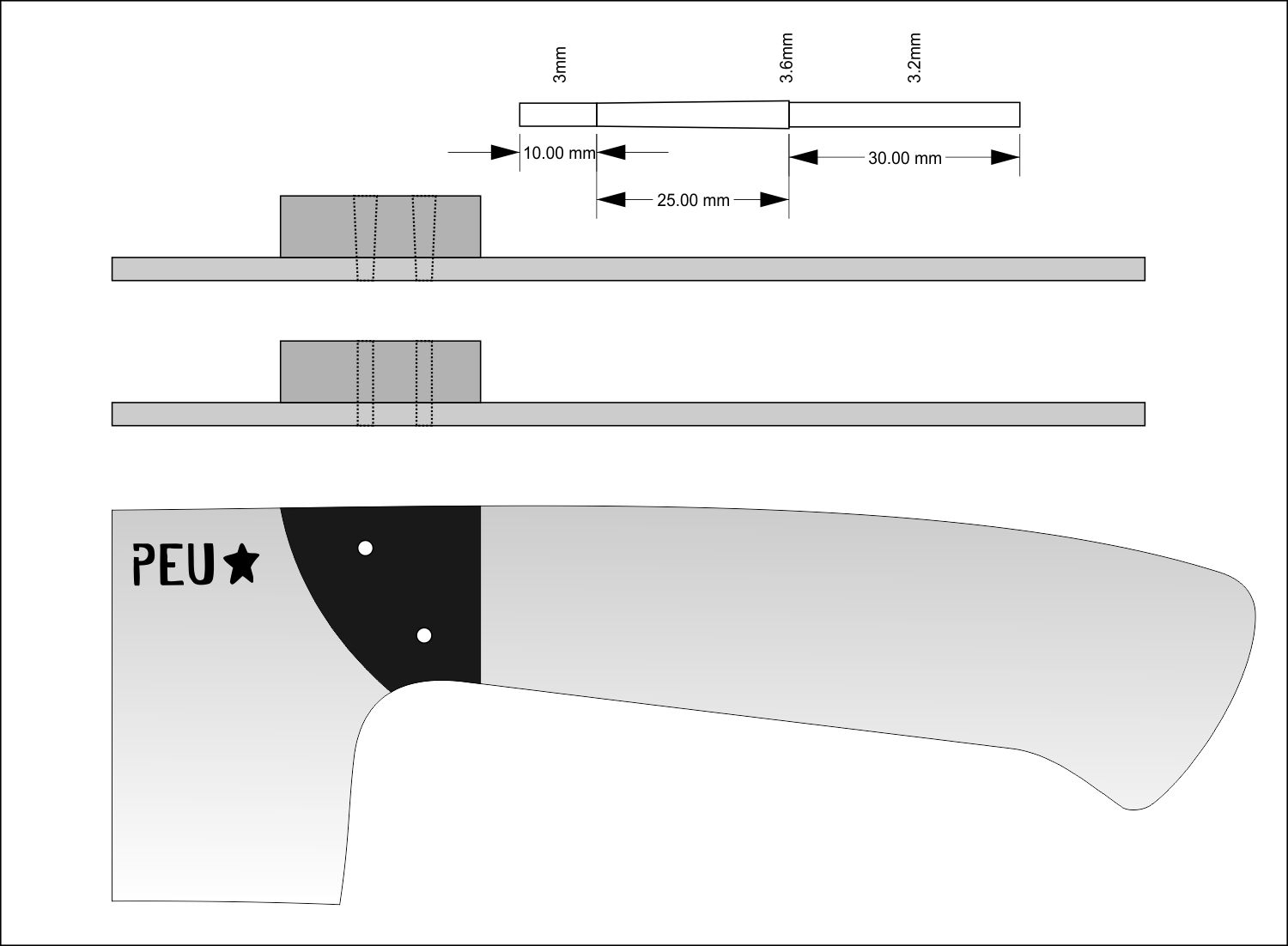
I tought of a tappered reamer or a custom made rotary diamond file:

dzX2ViP.jpg


(in the image the taper should ream only the bolster, its a quick draft)

anyone uses tappered reamers for the bolsters?


Pablo
 
Just a thought, but would it work for your design to put the pins in line with one another rather than top and bottom? There should be plenty of holding power, and if you're bedding them in epoxy or soldering it would seem practical.

Andy G.
 
Pablo,
I can give you these three tips:

1 - use 416 rod (3 mm are sufficient)
2 - for taper I use a old drill bit (3,5mm) I have made tapered by turning on the belt sander with the hand drill.
3 - use a hammer with round head

____________________________-
Riccardo Mainolfi
 
Riccardo is right on the steel's rod choice, but be sure to use similar steel also for the bolster or it will show.
Another tip worth considering is reducing the rod's diameter... 2 pins in 2 mm should be enough for the task and should make your life easier.
You will find a lot of useful tricks in slipjoint discussions (slippies are the realm of peened pins!!!)...the bigs use tapered reamers
 
anyone uses tappered reamers for the bolsters?

I haven't made a knife with pinned bolsters in several years... but back when I did, I always used a taper-pin reamer. There's less focus on peening the head -- since it will get ground off anyway -- and more focus on expanding the pin to fill the taper. I only ever used 416 bolster material with 1/8" 416 pin stock. I run a 4/0 taper pin reamer turned by hand in the drill press.
Erin
 
Tapered reamer was the hot ticket for me..

Softer steel as others mentioned will help as well.

I personally grind my bolsters close to final thickness/shape with a sacrificial pin in the hole.. Then ream the hole.. insert final pin in and grind it just above flush. I use a center punch to set the pin in the hole on both sides. Grind away the remaining tooling marks.


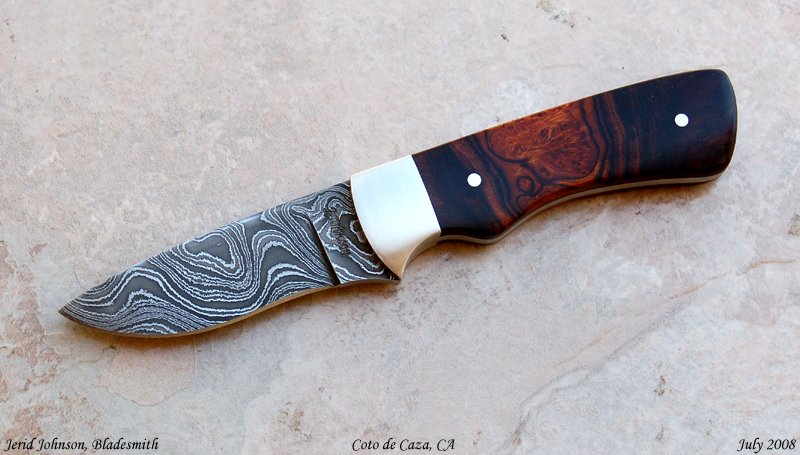
Here is a pic of the last one I did with 304 stainless.. Geez, it's been a while.. :-)
58.jpg
 
Just a thought, but would it work for your design to put the pins in line with one another rather than top and bottom? There should be plenty of holding power, and if you're bedding them in epoxy or soldering it would seem practical.

This is a great idea indeed, it solves the problem with elegance, but for my next knives, this one is almost finished.

Pablo,
I can give you these three tips:
1 - use 416 rod (3 mm are sufficient)
2 - for taper I use a old drill bit (3,5mm) I have made tapered by turning on the belt sander with the hand drill.
3 - use a hammer with round head

1 - here is not easy to find 416, closest is 420 but then, its difficult to find precise diameter rods, so I went 304.
2 - Will try to make one tomorrow.
3 - I have two ball hammers, one is 100 grams and the other is 500 grams, I peen with the small one then go to the heavier

Tapered reamer was the hot ticket for me..

I personally grind my bolsters close to final thickness/shape with a sacrificial pin in the hole.. Then ream the hole.. insert final pin in and grind it just above flush. I use a center punch to set the pin in the hole on both sides. Grind away the remaining tooling marks.

Did this once with sacrificial brass rods, its a lot of extra work but... it works. In hindsight I shoul... nevermind :)


Thanks for all the comments, today I was too angry to touch that knife, tomorrow is fixing time :D


Pablo
 
I used to shape and finish the front and the back of the bolsters put in the pins and hammer with the flat of the hammer and then grind to shape. This worked good for me without tapering the holes.
Frank
 
Riccardo is right on the steel's rod choice, but be sure to use similar steel also for the bolster or it will show.
Another tip worth considering is reducing the rod's diameter... 2 pins in 2 mm should be enough for the task and should make your life easier.
You will find a lot of useful tricks in slipjoint discussions (slippies are the realm of peened pins!!!)...the bigs use tapered reamers

Yes, as you rightly say. I assumed some things.

For rod diameter I change it in according to the size of the bolster. Only on 10mm wide guards I use always 3mm rod, but I know other knifemaker that use 2mm rod and something 2.5mm.

I think that all the way are good if they work: bolster solidarity with the blade and plugs that are not seen.

_____________________-
Riccardo
 
Peu,
rarely I use the AISI 304, it's hard to work with and does not add anything to the finished knife. But if this is the steel that you have, it works well too!
For the weight of the hammer, the ideal with thorns 3mm is to have a weight of 250-300grammi. I bought a "normal" hammer and then on the belt sander with attention I gave it the desired shape.
 
Back
Top