
Curved grind lines? How is it done?

Joined
Nov 12, 2013
Messages
9
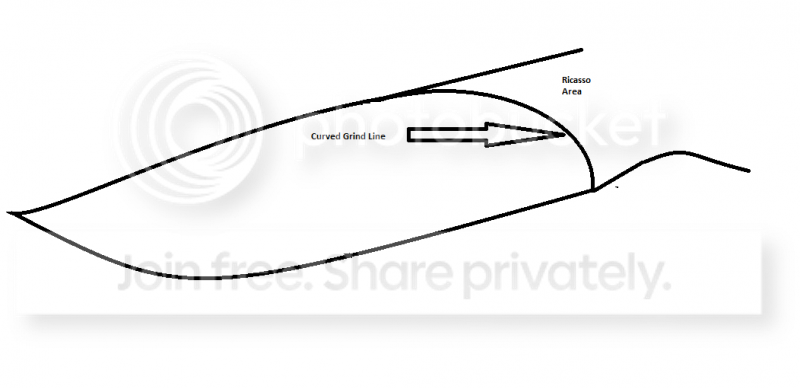
This is a very basic sketch of a grind I want to learn. I hollow grind almost everything but this curved line has me sort of stumped. I'd flat grind it if that was the only way to do it but I thought I'd ask if there was a certain technique for getting these curved grind lines. I haven't been successful with flat or hollow.....not even remotely. It doesn't HAVE to be a full grind to the spine...even if I could figure out how to get a large arc instead of the standard straight and then trail it out to the tip, I'd be happy. Any advice would be greatly appreciated!
 
Get some mild steel to practice on. My way is to mark the curve with an indelible marking pen then with edge up slowly start hollow grinding, keeping well away from your line til you get comfortable with your moves then creep closer to the scribed line until you;re almost to it. Change to a finer grit belt and go up to the line. I learned to do it that way from Rod Chappel in the 70s and it still works for me. Another thing Chappel taught me is to let your legs and hips do the moving. Don't stand still and make your hands and wrists do all the work. Hope this helps
 
Get some mild steel to practice on. My way is to mark the curve with an indelible marking pen then with edge up slowly start hollow grinding, keeping well away from your line til you get comfortable with your moves then creep closer to the scribed line until you;re almost to it. Change to a finer grit belt and go up to the line. I learned to do it that way from Rod Chappel in the 70s and it still works for me. Another thing Chappel taught me is to let your legs and hips do the moving. Don't stand still and make your hands and wrists do all the work. Hope this helps

Is the curve a result of hollow grinding?

I understand I can do it easily flat grinding on my disc grinder, but that's the only way I've tried to do it.
 
I'm getting to where I can get similar results to that, but still inconsistent with noticeable unevenness. I've found that what Bill said (use your body to control the movement instead of arms/elbow) helps significantly. You'd also want a fairly large wheel with raidused sides-or atleast, that's what works for me, I'm limited to a bench grinder though so might be a bit different with a belt grinder. Perhaps having the belt tracked slightly to the side would achieve the same effect.

I've read that some achieves the look by grinding edge down, but I haven't tried that yet.
 
I do that on a disc grinder. Try practicing on scrap steel bar stock until you get the "twist o' the wrist" down.
 
I grind edge up because I flat grind the blade to a 600 grit finish before I start the hollow grind, and have found that when I grind edge down with a 36 grit belt, some of the ground off steel comes around on the belt and dings the 600 grit finish. With edge up problem solved. I usually notch the blade at the rear of the area to be hollow ground si I can bring the finished thickness at the edge all the way back to the ricasso.

To answer Gizzards question, no the curve is done on purpose as I stated before. Anyone can hollow grind and have the rear of the grind @ 90 deg. from the top of the blade.
 
A curved grind like that one can also be done with an angle grinder - that is, if you're REALLY steady and light with it.
Honestly that's not something I would even consider, much less recomend. Even if it was possible with even close to respectable results, I can't think of a worse tool for grinding bevels cleanly or safely.
 
Another option is to grind perpendicular on the contact wheel. Essentially, hold your blade at an angle relative to the wheel and draw the tang towards you. Be sure to keep it moving as its easy to create divots in your blade. This results in a flat grind.

Brett
 
I read the article on Salem Straub's site. It was very helpful, thanks.

That's how I try to grind everything Bootstrap, swaying side to side using my whole body. I do my heavy rough edge grind sitting down on a stool but after that the stool goes away and I stand. Feel like I can concentrate better that way as well or maybe it's more that I don't lose concentration....something like that. I did try working up to a line as you mentioned. That was my first intention. I just didn't have much luck so I think it's just a matter of practice and patience. As long as I was on the right path I feel better about trial and error. Sounds like my approach is similar to yours. It's just my execution that's lacking still I guess.

I dunno about the angle grinder. That never occured to me to try. I may give it a try though. Never know what's going to click until you try it.

Thanks for the tips. That helps a lot.
 
I read the article on Salem Straub's site. It was very helpful, thanks.

That's how I try to grind everything Bootstrap, swaying side to side using my whole body. I do my heavy rough edge grind sitting down on a stool but after that the stool goes away and I stand. Feel like I can concentrate better that way as well or maybe it's more that I don't lose concentration....something like that. I did try working up to a line as you mentioned. That was my first intention. I just didn't have much luck so I think it's just a matter of practice and patience. As long as I was on the right path I feel better about trial and error. Sounds like my approach is similar to yours. It's just my execution that's lacking still I guess.

I dunno about the angle grinder. That never occured to me to try. I may give it a try though. Never know what's going to click until you try it.

Thanks for the tips. That helps a lot.

I would try other options than an angle grinder, angle grinders are dangerous, and not going to give you a glean grind. I think there are better options, as the others suggested.
 
Instead of grinding across the contact wheel (as in hollow grinding), orient the blade in line with the belt with the tang up. You'll want to contact the wheel at an angle (edge angled in/spine angled away). Start your grind near the ricasso, pulling the tang upward/toward you and ending at the tip. You'll want to find a spot on the contact wheel that allows you to see what's going on and I recommend practicing the motion without the grinder running first to get the hang of it. The curve you're looking for will occur naturally. I hope that's a clearer explanation.

Brett
 
I believe I saw a video where someone explained how to do it with the belt a little off the platen. Maybe the one by Daniel Fairly on plunges?

I got some odd plunges by having the belt tracked poorly so it may work if done correctly.
 
Instead of grinding across the contact wheel (as in hollow grinding), orient the blade in line with the belt with the tang up. You'll want to contact the wheel at an angle (edge angled in/spine angled away). Start your grind near the ricasso, pulling the tang upward/toward you and ending at the tip. You'll want to find a spot on the contact wheel that allows you to see what's going on and I recommend practicing the motion without the grinder running first to get the hang of it. The curve you're looking for will occur naturally. I hope that's a clearer explanation.

Brett

Yep, I see what you're saying now. Thanks.
 
Back
Top