Custom Knife Shop Efficiency...

Joined
Jan 10, 2010
Messages
1,818
Wasn't sure how to word that title... but there ya go. I'm going on about a year and a half with knife making as the sole source of my income (my share). With tax season here it's been a learning experience in terms of how this endeavor is going for me. Brief synopsis: Thrilled for being at it for such a short time but taxes suck. But all-in-all... it's viable.

It's really coming down to how much I can put out with the prices that I command. I do almost exclusively one-off type pieces with very little repetition. I do mono-steel, hamons, laminated and now damascus. My main question: What tips do other people who do 'one-off' art type knives have for increasing efficiency in terms of getting knives out? I realize this may be too broad of a question... but I thought I would throw it out there. I suppose I'm more looking for what people think works best in terms of planning their week out... one day forging blades, one day grinding, etc... I dunno. I know that some of it just comes down to getting better at things... like fitment. Fittings slow me way down. So some of it is just me getting better at the trade... but some of it is probably disorganization and inefficient workflow. That is what I'm looking for I think. Sabe????

Looking forward to seeing what y'all have to say.

(by the way... I should add... I'm well aware that my efficiency could go way up if I did runs of certain styles of knives.... but working exclusively on commission kind of precludes this)
 
I have no advice for you, but want to wish you the very best in your endeavors, and let you know I respect you for the bold decision to make customs for a living. My hat is off to you.
 
I always do runs of the same steel. Even if I have 4 or 7 different blade designs in a batch, I'll make sure they're all 1080, or all CM154. That way I can get the oven hot one time to heat treat them all, buy dry ice one time for cryo, temper them all at the same time and temp, etc. I grind and profile the entire batch at the same time, so I can get into a rhythm grinding flats. I drill all the holes at the same time, so I don't have to set up the drill press more than once for each hole size. You can take the parts of batch building that make the batch faster, without having to make all the same knives.
 
I try and work in batches, and it doesn't matter at all if they are all the same knives or all totally different. I do mostly full tang knives, because hand filing gaurds takes way to much to make money for me. I try and setup and do things in stages, so I am not running all over my shop: Trace out designs, cut on bandsaw, profile on the grinder, stamp my mark, drill the tangs, do texturing ( if there is any), mark center line, grind bevels, hand sand (if necessary). I don't like to fire up the kiln unless I have at least a few knives to do, It doesn't take much longer to treat 6 than 1 once it is up to temp. Right now use 5160 and L6 almost exclusively and they both can be treated together. Same thing with gluing up scales and grinding handles, and making sheaths. I have worked in production manufacturing for about 10yrs now. If there is one thing it has taught me, besides that I would rather be making knives, is to be EFFICIENT. Figure out a system that works for you, and try and stay organized.
 
If you're truly going to work on one piece at a time, there's simply no way do it with real efficiency. That's like trying to drink whiskey from a bottle of wine. Tooling/bit/belt/process changes will flat-out drive you broke unless you can command a very high price for your time.
 
Thanks for the input folks. I can see how doing runs on full tang knives... even if they are different in terms of profile/shape... can be the most efficient way to go. But it seems to me that hidden tangs with fitted guards are not so easy... unless you come up with a system in which all your knives have the same slot geometry for the guard and same tang/shoulder dimensions. From an art stand-point... it's difficult to see that happening. But something to think about.
 
But it seems to me that hidden tangs with fitted guards are not so easy... unless you come up with a system in which all your knives have the same slot geometry for the guard and same tang/shoulder dimensions.

Actually, I think that makes a lot of sense. It still leaves a great deal of options open for every other part of the knife. I'll note that many of the very best makers use a mill to cut their guard slots, instead of drilling some holes and filing till it fits. In my opinion, that's definitely still custom work. You're right, it's interesting to think about.
 
This may sound smart-assed but has anyone ever used a waterjet service to cut slotted guards? Never occurred to me before but it might save a bit of time if you can come up with a few generic (and/or oversize) guard designs/blanks to start from, then have them cut up in fairly large batches, with the slot cut a hair under size to fit with a file. If I did a lot of slotted guards I would give this some thought, get 80% of the dumb work out of the way in a helluva hurry compared to the usual method.
 
This may sound smart-assed but has anyone ever used a waterjet service to cut slotted guards? Never occurred to me before but it might save a bit of time if you can come up with a few generic (and/or oversize) guard designs/blanks to start from, then have them cut up in fairly large batches, with the slot cut a hair under size to fit with a file. If I did a lot of slotted guards I would give this some thought, get 80% of the dumb work out of the way in a helluva hurry compared to the usual method.

You can buy pre-slotted gaurd "blanks" from most knife making suppliers.
 
You can buy pre-slotted gaurd "blanks" from most knife making suppliers.

You are right, but unless I miss my guess, they are all cast material which I have a strange aversion to. They are also fairly easy to spot on a finished knife if you are familiar with the common styles, and most of the shapes just look cheesy IMO.
 
My opinion will not give immediate efficiency but I think it would be more realistic for you and your style(s) of knives.
I base my opinion on my experience not with knives but woodworking projects.

I think you are doing the right thing working on one knife at a time.
Since the knives you make are not just a tool but a piece of functional art.
Staying focused on the one project allows you to create a work of art instead of a more generic piece.
My thought is that in time your skills will increase to where you are able to do the work faster, better and sell for more money.
When working on several projects at once it is easy to lose your train of thought and just one mistake can eat up all the time you were trying to save.
At least that is what has happened to me.

Maybe if you came up with something that you could produce easily that is a quick seller for your bread and butter.
You could use that as a break between the commissioned orders and to keep the cash flow going.

Not sure if I am making sense here,
but I see you more as an artist and not a production worker.
Just my 2 cents worth.
 
As far as advice for increasing efficiency goes, you need to find your common "practices" and set yourself up for those.

Make some gauges and jigs where you can, pre-stage and set up tools you know you are going to need, and try to limit tooling changes where possible. Also, do batch work where you can.
 
You are right, but unless I miss my guess, they are all cast material which I have a strange aversion to. They are also fairly easy to spot on a finished knife if you are familiar with the common styles, and most of the shapes just look cheesy IMO.

I'm talking about the gaurd blanks that are nothing more than a piece of slotted flat stock. Usually a peice of brass, stainless, or nickel silver. The maker can then file, round, polish and shape as necessary.
 
This is basic assembly-line mechanics. Took a course in just that several years ago and couldn't imagine just how much it opened my eyes to thoughts of efficiency.

Personally, I would recommend multiple drill presses so they can always be chucked with the bit you use. No more hunting for a bit or changing out bits. Just step to the side, to the next drill, and go. At the very least, change out the chucks to a keyless variety to help speed up the bit-changing.

With sanders, it's faster to step left or right to go from flat platten to slack belt to 10" wheel than it is to change the tooling arm out. If that's not possible, study your setup to be sure that your tooling arms and belts are within easy reach and can be switched out with little wasted movement.

Identify the commonalities and maximize their potential. For example, the only difference between a through-tang and a half-tang is the length. From the ricasso back to the middle of the handle, every dimension of the two tangs can be the same. Changing those dimensions makes more work for you because you've added a step to the making process.

Buying pre-cut guards in a variety of materials can save a lot of time. Even if you have a milling machine, you don't have the capability to pound out dozens or hundreds of guard blanks per hour like the big shops can. Take advantage of their capabilities to do the majority of the work, and you can spend your time fine-tuning their work to fit your knives. It's quicker and cheaper in the long run.

Similarly, you can get some basic blade blanks cut out for you. Ever notice that all bowie knives look basically alike? The blade is 8" long, .25" thick and 2" wide...roughly. The only differences between makers are small ones and easily made: a few minutes at the grinder and you can drop the point a hair, or lengthen the clip cut, or add a bit of recurve. Anything to make the blank completely different from anything you've ever done, but the starting point doesn't begin with a piece of rectangular barstock that requires a lot of time to bring to profile.
 
In my humble opinion, you can either make production runs of similar knives quickly and efficiently, or you can produce ART, which requires stepping outside the realm of mass production..........I don't see where you can gain much efficiency on one of a kind stuff. Also, I figgure that making original, individual works of art is more about the process than it is about the paycheck.......the paycheck being a nice bonus. My opinion only, and probably expains why I am a part time hobby hack:rolleyes:.
Darcy:)
 
Thanks for the input folks. Great advice Mark... makes a lot of sense.

I do have a mill.. and that does help quite a bit. But I'm still new to it's use and am not making the best use of it. I get close and have to do a lot of filing to slider er home.

Pre-made stuff wouldn't work out for me because I almost always use wrought iron, smelted iron, shear steel, etc... unusual stuff for my fittings. And blade blanks are completely out of the question due to my use of laminated steel. Although... water jetting a bunch of slots into my wrought iron plates sounds interesting. I've also started taking an interest in bronze fittings... and am considering shipping out some wax carvings for a bunch of cast guards that can be used for various things.

And yep... need another grinder and another drill press too. Not to mention a disk grinder would save time on flattening stuff.

I think coming up with a standard hunter or EDC that reflects my style would be the best thing I could do right now... the bread and butter as Mark says.

Thanks again....
 
I'll try to add my two cents in a few areas, Scott...

Models
I have a few bread and butter models that I can whip out fairly quickly. This takes some the pressure of paying the bills and allows me to take the time I need to finish more involved projects. I realize you stated that you work by commission but it is something to consider.:thumbup:

Guards
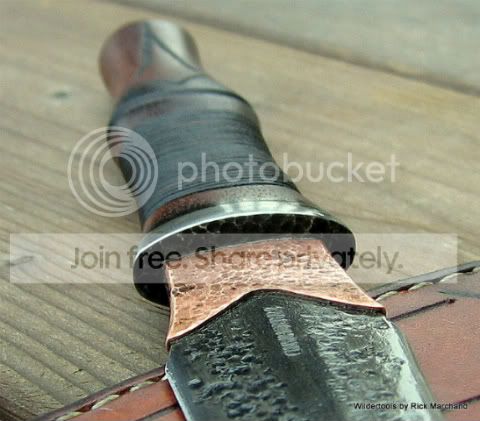
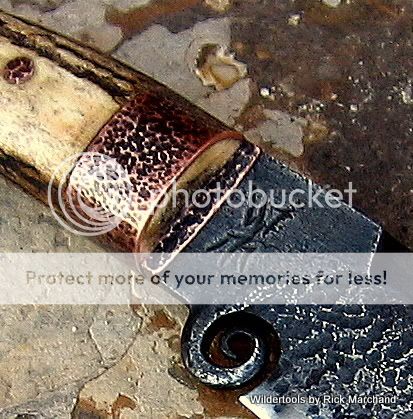
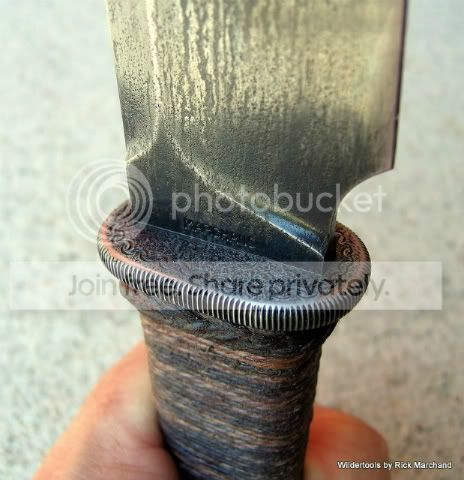
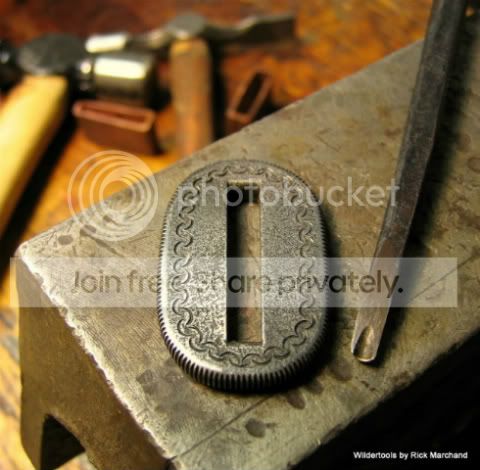
You are a forger like me, so maybe this is an option... I know it made a huge difference for me. I sucked at drilling and filing guard slots(just wasn't fast at it and left gaps.) So I tried drifting them out, instead. I drill one hole and drive a prefab shank through it while its red hot. I get it close to size, grind the top and bottom flat, then do the final fitting to the actual tang, hot. I can "tap in" all the gaps. This may not work for the mirror finish makers but suits the style of guys like us, who are rough around the edges.;)

Stations
My efficiency doubled when I made dedicated work stations for the different aspects of my knifemaking process. (Forging, Heat Treating, Grinding, Sanding/Filing, Fittings, Handles, Polishing/Sharpening, Sheaths.) It seemed like I spent much of my time preparing the work area as I did for the operation itself.:confused::grumpy:

Something to Think About
I often joke about this next one... but there is truth to it. The more you develop your skillset, the more involved your work becomes. Eventually, you reach a point where the time and effort you put into a piece overtakes the price that the market will bear. When I decided to go full time, I was a bit turned off when veteren makers would say that there is no money in making knives. I thought... "I am doing pretty well and my knives aren't even as good as yours."..... then I started seeing a pattern. These makers where the top of the food chain with mad skills. The time they put into their work, the intricacy and attention to detail, was unmatched.... there was no way they could ask for the appropriate compensation for that kind of involvement...... and they weren't, considering the statements they were making about the business end of custom knives. I just kept thinking "I'm glad I'm not that good!". I forget who the maker was but they asked how they could make more money.... they were going as fast as they could and not getting the price they needed. After explaining my observations of the relationship between Talent vs Price Point and how talent will continue to climb while target markets shrink and prices plateau.... my suggestion to them was "Become a worse knifemaker." That was obviously not to be taken as literal advice(I mess around a lot) but there is something to be taken from that. It is good to spread your wings and showcase what you are capable of but realize that unless this is a hobby for you, you have to treat it as a business in order to continue doing what you love. You can still approach simpler, more market friendly projects, while maintaining that same dedication to detail. There is a balance..... "logical compromise" isn't synonymous with "less than your best".:cool::thumbup:
 
Last edited:
Good words man! I have been in the situation this year my self being fulltime for the last year or so. I have been making knives and selling for prob 10 years or so. Now I'm struggling to be more efficient.

Work stations is the best idea to be fast!!!
I'll try to add my two cents of a few areas, Scott...


Something to Think About
I often joke about this next one... but there is truth to it. The more you develop your skillset, the more involved your work becomes. Eventually, you reach a point where the time and effort you put into a piece overtakes the price that the market will bear. When I decided to go full time, I was a bit turned off when veteren makers would say that there is no money in making knives. I thought... "I am doing pretty well and my knives aren't even as good as yours."..... then I started seeing a pattern. These makers where the top of the food chain with mad skills. The time they put into their work, the intricacy and attention to detail, was unmatched.... there was no way they could ask for the appropriate compensation for that kind of involvement...... and they weren't, considering the statements they were making about the business end of custom knives. I just kept thinking "I'm glad I'm not that good!". I forget who the maker was but they asked how they could make more money.... they were going as fast as they could and not getting the price they needed. After explaining my observations of the relationship between Talent vs Price Point and how talent will continue to climb while target markets shrink and prices plateau.... my suggestion to them was "Become a worse knifemaker." That was obviously not to be taken as literal advice(I mess around a lot) but there is something to be taken from that. It is good to spread your wings and showcase what you are capable of but realize that unless this is a hobby for you, you have to treat it as a business in order to continue doing what you love. You can still approach simpler, more market friendly projects, while maintaining that same dedication to detail. There is a balance..... "logical compromise" isn't synonymous with "less than your best".:cool::thumbup:
 
Sweet post Rick. You are hitting on some major points when it comes to the complexity of the projects. I've slowed down a lot in the last several months as I've been pushing myself into new areas and new levels of complexity. My idea is that the more involved pieces increase your reputation and name value (if done well!) and thereby increase the value of my less complex work. But I just can't stop working on those kind of projects lately! But that's mostly due to the Little Rock show coming up.

And great idea on the guards. I've already started playing with that idea on larger swords. And a nice idea for the japanese stuff where the gaps get hidden by a habaki. But then there is making that bloody habaki... ;-)

I appreciate the suggestions Rick...
 
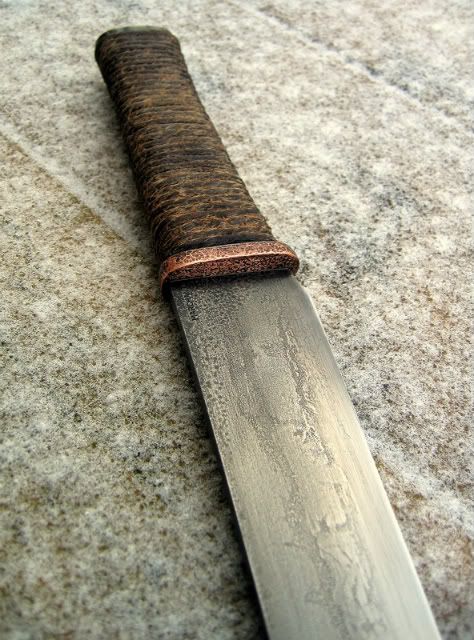
I have started making seamless habaki..... I just stretch the habaki to size.

IMG_0085-3.jpg

IMG_0002-12.jpg


The hot-fitted guards are surprisingly snug and clean...
IMG_0079-1.jpg

IMG_0003-8.jpg

IMG_0018-4.jpg


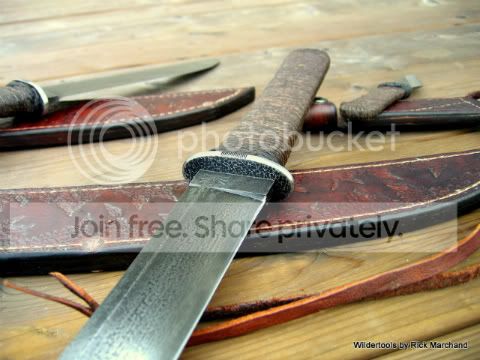
You can see a couple seamless habaki in the background here...
IMG_0041-5.jpg
 
Back
Top