Cuttin' a few Blocks of Wood

Stacy E. Apelt - Bladesmith

ilmarinen - MODERATOR
Moderator
Knifemaker / Craftsman / Service Provider
Joined
Aug 20, 2004
Messages
38,512
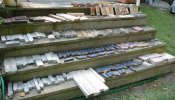
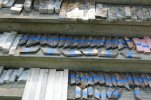
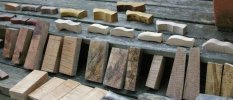
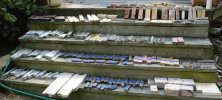
I just finished cutting up most of the 167# of wood I got back from WSSI.
Here are some photos. There is about another 50# to cut. Most of the wood uncut is the better stuff ,but this batch is really nice. I'll post more later with specifics.
Stacy
 

Attachments

  • 215.jpg
    215.jpg
    53.5 KB · Views: 157
  • 216.jpg
    216.jpg
    56.6 KB · Views: 123
  • 217.jpg
    217.jpg
    50.5 KB · Views: 109
  • 219.jpg
    219.jpg
    46.7 KB · Views: 121
And a few more photos.
 

Attachments

  • 220.jpg
    220.jpg
    38.4 KB · Views: 95
  • 221.jpg
    221.jpg
    42.7 KB · Views: 72
Jeesh! you wont be having any problems with having handle material on hand for hte next year or two !

Some gorgeous wood there Stacy
 
Stacy,
What are you going to do with 167 lbs. of stabalized wood?

My Goodness, I think you got the "obsession" about handle material like I have about HT steel.....

You do have some mighty pretty slabs there though!
 
Jeez that's a lot of wood.

How much did that cost you...if you don't mind me being curious?
 
Wow Stacy! That's a nice haul! Can't wait to see some of it all finished up and mounted :)

-d
 
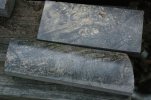
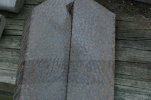
That's right - Asian Black Palm. I cut it at a double 45 degree cut (two axis). I get wide and long pieces with heart shaped "fish scale" look. I cut left and right cuts to get sets of scales
My favorite is the spalted curly maple. It is some that Bill Moran had squirreled away for about 30 years. He put it on the floor of the shop and covered it with dirt, letting it spalt slowly. It just looked like mud covered planks at the auction. I knew if Bill went to the trouble of putting it with his "private stash" of superb handle material, there must have been a reason. That box of handle cutouts, planks, and blocks was a treasure trove. There were a bunch of Osage orange handle templates Bill had cut out and marked "large" and "small", as well as cutouts for the knives he did for his 50 Years knives (He evidently cut out several candidates and used the one he liked the best. The rest went in the "keeper" box. The box was labeled,"GOOD".) On one board of curly hickory he had sawn out one handle,with a scroll saw, and marked out four more.There was an arrow drawn to the place where the one was cut out and the note,"THIS ONE". There were other boards marked with circles or handle shapes where there was a special pattern or unique curl. I cut those out. You can see some on the top row.

There is a lot of California Buckeye Burl in there, some curly maple, spalted persimmon, walnut burl,curly hickory, redwood burl, figured maple, Osage orange, and more.

Shappa - It cost $1450.00, plus shipping. I buy wood all year long (and bought a lot at Bill's estate auction) and cut out the best pieces.I dry them for up to 3 years,then I have it stabilized in large batches. I have about 200-300 pounds still drying. There is another several hundred pounds that isn't up to having stabilized (with so much better stuff). I give away a lot of the nicer, but not superb material,or save it for odd projects, like the wooden gun I did. I sell a lot of the stabilized wood and some mammoth at the Harrisonburg show in April. The cream of the crop goes into one storage cabinet I keep for my personal projects.Some of this Moran wood will be used to handle the blades that Bill forged before his death, but never finished.Out of the approx. 300 blocks/scales I cut ,I will give away about 50 to friends, sell about 200 ,and keep 50 for myself. That will last a year....maybe two.

Oh Yeah, In the winter, when I burn the first fire in the fireplace, we have our annual $1000 fire. I burn all the cut offs,bad pieces,scraps, and wood not worth cutting ( I save them all year). Making a fire out of snakewood, Desert Ironwood, rosewood,ebony,rare burls,etc. is just too much fun to describe.
Stacy

 
Just a dumb question, but why don't you cut it up before having it stabilized? That way, the stabilization would soak into the smaller pieces deeper. ???
 
If you get to a real close to final size, it might warp, Dan.
Maybe not much on the straighter grains, but on the burls it just might waste a real nice piece.
 
Wow, that's a lot of wood...and $$.

How thick do you think redwood burl could be and still get complete penetration?

What do you consider the optimum size for stabilization?

Whens the mashmallo roast?:)
 
When done by WSSI you could use almost any reasonable size block. The redwood burl was 10X5X3" blocks. I have had buckeye blocks done at 12X6X4". The penetration is equal throughout the wood. By cutting the wood to exact size, you run a higher risk of warp and crack. The bigger blocks hold up better. The key to ALL stabilization success is DRY WOOD. Moisture content should be below 10% and preferably below 7%. Another advantage of doing blocks is cutting for scales. A 10X5X1.5" block can be put on the saw table and sliced like a loaf of bread into perfect book matched scales. I take the blocks when I get them back and sand the outside surfaces (they are ugly and covered with excess resin) on my 6X48 with a 36 grit CZ belt. Then I slice it to the size blocks and scales needed. I also don't slice it all up. A large block can be cut into any size handle or scale later on. A set of scales can't be made back into a block.
Another thing is pattern direction. Often it looks like the pattern is best using side A of a block. If I cut it up before stabilizing, I might never know that after stabilizing side B or C was unbelievable. This actually happens a lot. Wood looks a lot different after stabilizing (when done right).Burl and curl are often greatly highlighted. I have occasionally sliced a block at 30 degrees to get the best look.Wasteful - yes. Worth it- definitely! I save the smaller pieces for friends who make folders and for bolster blocks on built up handles

When I am dealing with wood like buckeye or spalted maple. I cut it into oversize pieces around the best figure. Leave some extra. It is better to have to saw/grind away $5 worth of wood and stabilizing to get a show winning handle, than to find out the best pattern is not centered or complete. For the same reason ,I cut my blocks on the large size (often ridiculously so). I would rather have to shape the block to fit the knife handle than to design the knife around a 1X5X1.5" rectangle of wood. I often cut the wood on a curve to get a better fit of the grain and pattern.
Stacy
 
Back
Top