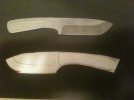
Cutting a Profile Precisely on a Pattern

redsquid2

Rockabilly Interim Pardon Viscount
Knifemaker / Craftsman / Service Provider
Joined
Aug 31, 2011
Messages
3,125
Here is how I have been profiling: I take spray adhesive and stick a paper pattern on a bar, then I dab dykem around it, to make the outline on the steel. Then I peel off the paper pattern and set it aside. I do most of the profiling with an angle grinder, using the thinnest wheels I can get. The metal gets very hot, though, and it kind of "cooks" the dykem off. So it is hard to see exactly the outline. Later, I use my paper pattern for reference, as I refine the profile with files and a grinder.

I was wondering if there is an easier way to come up with a resulting profile that matches the pattern.

Any suggestions?

Thanks,

redsquid2
 
I use a pattern made from Lexan, micarta or composit core plywood. I dykem the flat bar then set the patern on it and trace the patern with a scribe. The scribed line stands out even as the steel heats up
 
Interesting, I've been meaning to pick up some dykem so I have something that would stand up to the heat and water....

I make multiple paper copies and glue them on when needed. When grinding to the final profile shape I keep a wet rag handy and quench the steel from the opposite side as the paper. It usually holds up until the shape has been ground, if not, another gets glued on. For grind line and plunges, I cut those sections off the paper template, place that "sub pattern" over the area that will be ground and mark the area that won't be ground with a sharpie.

I use sharpies that I picked up from Lowes, they are the Industrial version formulated to hold up to chemical washes and up to 500 degrees. I have had sharpie marks survive through heat treat. The marks were under clay, but they survived the heat treat.

Barry
 
I use a gluestick to stick the drawing/pattern to a thin piece of cardboard, carefully cut it out... then scribe it onto the dykem painted metal. If it's a pattern I plan on repeating, I make a more permanent pattern out of whatever scrap material I have laying around (steel sheets, lexan, plywood, etc) and use that.

So basically in short, get yourself a carbide tipped scribe. You can get them at almost any hardware store. That'll give you lines that you'll be able to see easily while grinding.
 
I still use a file, but I think if you're cooking the dykem off, your over heating your stock. In many of the WIP posts and videos the guys that use the big grinders will take a pass or two and dip their stock in a bucket of water to control the heat, the dykem usually stays.
 
I start with a hand drawn sketch which I scan into the computer or start with a design I've created on the computer. I work out the proportions so they fit my hand well then print it out. That print gets some spray adhesive and then applied to the smooth side of a piece of Masonite board. The same can be done with acrylic sheet or other kind of board. I cut out the template leaving a little room outside of the lines. The template is then profiled exactly the same way I would with steel on a variety of sanders. This gives me a durable reusable template that has similar proportions to the steel I'll be using. I apply Dykem to my steel blank then line up my template on the steel and secure it with a couple of vise grip pliers. Trace the template with a carbide scribe and you're good to go. You really shouldn't be cooking the Dykem off. Definitely cool the steel in water before you over heat the metal.
 
one of the advantages to using dykem and a scribe is that the blank can be dunked in a "quench bucket". I keep a #10 coffee can of water next to my grinder and quench the steel every few passes.
 
I start with a hand drawn sketch which I scan into the computer or start with a design I've created on the computer. I work out the proportions so they fit my hand well then print it out. That print gets some spray adhesive and then applied to the smooth side of a piece of Masonite board. The same can be done with acrylic sheet or other kind of board. I cut out the template leaving a little room outside of the lines. The template is then profiled exactly the same way I would with steel on a variety of sanders. This gives me a durable reusable template that has similar proportions to the steel I'll be using. I apply Dykem to my steel blank then line up my template on the steel and secure it with a couple of vise grip pliers. Trace the template with a carbide scribe and you're good to go. You really shouldn't be cooking the Dykem off. Definitely cool the steel in water before you over heat the metal.


Thanks for such a clear and detailed description. I think you are describing similar method to what others are posting here. I am going to try this.
 
I still use a file, but I think if you're cooking the dykem off, your over heating your stock. In many of the WIP posts and videos the guys that use the big grinders will take a pass or two and dip their stock in a bucket of water to control the heat, the dykem usually stays.

The reason they dunk the blades while profiling is that they become too hot to hold. It doesn't matter that the blade heats up pre-HT because your HT process is going to set everything right. I use leather gloves while profiling and hog metal off. I only dunk a blade when it becomes too hot to hold with these gloves on! There's quite a bit of sizzling going on.

For $80 you can get yourself a bandsaw at Harbor Freight and take care of your problem ;)
 
I draw my knives on a piece of cardboard. Cut em out,trace them on the steel with a sharpie and grind away. I like to keep it simple. If you clean the steel before using sharpie it will last long enough to get the grinding done.
securedownloadm.jpg
 
I've use glued on paper, dykem, magic marker on steel, even painted the steel white (latex paint) and traced the pattern with magic marker. Non of them prevent me from grinding a little too deep on a spot now and then. For me, such precision is not needed and I don't sweat a little "free-hand" grinding. I am an "ARTIST", not a machine! ;-)

About that painted steel, it rusted under the paint. I don't recommend it at all.

- Paul Meske
 
The reason they dunk the blades while profiling is that they become too hot to hold. It doesn't matter that the blade heats up pre-HT because your HT process is going to set everything right. I use leather gloves while profiling and hog metal off. I only dunk a blade when it becomes too hot to hold with these gloves on! There's quite a bit of sizzling going on.

For $80 you can get yourself a bandsaw at Harbor Freight and take care of your problem ;)

Thanks for the input, I've read that the dunking was done for different reasons, same with whats in the bucket, some run a mixture of water and windex, other use dish soap and some use simple green, I've heard many different reasons for that too. At this point I'm not too concerned with it as I'm still using files.

HF wonderful prices don't extend to Hawaii shipping offsets most of the goodness. I'm stuck with files because of the noise that the grinders make, I do everything on my balcony... Anyways I don't want to threadjack so back to the redsquid2 and his original questions!!!
 
Go to Fastenal (or even Kmart) and get a tube of the paint type metal maker ( the brand I use is Markal). I like the white, because it is titanium dioxide, but the black is great, too. Clean the steel off with acetone and draw/trace the outliner. Let it dry a few minutes and it will stay there as you grind/dip/get it hot, etc. I mark the tangs with it after shaping the blade to identify the steel type when HT time comes. It even survives the HT. I send blades to Peter's with SA-S35VN on them and they come back with the writing still readable.

BTW, use them to mark all your steel on both ends and both sides the minute it arrives. Every time you cut a piece off the bar, mark it again, as well as the piece you cut off. 1095 looks just like 1075 after a day....don't ask ne how I know this.
 
Stacy, Since the paint you mention stays on post HT, I wonder if painting the whole blade with it before HT would help to reduce scale? Just thinking out loud here.
 
Not likely to help.....and it surely wouldn't be cost effective.
The markings stays on the blade because the pigments are metal oxides. The paint carrier burns away, leaving the minute balls of pigment baked on the blade surface. That doesn't really do anything to prevent oxygen from reaching the steel.

An anti-scale compound has to be able of withstanding the heat of the oven, as well as keeping oxygen from the blade surface. Hot oxygen is a pretty permeable gas. It requires a reasonably thick coating of some sort of refractory ( thin wash of satanite), or a high-temp compound like Turco (fine clay and boric acid) or Brownell's PBC for carbon steel up to 1500F. Beyond that, you need a physical isolation of the blade in a foil packet.

The best way is to use an argon injector or draw a vacuum in the oven, and eliminate all oxygen from the environment .... but that isn't suitable for most home setups.
 
Back
Top