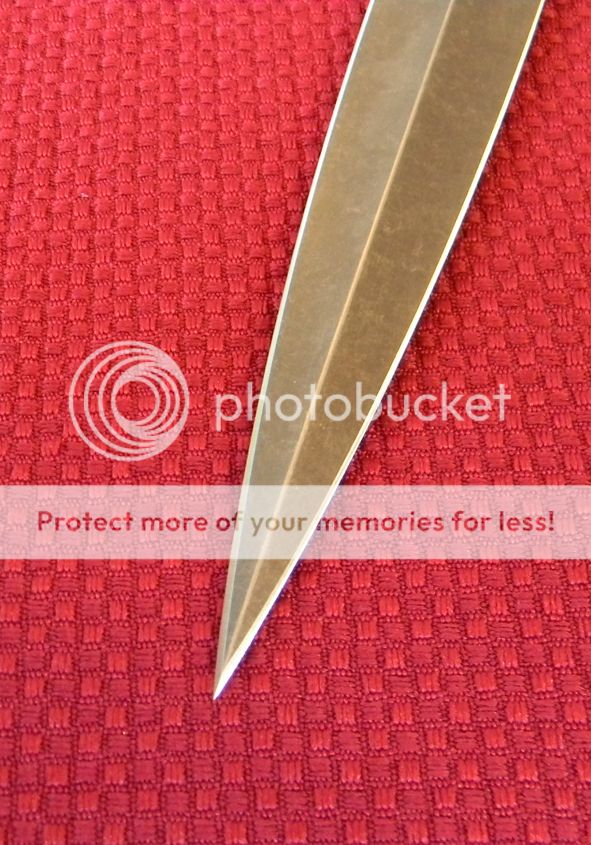
dagger grinding tips?

Joined
May 3, 2008
Messages
1,436
Haven't done a dagger in ages- current fun project is a recreation of a V-42 for my son, who just earned the right to carry a dagger that matches the patch on his shoulder.
It's a fairly simple stock removal, but as so often happens, I feel like I'm missing something obvious- when grinding to the center line on the "flat" is there any way to see what you're doing? I'm grinding blind here, and it's a little disturbing. Not terribly different from a lot of other bevels, but it would be so great if I could figure out a way to see that center line as I'm grinding gradually up to it.
Any suggestions?
Thanks, Andy G.
 
Ended up going to a 4" wheel, and the "obvious" part is that it's a lot easier to see what's going on with a well positioned small wheel than a flat platen.
Still, roughed out with a 120, then a Norax 16 and a lot of patience- was surprised how well the 16 cut on a small wheel, I think of it as a polishing belt, but it was perfect for this job. Wasn't too hard to carefully walk the grind to the lines.
 
Just know that you can't (or rather, shouldn't) use a jig to grind a dagger. The geometry changes toward the tip. Otherwise, it gets too thin.
 
^ If you set your bevels at something like 10 degrees and just leave it there the point gets weak. It gets a twist towards the tip, becoming more obtuse to maintain meat behind the point. If you're feeling adventuresome you can do that at the plunge too. :thumbup: :D
 
Freehand grind the basic bevels in and leave a long triangle of unground steel from the ricasso to about 25% from the tip. Hand file the bevels in from there. You can do this on the grinder with experience, but a tiny over-grind means making a correction on every other bevel. Best to sneak up on it slowly. Hand sand the final surfaces in long strokes from ricasso to tip.

TIP ( pun intended):
Make the tip thicker than the main bevels by increasing the angle as you do the last 25% of the blade. This "fattens" the tip and makes it stronger. If you just made the bevels all the same angle, it would end in a needle with no thickness, and bend or break. I like the last 10% of the tip to be fat diamond shape to square. This requires an edge angle of 60-90° in the tip. As Nathan said, in filing and sanding, you twist your hand as you come down toward the tip to make the angle increase as you approach and go off the tip. I call this type tip a "piercing point".
 
A challenge, for me, has been sharpening this kind of twisted grind because the edge angle and bevel angle can converge, required a twisted edge as well.


33.jpg~original


I'm set up to do a specific set edge angle, but this becomes a problem on some daggers and I have to free hand it, which makes it difficult to get a clean unfaceted edge. Of course this is the final operation in a freakin finished dagger. This sort of thing is the reason I drink.
 
You could also doing what Nathan and Stacy suggested by doing it "backward" ;)
Profile your blade, trace your edge's thichness up to the point (if you want you can have it thicker at the tip) and then grind to it, the distal taper will follow accordingly as well as the bevel angles down to the tip, exactly as N.&S. said.
You could hog some at the grinder at beginning, but go by drawfiling until estabilished main geometry, you can't go wrong
 
https://goo.gl/photos/W8PVtqcJro3KFzxG9

It's O-1. I decided, because the context is military, to be kind of informal with the stamps and makers marks- DOL (for the SF motto).
The grind is far from perfect- I went very slightly over near the plunges and had thought to finish that last little squeak on the rest to walk the bevels to the center line after HT, but decided it's going out as is- done on a 4" wheel. Filing kind of wasn't an option because of the hollows.
For a first attempt, I'm pretty happy with it overall. Now to tackle my first stacked leather handle and my first machined pommel.
Thanks for all the suggestions, everyone!
Nathan, that is wicked clean- very inspiring, as always.
 
It's interesting that where it's slightly uneven, my hand picks it up more than my eye...Hand sanding would probably fix everything, jury is still out on whether it'll get that.
 
It's interesting that where it's slightly uneven, my hand picks it up more than my eye...Hand sanding would probably fix everything, jury is still out on whether it'll get that.

Yessir... your finger calipers can pick up on those details much better than your eye can.

I doubt that I can still do it as consistently, but when I was working in a machine shop, I could reach into a box of shim-stock and pick out .003", .005", etc.. often times, I could tell them apart by how they flexed in my fingers. Most of the guys on the floor could do that, so I wasn't a unique butterfly.:grumpy:
 
Last edited:
Back
Top