Damascus by hand

Joined
Oct 29, 2006
Messages
2,912
I am in the process of trying to make a damascus billet by hand. It's only 12 layers that started at 1" wide x 1 1/2" (12 x 1/8") x 3" and is now about 1 3/8" wide x 1/4" x 8".

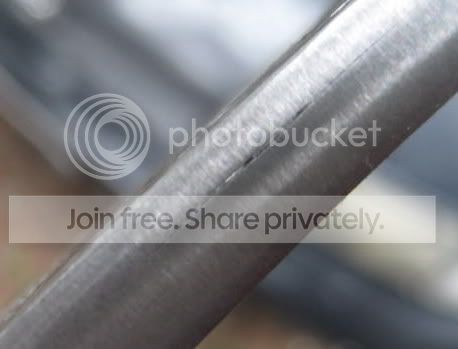
I did half yesterday. Just to take a look, I ground the sides flat and started forging it tonight and in the first round of forging, I noticed a couple definite "shelves" as if the layers slipped. I'm guessing my initial weld didn't work but wondered if you think that's it's salvageable.

I re-fluxed (with Z-weld) and cranked up the heat to try to set it all again and hope that it takes or is it likely too late.

I thought I did everything right with heat and time and flux but wonder if I should have smacked it harder. I read that you don't need crazy force but not having done this before.... well....

I am tempted to not bother re-stacking and making a blade just to see..

Any ideas?

Thanks.
 
Clean it up good and grind down the sides.Take a wire brush or better yet a whirlybird and hit those bad spots hard. Try to get them as clean as possible. Flux the piss out of the bad spots and let it soak real good. Make sure it comes to heat all the way thru. You can probably fix those flaws...Since these flaws are in the billet start your blows little harder than you would normally start. You have to seat them together. Dont hit it like your killing a hog, but firm.
You can set a weld with a handle and no hammer. Dosnt take much at all to set it..Bad welds are most often caused by too low a temp. Hitting it to hard can sure do it too..From now on start with light blows. Like your driving a finishing nail. Tap,tap,tap...Brush, flux back in the forge..Next time a bit harder..etc..etc..
...................................................
Temp is everything with welding, get the temp right and you can fix a broken heart or a hole in the sky..;)
 
Last edited:
Stuart don't give up yet buddy, Kentucky has offered some great tips.

Just like Kentucky said most problems are not hot enough or hitting to hard. Don't be afraid to let it cook a little, when I teach people to forge weld they always want to pull it to early. I always tell them when they think it is ready walk away for about 10 minutes then it is ready. The billet should be the same color as the interior of forge and no shadows when you roll the billet over in the forge.

Also work your billet from the middle out so you don't weld the edges first and trap flux in the billet. Post some pictures we can give you better advise if we can see what you have going on.
 
Thanks guys. I did basically what Kentucky said. I started with firm "taps" and then fluxed and reheat, a little harder still, then a third time I gave it some good solid hits with my 12lb'er one handed.

I let it cool this evening and ground the edges again and I have one spot that I now know is a problem. I can catch my fingernail in it. It's about 1" long about the middle of billet. I'm going to think about cutting and restacking and hope that one spot cures itself in the process. If not I'm sure the HT will give me a nice surprise.

I will try to be more patient with the soaks. The forge was so hot and bright that I could only look at it with sunglasses. The billet did look the same colour as the sides... hmmm... I think it's like you said Mike, if I think it's ready, I should just walk away for 10 minutes.

I lightly etched the edges to see the layers (I couldn't help myself) so I hope if any got in the fissure that it won't cause problems.

Thanks guys. Wish I could start over...
 
Nope won't hurt it Stuart, you could even soak it in vinegar to help break up the scale.

Pictures where are the pictures :p? Stuart let that baby cook, also make sure the flux does not cook off either and when you think it is ready go get some coffee or something. If you still have trouble come on down I would be happy to help you out.
 
A couple more tips.
Get rid of the 12 pound sledge. A 3-4 pound forging hammer with a slightly rounded face is the most you need for welding.

Get a pair of welding glasses from Aura lens or the welders supply, or you will be blind before long. The UV and IR will destroy your retina. AUR99 is the one most smiths use. You can get them in your perscription and in just about any style you want:
http://www.auralens.net/m2_metalshop.cfm

(This just reminded me to order a new pair of Aur99 clip ons)
 
Good Gods man I would never use a 12 pounder for welding!
I do all my damascus by hand. The revelation that made it so that every billet worked was at Ashokan when either Delbert Ealy or Kevin Cashen said that you start your welds with a gentle tap, just enough to bring the layers into contact with each other.
I tried that that evening, a gentle tap in the center just to bring the layers together, another one to make sure that they are in contact, re-flux and back into the fire. It worked splendidly! I taught a new student to weld the following week and his welds all took.
Here's how I do it to make sure it works every time
First, never too many layers to start. Typically I'll start with 5-7 layers. I clean the layers, make the stack, put boric acid powder on the edges, put in the fire, heat for a few minutes, add more boric acid powder, heat again, more boric acid powder (now it is starting to glow and the boric acid starts to sizzle and wet) when it starts to get into the orange range I start introducing 20 mule team borax (I flux over a bucket to catch the excess and spalloff) and will flux once or twice to make sure the flux has flowed into the layers. When the flux is running and blistering (bright yellow-orange color, you will see the flux grow "pimples" )I let the billet soak in the heat and rotate it to make sure it is evenly heated, make sure I can grab my hammer in striking position, pull it out, lay it FLAT on the anvil, tap it STRAIGHT into the anvil (twisting, hitting off axis etc. will set up shearing forces that will ruin your weld) tap it again, and put it back in the fire. Bring it up to welding heat and hold it there to allow the crystal structure to knit for a minute or 3, then take it out and place it flat on the anvil, and gently strike it starting from the center of the weld and spiraling out to the edges. It will take 3-5 heats to completely bring the welds out to the edges. Once you have brought the welds to the entire billet REHEAT AND SOAK then start forging harder. Never forge (changing the shape) while welding. Always do your welding THEN your forging.

-Page
 
Wow... Now I really wish I could start over.

I'll try to take some pics of the "mistake" but it won't look like much.

Great info! Thanks!
 
Wow... Now I really wish I could start over.

I'll try to take some pics of the "mistake" but it won't look like much.


Great info! Thanks!

Just forge what you have into a blade, keep your forging temps hot, don't get heartbroken if there are issues, if it turns out well great, if it doesn't it was a learning experience (trust me I have had lots of learning experiences, some of which people have seen , most of them went "under the bench" never to be seen again

-Page
 
A couple more tips.
Get rid of the 12 pound sledge. A 3-4 pound forging hammer with a slightly rounded face is the most you need for welding.

Get a pair of welding glasses from Aura lens or the welders supply, or you will be blind before long. The UV and IR will destroy your retina. AUR99 is the one most smiths use. You can get them in your perscription and in just about any style you want:
http://www.auralens.net/m2_metalshop.cfm

Very good advice here.
In addition, while keeping the temps up for welding, it is important that the piece is heated EVENLY. A lot of guys seem to think "blast-furnace" rather than forge. The flux burns off and they get a billet that's too hot on the outside and not quite hot enough on the inside of the billet, then whack away with far too much force and wonder why it didn't work.
Important points include having clean joints, high and steady heat (preferably with a gentle atmosphere that won't scorch your flux off and contaminate your joints), a well-soaked billet, firm and steady hammer blows.
 
I have never forged damascus by hand but a bunch under a press and hammer. One thing that I have noticed is that the longer soak times and the more physical manipulation of the material at welding temps, the less chance of bad welds. When bad welds appear they are usually on the last weld that was done. that weld often had much less soak time and manipulation (for example the welds in the ferry flip) than previous welds. If I were you I would not worry about the issue you have because if you do several more restacks and forging out at welding temps, I would expect the issue to resolve itself. If this was your final weld, I would soak in vinegar overnight, reweld and hope for the best.
 
make the stack, put boric acid powder on the edges,.... add more boric acid powder,....... the orange range I start introducing 20 mule team borax (I flux over a bucket to catch the excess and spalloff)
-Page

I'm light years away from trying this at home. I am wondering though, most posts I've read about making damascus, people talk about using anhydrous borax(20 mule team borax?). What's the difference between using that and boric acid? Do they function differently?

This is more along the lines of what I originally wanted to ask. Kids, grand daughter and sick wife have my head spinning today.
 
Last edited:
I'm light years away from trying this at home. I am wondering though, most posts I've read about making damascus, people talk about using anhydrous borax(20 mule team borax?). What's the difference between using that and boric acid? Do they function differently?

This is more along the lines of what I originally wanted to ask. Kids, grand daughter and sick wife have my head spinning today.

Boric acid has a lower melting point and a lower activity threshold than borax, it aggressively dissolves scale and in the jewelry business it is used (dissolved in alcohol) as an antioxidation coating before soldering, however it becomes inneffective below welding temperatures. Anhydrous borax is basically borax that has had the water baked out of it. 20 Mule Team is not anhydrous. 20 Mule team foams up then melts, then wicks into joints and between layers, I have never bothered to get anhydrous borax or prebake the 20 mule team, Borax is hydroscopic, so if you leave anhydrous borax unsealed, eventually you will have hydrated borax. The borax in the bucket that I use as a catchbucket has boric acid mixed in with it, once I have done the initial fluxing heats, I often use the mix in the bucket for fluxing, I lose a bit of heat boiling the water out of the borax when I sprinkle it on, but my forge is powerful enough that the little bit I lose is trivial

-page
 
There are many flux's out there that work. Borax and Boric Acid are two of the most popular. There are some who do not like one or the other. I have had the experience of problems with Boric Acid. It caused some serious porosity int he billet so I stopped using it. I used to use 20 mule team and it worked fine until I went and took a class from Wayne Goddard. He uses anhydrous borax and using it at his place sold me. I flows easier, lasts longer and works better for me when wet welding. Here is the write-up from US Borax regarding Dehybor (anhydrous borax) "Dehybor® is a product resulting from the dehydration and fusion of borax. It is a hard, glassy material, granular in texture. Dehybor does not rehydrate under ordinary storage conditions, and can be handled in bulk." It is shipped in perforated bags, if it re-hydrated there would be some serious problems.

Stuart, First take Nick up on his offer. It is a great experience to see it done first hand. Also scale things down a bit. 7 layers is plenty for hand hammering. And absolutely use a smaller hammer. Setting the damascus does not need a heavy blow. If you want to use the heavy hammer for the drawing process then go for it but you will need an anvil that will handle that size hammer. Good luck and keep on forging.
 
I am definitely going to head down to Nick's in the not too distant future. Can't wait. :)

But before that, in May, I'm planning to visit Dave Lisch for some sheathmaking and damascus making. :)

I tried to fix it up tonight. Not sure if it worked because it's gotten too thin, around 1/4" to see. Interesting symptom though, as I brought it up to heat and fluxed, I noticed air bubbles where the fissures were.

I ground the billet and cut it in 3 to restack. As I was grinding it flat and ground a little through a layer I could see quite clearly, maybe too clearly, the line between the types of steel.

Well, I'll fire it up after work tomorrow and try Page's method, sans boric acid though as I don't have any.

Great information! THanks!
 
Stuart, it doesn't hurt to open up those bad spots with a chisel, clean 'em out and reweld. If they are gonna open, might as well open them widw and try to salvage what you have.
I keep a dental pic handy to scrape out scale in places like that.
 
Sorry for the delay in photos but here's a couple.

First is the fissure. I kept working on it until the billet was about 3/16" - 1/4" thick by about 8" long by about 1 1/8" wide. Never really seemed to fully resolve itself.

damascus1.jpg


I decided that at those dimensions and with all the hammer marks and such that I would restack and try welding again and if it cured the fissure, great!

So I did as Page's post recommended; single tap, re flux and back into the forge. I did about 5 heats, increasing the number of blows but not really hitting any harder.

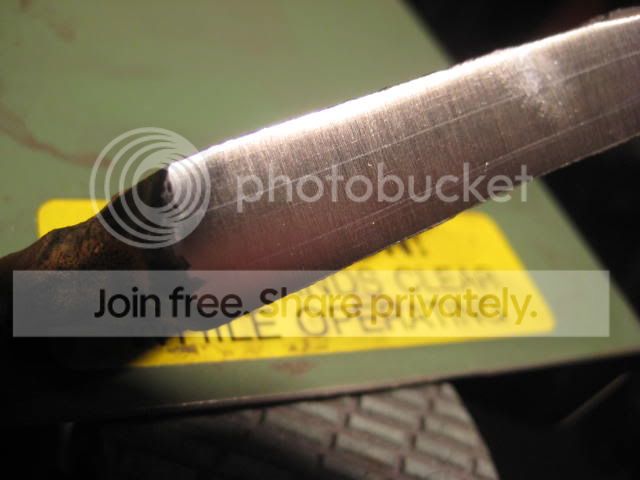
I let it cool and ground the edges clean to see what happened. It looks nice except I can clearly see the 3 layers I cut the billet into.
Now, I don't have a surface grinder but I cleaned up the pieces really well. I could still see light between them when I stacked them and tack welded them together. I fluxed like mad to prevent anything getting on my nice clean surfaces.

damascus3.jpg


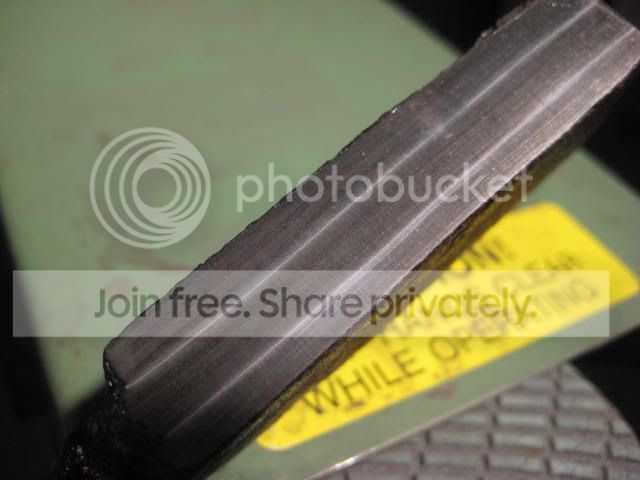
But after a quick etch you can really see where the layers are. I'm hoping further forging will get rid of that. I have the piece soaking in vinegar just in case and will forge this into a blade tomorrow night. It's supposed be 36 layers now but i must have ground off or burned off some. There certainly doesn't look like 36 there.

damascus2.jpg


What's going on here?

Actually I can't believe how much material I've lost. This started as a 12 piece stack that as I said roughly measured 1"w x 1 1/2" h x 3" L.
It's now about 1 1/8"w x 5/8"h x 2 5/8"L. :eek:
I guess a smallish hunter... :redface:
 
Last edited:
Back
Top