
-
The BladeForums.com 2024 Traditional Knife is available! Price is $250 ea (shipped within CONUS).
Order here: https://www.bladeforums.com/help/2024-traditional/
You are using an out of date browser. It may not display this or other websites correctly.
You should upgrade or use an alternative browser.
You should upgrade or use an alternative browser.
damascus, is it all for looks?
- Thread starter sogflash
- Start date

- Joined
- Jul 3, 2009
- Messages
- 1,213
Yup, its the same steel they will all perform fantastically. Just, the Damascus does it with more style.So you guys are saying that Shun's knives that are 'damascus' style with a VG10 cutting edge or William Henry's Damascus with ZDP-189 cutting edge, offer not additional performance over a knife made completely of VG10 or ZDP-189?

- Joined
- May 3, 2006
- Messages
- 2,401
So you guys are saying that Shun's knives that are 'damascus' style with a VG10 cutting edge or William Henry's Damascus with ZDP-189 cutting edge, offer not additional performance over a knife made completely of VG10 or ZDP-189?
"performance" as in "cutting performance"? Then yes, that's exactly that...no additional cutting performance. They add some corrosion resistance performance, though, on a large portion of the blade. And they offer a different look - some like, some don't.

- Joined
- May 28, 2012
- Messages
- 3,189
I have a couple of hunting knives that are damascus and they are very well built pieces of cutlery that hold a fine edge. I thought they felt good in my hand which was why I bought them. The pattern on the blade was just the results of the knifemakers talent in making a fine and usefull tool. One is a skinner, the other your basic hunting knife. They didn't cost any more than a good convential knife would have. I'm old fashion and enjoy the walnut and steel combination instead of the stainless black handle which so many have today.


- Joined
- Mar 8, 2008
- Messages
- 26,274
Yup, its the same steel they will all perform fantastically. Just, the Damascus does it with more style.
"performance" as in "cutting performance"? Then yes, that's exactly that...no additional cutting performance. They add some corrosion resistance performance, though, on a large portion of the blade. And they offer a different look - some like, some don't.
Exactly. Corrosion resistance is added, and perhaps some additional lateral toughness, but that could be done by simply cladding the blade with plain ol' monosteel in the manner employed by Mora or Cold Steel's "San Mai" blades. And the advantage is still relatively minor. No need for the fancy patterning.

- Joined
- Jul 3, 2009
- Messages
- 1,213
Gatorflash, I really like the second knife, thats very nice and a nice sheath to.
Last edited:

- Joined
- Jun 23, 2012
- Messages
- 2,398
QUOTE=muradtexas;11116841]Put it this way: Some time in the future, your great-great-grandson will show your S30V knife, and his friend with a light saber will call CPM whack.[/QUOTE]
I almost spit out my water. That was damn funny.
I almost spit out my water. That was damn funny.

- Joined
- Jan 31, 2012
- Messages
- 4,704
"performance" as in "cutting performance"? Then yes, that's exactly that...no additional cutting performance. They add some corrosion resistance performance, though, on a large portion of the blade. And they offer a different look - some like, some don't.
I didn't mean cutting performance, just overall. I was talking about toughness like someone else mentioned.
- Joined
- Mar 8, 2008
- Messages
- 26,274
I didn't mean cutting performance, just overall. I was talking about toughness like someone else mentioned.
It's worth noting, however, that lamination like that really doesn't provide much benefit for kitchen knives. The ones nice enough to have laminated blades are generally not so abused as to gain any advantage from the added toughness. They could be done in monosteel and do just fine. The thing that tends to take the most damage with kitchen knives is the edge--and the very tip in households with folks that use them for prying--neither of which gain advantage from laminating because the exposed core metal is presenting itself unsupported in those regions. The toughness added by laminating would mitigate strain from flexing the blade laterally, which is not a common occurrence for most kitchen knives--at least not to the extent to which they would require additional support, even with a pretty hard blade.
Personally I don't even really want super hard or wear resistant steel in my kitchen knives. I'd rather be able to slap a screaming edge back on them with a few quick licks of a fine diamond stone. Whenever I dull the edge it's usually by accident and on something that would have dulled ANY knife.
Damascus, by usually being a combination of a hard and a soft steel, is usually a little tougher (the blade itself, not the edge) than a hard mono-steel. The softer steel along the edge will also wear away a little bit more quickly, leaving a slightly serrated edge after a bit of use (or so I heard), this can be seen as both a good and a bad thing, depending on your uses for the knife. But as most of the people here have mentioned the techniques behind damascus were developed to make up for shortcomings in the older steels, and modern supersteels will almost always outperform modern damascus.
Regarding your question about damascus cladded knives, they will actually perform just slightly worse than their mono-steel counterparts, though it should hardly be noticeable. This is as the rougher surface of a damascus blade will provide a teeny tiny bit more resistance when cutting.
Regarding your question about damascus cladded knives, they will actually perform just slightly worse than their mono-steel counterparts, though it should hardly be noticeable. This is as the rougher surface of a damascus blade will provide a teeny tiny bit more resistance when cutting.
Two concepts are being addressed now... pattern welded damascus, and laminated blades.
As others have stated pattern welded damascus is done for the appearance and it doesn't really add to performance in modern blades.
Laminated blades (a layer of one material, clad on each side by another material) can affect performance by a fair bit. For example you could have a high carbon steel at high rc as the center portion with a lower carbon/lower rc steel clad on the outside. If done right it will help quite a bit in lateral stress and shock. Although the edge/tip would still chip as if it were a monosteel. You could also sandwich a high rc steel between layers of low rc damascus, but as Fortytwoblades pointed out, it wouldn't have any benefit over sandwiching it between regular monosteel other than the appearance.
Personally I like damascus for the variety. Theres nothing wrong with a good mirror polished blade but after looking at thousands upon thousands of them its nice to have some damascus to look at as well. (then you can stare at thousands of them until etched/patina'ed, titanium, engraved, etc knives all appeal for the variety)
As others have stated pattern welded damascus is done for the appearance and it doesn't really add to performance in modern blades.
Laminated blades (a layer of one material, clad on each side by another material) can affect performance by a fair bit. For example you could have a high carbon steel at high rc as the center portion with a lower carbon/lower rc steel clad on the outside. If done right it will help quite a bit in lateral stress and shock. Although the edge/tip would still chip as if it were a monosteel. You could also sandwich a high rc steel between layers of low rc damascus, but as Fortytwoblades pointed out, it wouldn't have any benefit over sandwiching it between regular monosteel other than the appearance.
Personally I like damascus for the variety. Theres nothing wrong with a good mirror polished blade but after looking at thousands upon thousands of them its nice to have some damascus to look at as well. (then you can stare at thousands of them until etched/patina'ed, titanium, engraved, etc knives all appeal for the variety)

shunsui
Gold Member
- Joined
- Aug 12, 2008
- Messages
- 5,877
FWIW I had the opportunity to see several japanese swords at the De Young Museum in San Francisco when they had a show come through. This was way back when. The swords didn't have hilts on them, just the blades and tangs. I got up close and looked at them without my glasses (I'm nearsighted) and the steel had these little ittty bitty lines, super close together, and there were LOTS of them. Very cool stuff.
- Joined
- Mar 8, 2008
- Messages
- 26,274
FWIW I had the opportunity to see several japanese swords at the De Young Museum in San Francisco when they had a show come through. This was way back when. The swords didn't have hilts on them, just the blades and tangs. I got up close and looked at them without my glasses (I'm nearsighted) and the steel had these little ittty bitty lines, super close together, and there were LOTS of them. Very cool stuff.
Yup! And the reason for the patterning being that fine is because they were trying to homogenize the steel rather than doing it for looks like is common today. I appreciate pattern welded steel, but if it were ever on a personal knife of mine it would have to be that subtle. Modern pattern welding usually is too "loud" for my tastes. Heck--I really prefer the look of monosteel even. If I want patterning on my blade it's a natural patina on carbon steel.
 But to each their own and if it keeps the art alive I'm happy. Like I said, I think it's neat--just not to my tastes.
- Joined
- Jul 26, 2012
- Messages
- 1
Historically damascus was done in an attempt to improve the qualities of the rather poor steels available at the time (think middle ages). These days it's for looks... In theory I think it would be possible to make damascus out of any steel including the ones you mentioned, but it could be really hard to do and I've never heard of damascus out of S30V
Excellent answer. Just look at damascus steel firearm barrels, there are lots of precautions.
- Joined
- Mar 8, 2008
- Messages
- 26,274
Excellent answer. Just look at damascus steel firearm barrels, there are lots of precautions.
"Damascus steel" firearms are really just spiral forge-welded rather than repeatedly folded. This was done because at the time it was one of the easiest methods for making a gun barrel (though no easy feat!) and the reason for the precautions is that if the weld were not done properly over the entire length of the weld you could risk busting the weld and the barrel flying apart on you.

- Joined
- Jan 9, 2011
- Messages
- 16,421
I didn't really care for Damascus until I used some, now I am a big fan. It looks so cool in person, why not cut with style!
Performance wise it can be like any other steel, this particular mix is mostly 52100 and 5160 so the performance is excellent in my opinion.
Damascus can be different than the steels that make it, it isn't so simple. Carbon can migrate between the steels and change the performance, there are many variables. For example, a lot of Damascus is a 15n20 and 1095 blend, one steel is fast quenching and one is medium speed... yet the two combined still work. Soak times and quench temperature can also change things a lot, for example 1095 soaked for a short time and at a low temp converts less carbon over than at a higher temp... even the quenchant used plays a big role. There is a lot to it.
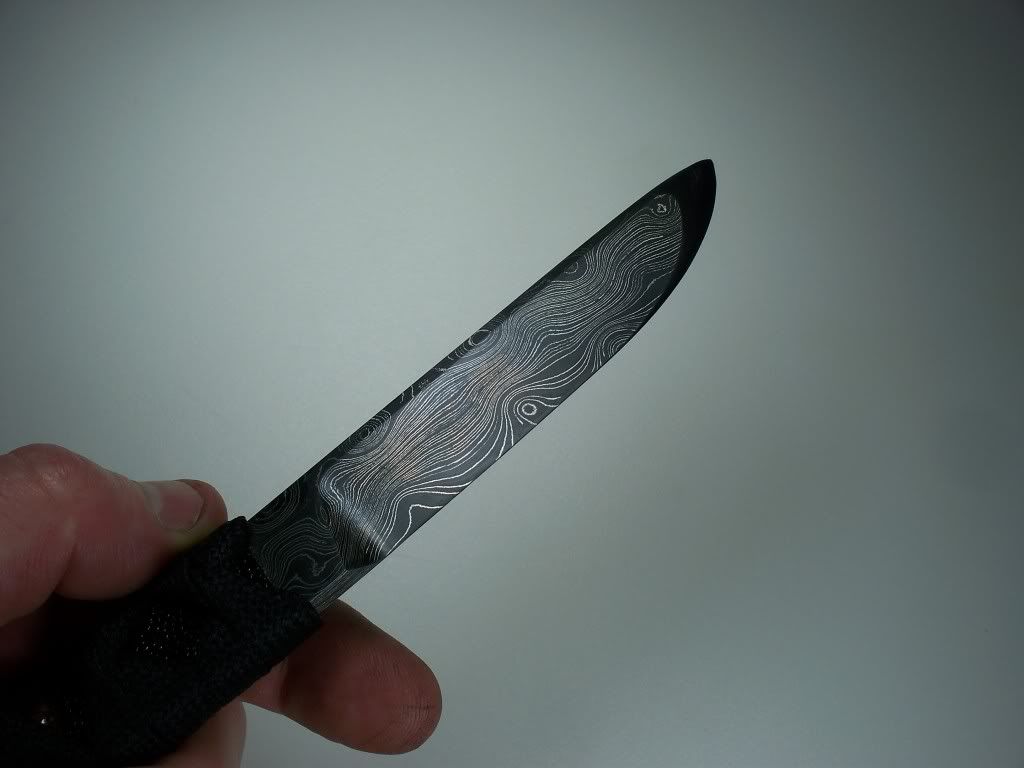

Performance wise it can be like any other steel, this particular mix is mostly 52100 and 5160 so the performance is excellent in my opinion.
Damascus can be different than the steels that make it, it isn't so simple. Carbon can migrate between the steels and change the performance, there are many variables. For example, a lot of Damascus is a 15n20 and 1095 blend, one steel is fast quenching and one is medium speed... yet the two combined still work. Soak times and quench temperature can also change things a lot, for example 1095 soaked for a short time and at a low temp converts less carbon over than at a higher temp... even the quenchant used plays a big role. There is a lot to it.
- Joined
- May 28, 2012
- Messages
- 3,189
Gatorflash, I really like the second knife, thats very nice and a nice sheath to.
Last edited by roughneckrob; Yesterday at 09:49 PM.
That is a "skinning" knife with about a 6" blade. The snake skin sheath was a plus. I appreciate the effort the knife maker put into these knives. I think he made this skinner out of motorcycle chain but am not positive about that. It is a very good well-balanced cutter. These hunting knives are way more than art.
Last edited by roughneckrob; Yesterday at 09:49 PM.
That is a "skinning" knife with about a 6" blade. The snake skin sheath was a plus. I appreciate the effort the knife maker put into these knives. I think he made this skinner out of motorcycle chain but am not positive about that. It is a very good well-balanced cutter. These hunting knives are way more than art.
- Joined
- May 28, 2012
- Messages
- 3,189
My Damascus choppers have that 'toothy' feel to them. They cut great and look superb in the process! Be sure to liberally coat the blade with a good oil though...rust follows like a demon in the wee hours of the morning.
I might suggest instead of using oil, try Breakfree CLP. It is a synthetic product that I have used for many years to keep my firearms, knives (regular and damascus), and tools from rusting. Unlike WD-40 type products it seems to stick well avoiding the need to continually apply it. It is not expensive and you can find it at most gun and sporting stores. Rem Oil is the same compound.
http://www.thegunzone.com/rust.html