Damascus, just for looks or?

Joined
Mar 21, 2006
Messages
552
What kind of steel is Damascus? Is it crap steel with nice patterns or is it a better steel than S30V, D2 or 154CM? Could I buy a Damascus folder to be a great user or is it just eye candy?

 
You know, before I had my Kershaw Zing in damascus, I wasn't sure just how well it would hold up. For my job, I cut open a lot of cardboard boxes and packages, and I have found it to hold an edge much better than I expected. I don't know just how well it compares to other steels, and I think it relies greatly on what the damascus is made from. I believe damascus is made mostly of carbon steels and nickel? Someone more knowledgeable may come along and correct me, but as far as I'm concerned, damascus can hold an edge quite well, kershaw's does anyway. Good luck with your research.

Kyle
 
Damascus steel is not one particular steel. As I understand it, damascus today refers to folded or laminated steel. The pattern comes from the different layers of steel, sometimes hundreds. You could certainly us a damascus folder for a user, assuming that: It is made of good steel and properly heat treated. Is there any particular folder you are looking at?

And as always: If I am mistaken someone please correct me.
 
Depends on the damascus. A cheap chinese damascus blade is not made of the same stuff as a 14th century Iranian saber. It's a very, very old technology, and there's a huge variety of different styles and qualities.

There are damascus blades that would make great users, just like there are regular or powder steel blades that would make great users. There are also damascus blades that would make god-awful users.
 
There are lots of different damascus steels. Some are high carbon, some are stainless, and some are hybrids. I have a Mcusta with a VG10 core and multiple layers of a stainless over it. The steel is going to cut like the VG10 core.
Some Damascus is going to be very high quality, but some of the cheaper stuff is not - it is not good stuff.
Damascus is now intended to be pretty. Originally, it was designed to increase the toughness of steel by bonding a mix of hard and soft steel. This was aimed at providing a steel with good edge retention with a tougher steel mixed in. Now, it is mainly used as a decorative option.
I am not sure what the Kershaw damascus is made from - I couldn't find it at the Kershaw website.
Frankly, I tend to reach for a box cutter when I need to open packages or boxes - it it involves cutting the cardboard.
 
You're pretty-much right except laminated steels are different from damascus. Laminated steels are typically composed of an inner core of hard but brittle steel sandwiched between milder steel. The center steel retains a sharp edge while the outer layers give it strength & flexibility.

Most modern Damascus is pattern-welded and is composed of many layers of at least 2 different types of steel. There are many suppliers of damascus and the quality will differ greatly.
 
...Damascus is now intended to be pretty,...Now, it is mainly used as a decorative option...

I don't entirely agree, I only have two Damascus blades and both are users, one is a Case mini Coke Bottle/Swell Center Jack in 512 layer Parker Edwards Damascus and a Maserin Spirit in SS Damascus, bothe are EDC'd on a regular basis and both knive were under $200 each.

BTW I don't know what the steel make up of either knife is but both take a scary sharp edge and hold it for a long time.

I bet if ya took a poll of how many people use damascus blades as EDCs you'd be surprised.
 
I recently read somewhere that modern "Damascus" was not really Damascus, but merely etched on patterns. From what I read, this is not true; that Kershaw (for instance) makes real Damascus blades.

According to this Wikipedia article...

The original method of producing Damascus steel is not known. Due to differences in raw materials and manufacturing techniques, modern attempts to duplicate the metal have failed. Today, the term is conventionally used to describe steel that mimics the appearance and performance of Damascus steel, usually that which is produced by the techniques of crucible forging or pattern welding.
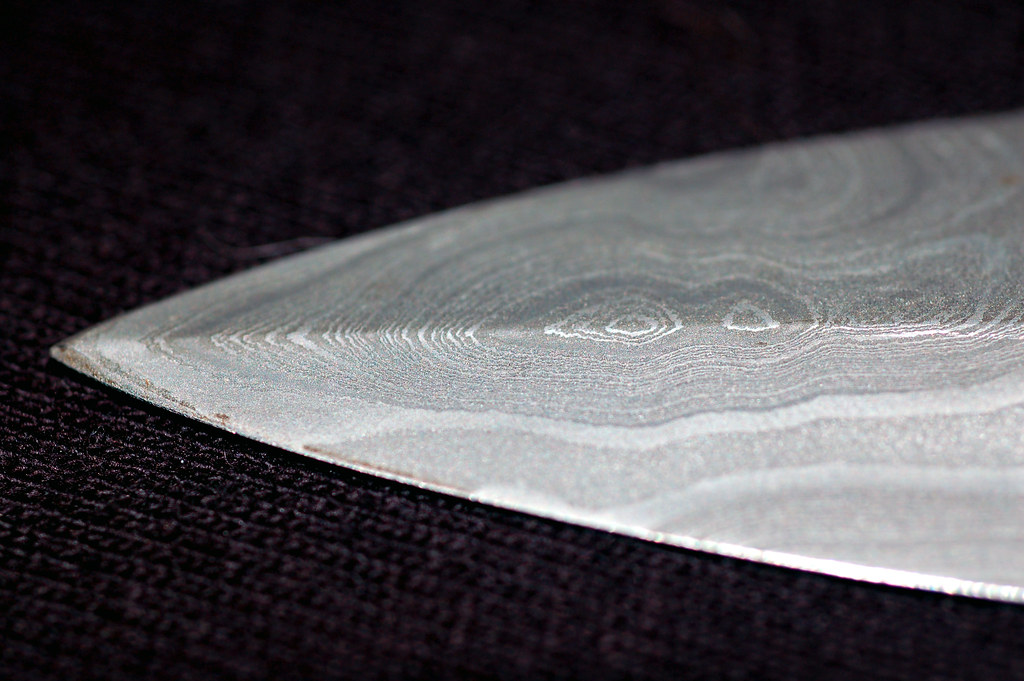
I am curious to know the differences in methods used to produce different Damascus steel. I have one Damascus blade. It is obviously different from that of a Kershaw blade. Does anyone know what the deal is with this?

3727700121_f0d32006ae_b.jpg
 
There are lots of different damascus steels. Some are high carbon, some are stainless, and some are hybrids. I have a Mcusta with a VG10 core and multiple layers of a stainless over it. The steel is going to cut like the VG10 core.
Some Damascus is going to be very high quality, but some of the cheaper stuff is not - it is not good stuff.
Damascus is now intended to be pretty. Originally, it was designed to increase the toughness of steel by bonding a mix of hard and soft steel. This was aimed at providing a steel with good edge retention with a tougher steel mixed in. Now, it is mainly used as a decorative option.
I am not sure what the Kershaw damascus is made from - I couldn't find it at the Kershaw website.
Frankly, I tend to reach for a box cutter when I need to open packages or boxes - it it involves cutting the cardboard.


As far as I know, it seems Alabama Damascus provides the damascus for kershaw, but I could be wrong.
 
That excerpt from the wikipedia article is incorrect. Watered steel/damascus/bulat/wootz is made by several people around the world today.

What we typically call damascus is pattern welded steel. Take multiple pieces of steel (and some other metals on occasion), in plate, wires, chain, powder, etc, and forge them together. Depending on how the billet is manipulated in forging, different patterns will form. These patterns are brought out through surface finishing and etching.

The whole process is for aesthetics, just as we like stag, burl wood, timascus, mokume, etc to embellish our knives. The steel should perform well, but pattern welding does not offer inherent advantages to unmixed modern steels.
 
Real Damascus is not made much anymore...if at all. What we now call Damascus is, as noted, layered and frequently etched with acid or other chems to accentuate the patterns. Some are made from ball bearings smashed together...I guess.

Original Damascus was made, I think, in India and the cultural areas adjoining it and it was a steel with a very prominent grain caused by the distribution of carbides. Wootz, which is made today is pretty similar.

If you can get your hands on a Roselli UHC you will see a type of Wootz steel. The grain is just crazy to see and the color of the steel, even on the ground bevel is a very dark gray.

At any rate, modern decorative Damascus is just that, decorative. I'll take a nice patina on a carbon blade or a good high end stainless...like CPM 3V or 30V or 90V or something like that any day. Or for that matter a nice blade in Sandvik 12c27 (if I have the nomenclature correct) or VG-10. All great steel that should probably out perform modern Damascus.

No, I don't care for the trend in Damascus and would pay for one, factory or custom.
 
depends on the damascus. i have one knife with it (kershaw shallot) and it is comprised of 52100 and 5160. in other words its good stuff :thumbup:

kershawshallotfront.jpg
 
William Henry offers laminated blades with a ZDP-189 core surrounded by stainless Damascus. You get the look of Damascus with the performance of a supersteel. I have stainless and Carbon Damascus blades and am underwhelmed by their edge holding abilities.
 
Depends on the damascus.

:thumbup: Yep.

A great many are done just to look nicer or "different" (or more expensive?), with no real interest in combining the steels for optimal performance. But there are exceptions. If you do some searching here you should find several threads where its discussed in depth.
 
I used to have some knife, can't remember which, that was supposed to be "real" damascus, and I called to ask what kind of steels were in it, and the guy said he didn't know except one of them was 1095. It held an edge pretty good, and sharpened easy
 
Before todays super steels, no, not just for looks. Today...just looks, especially the high contrast stuff that uses metal not usually seen in cutlery.
 
For even more fun, ask the mfg what the rockwell hardness is on their damascus blades. ;)
 
Back
Top