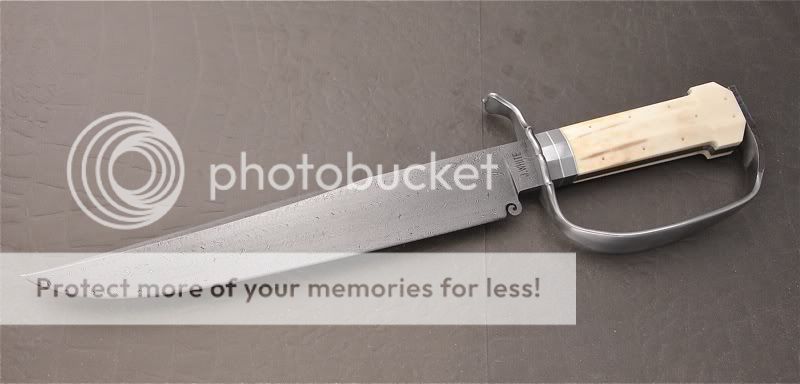
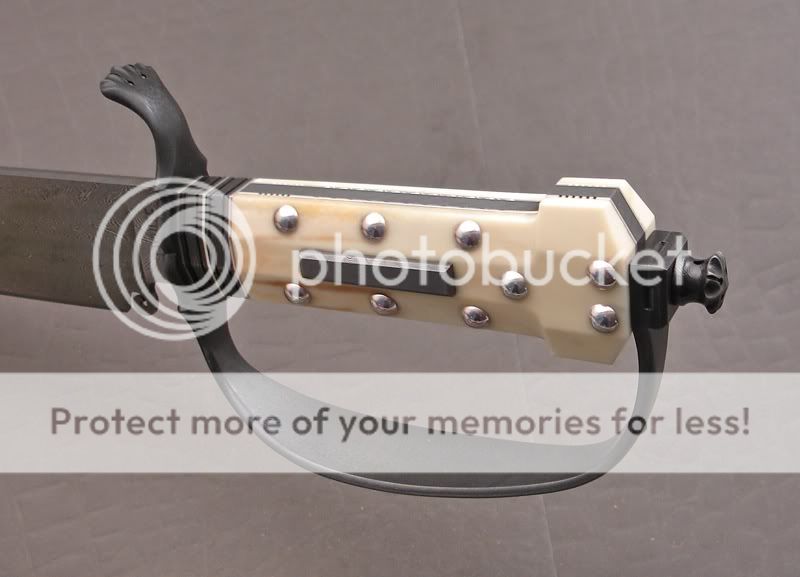
Damascus/ Walrus D-Guard Dogbone Bowie WIP- Buddy Thomason Photo-Paul Long Sheath

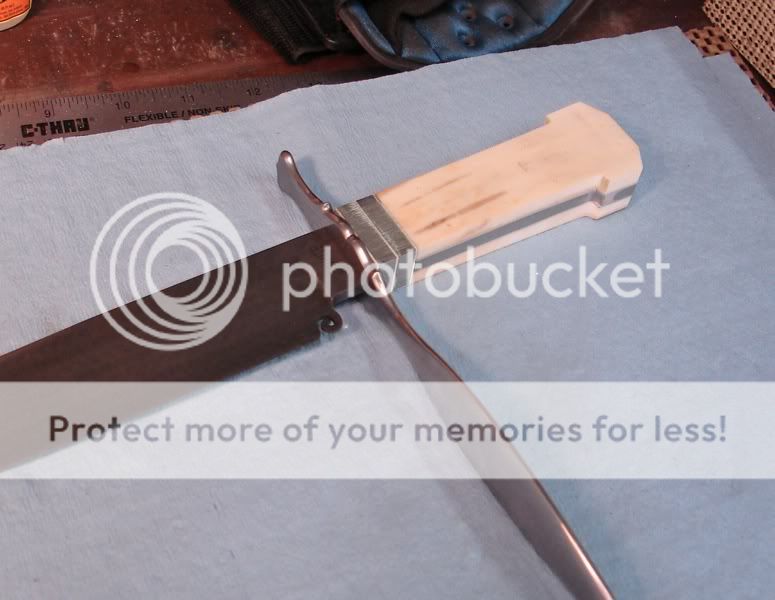
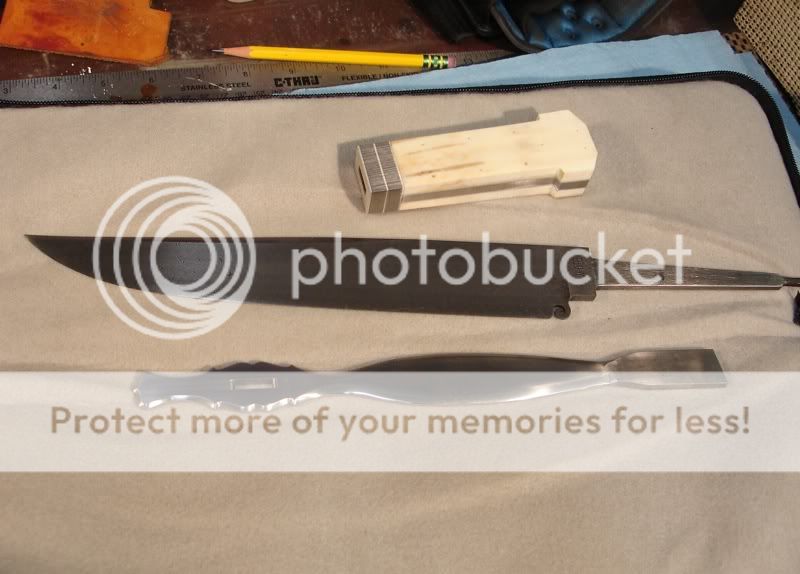
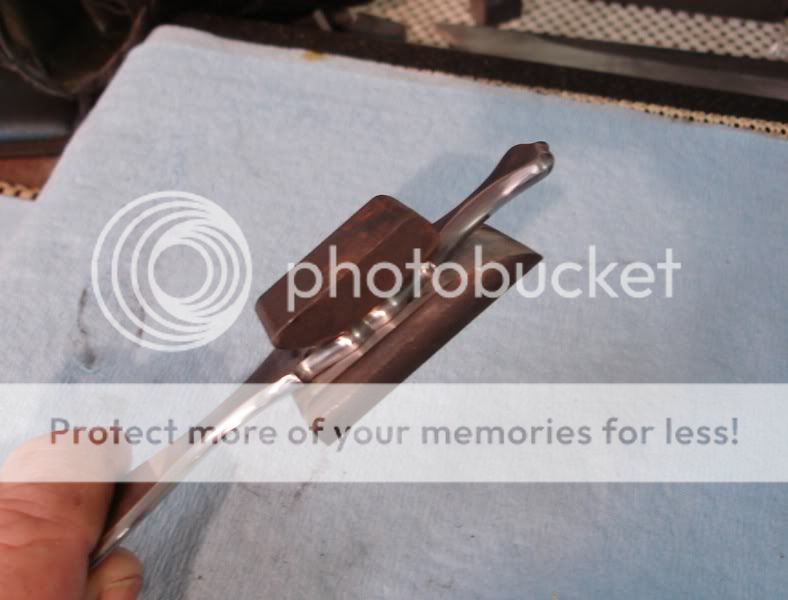
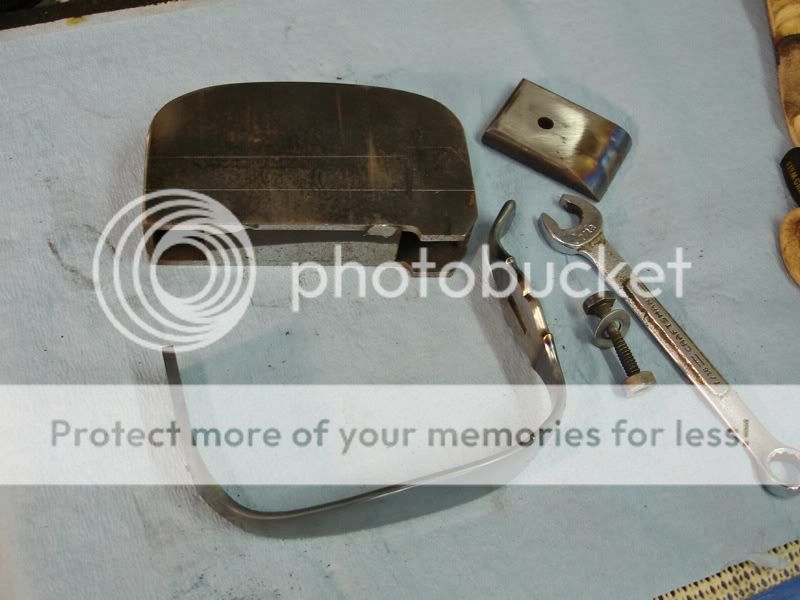
I'm always amazed at how absurdly long the guard looks before it is bent. I don't doubt it will fit perfectly, but it doesn't look it at that stage.

Roger
 
Roger,

The guard's actually about a half inch too long, and unfinished on the butt end. Better too long than...

Rolling the bow around the mandrel should give the exact length, but ..
 
Last edited:
Next comes the handle assembly.

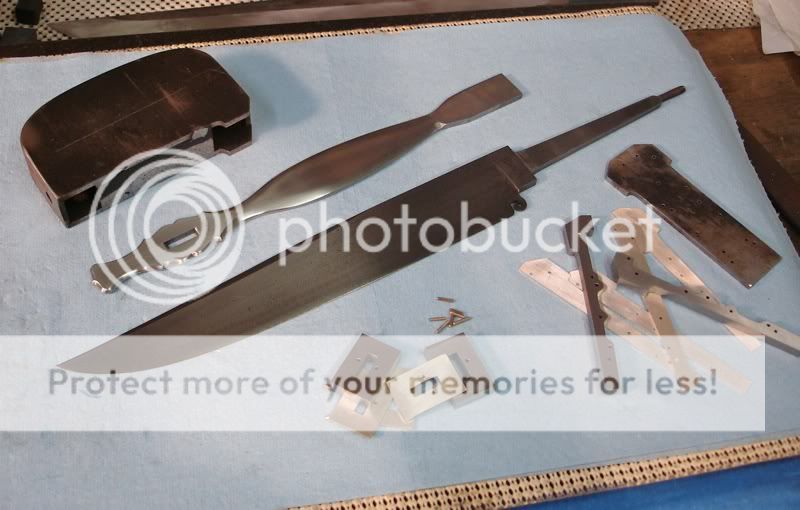
This starts with two twist damascus pieces forged roughly to shape, and a handle pattern made from the knife drawings, with silver pin holes and assembly pin holes carefully drilled.

One of the frame pieces here has already been ground to thickness.

5db7bba3.jpg


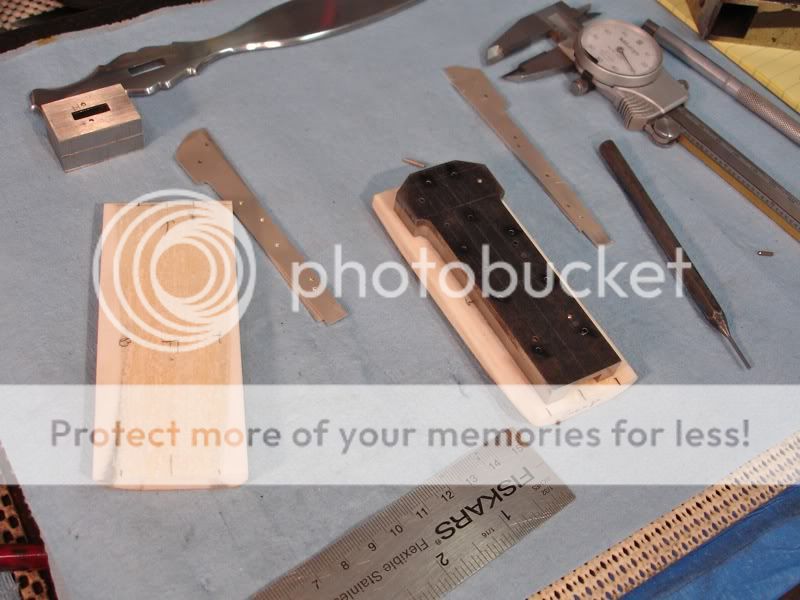
About three-quarters of a day of super-gluing frame pieces to the pattern, drilling, grinding to shape, "skeletonizing" to reduce weight, and repeating the process with four Sterling silver liner pieces produces a frame assembly to go with the collar assembly.

e766c523.jpg


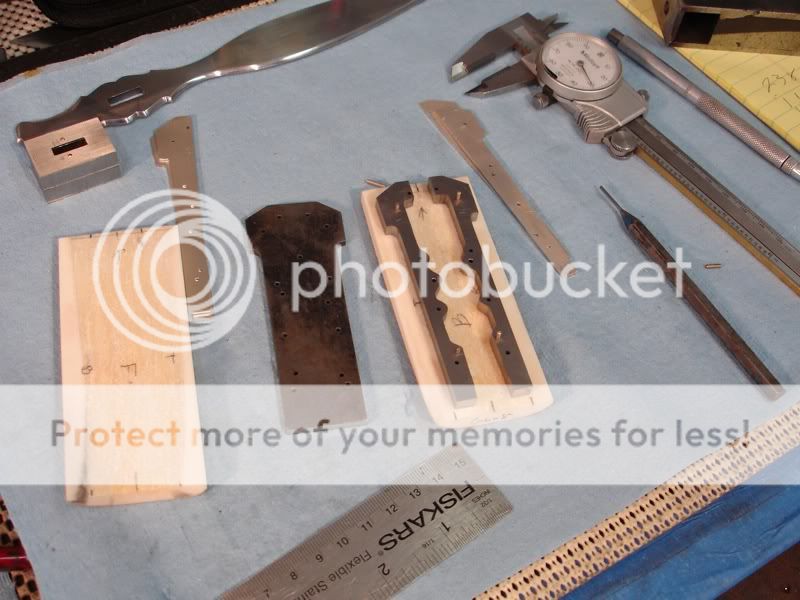
Assembling the drilled damascus frame pieces to the handle pattern allows super-gluing the frame pieces to one Walrus scale.

de48a052.jpg


With the pattern removed, the Walrus can be back-drilled through the frame pieces for the assembly pins.

Six of the holes in those frame pieces get drilled .090 into the Walrus with a #52 bit for the 1/16th assembly pins.

Eight of the holes get drilled through the Walrus later, with a #51 bit, for the slightly thicker Sterling silver pins.

Drill the wrong holes, and you get to eat $400 worth of walrus.

99bf7e97.jpg


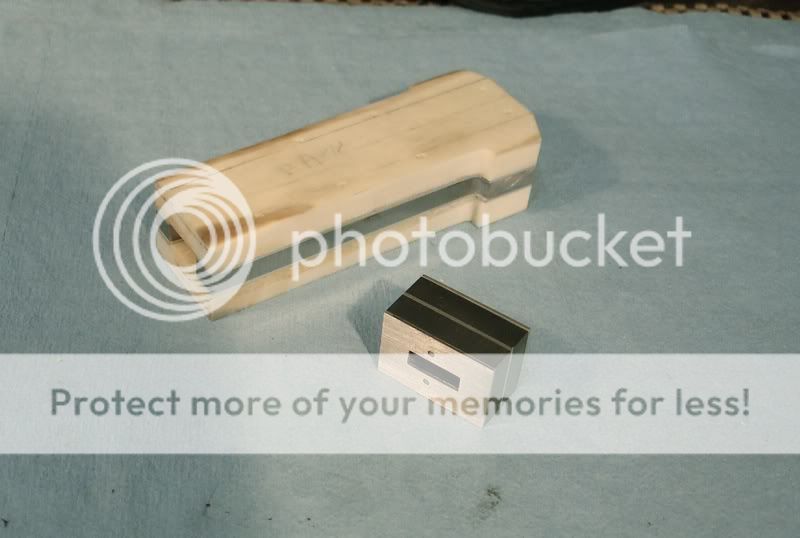
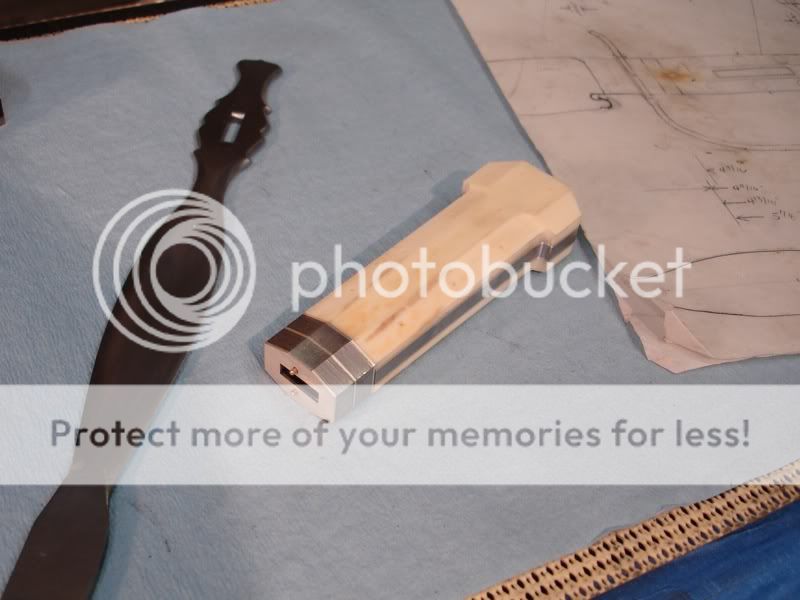
With assembly pin holes drilled in both scales, the handle can be put together, and rough ground to the frame profile.

a46edf9a.jpg


Then slid onto the tang, super-glued to the top silver spacer of the collar assembly, and back-drilled for pins to hold handle to collar.

eaad28e1.jpg


At this point, the through holes for the silver pins can be drilled, and the taper on the flats ground.

The collar assembly was sized to the drawing where the Walrus met the silver spacer. The taper is ground on the platen, from the butt down to the guard end, in stages, just kissing the line where spacer meets walrus. Easy.

5bd49c4a.jpg


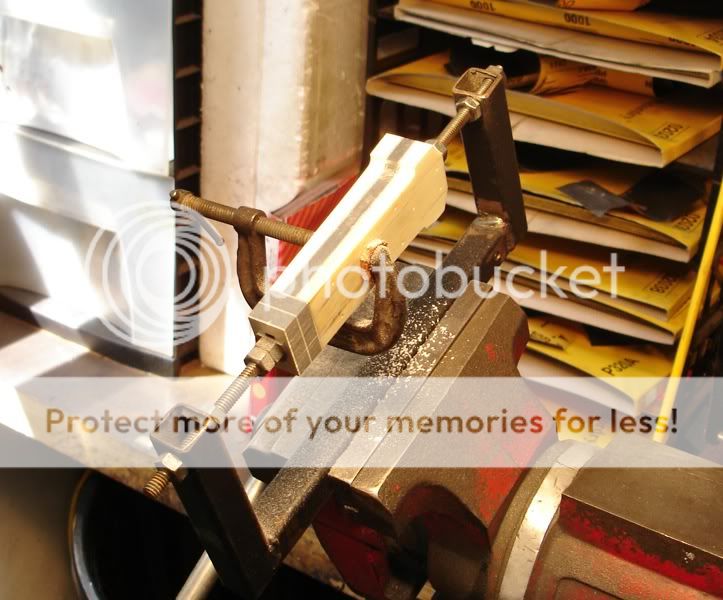
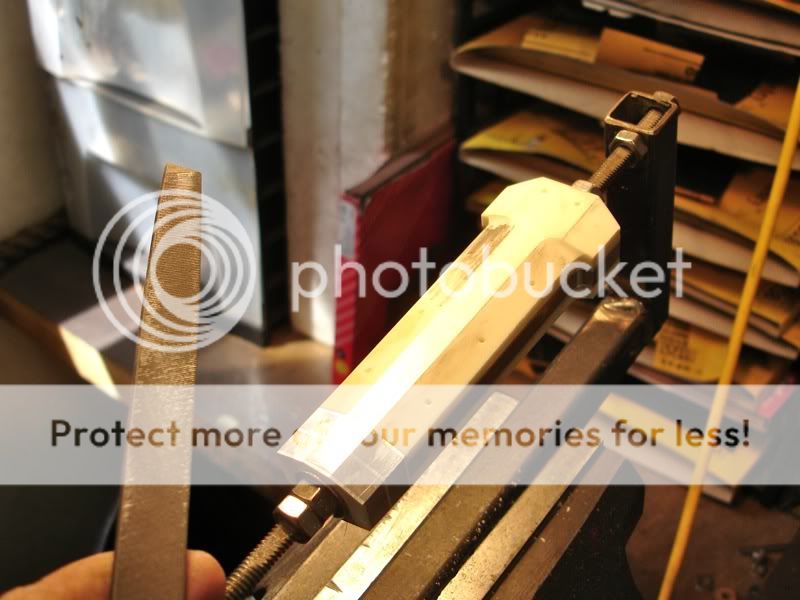
Before grinding in the Dogbone bevels, the double tapered handle is put on a rotating jig, and the flats sanded down to 1000 grit, while the flats are still big enough to keep everything level.

fc9aa477.jpg


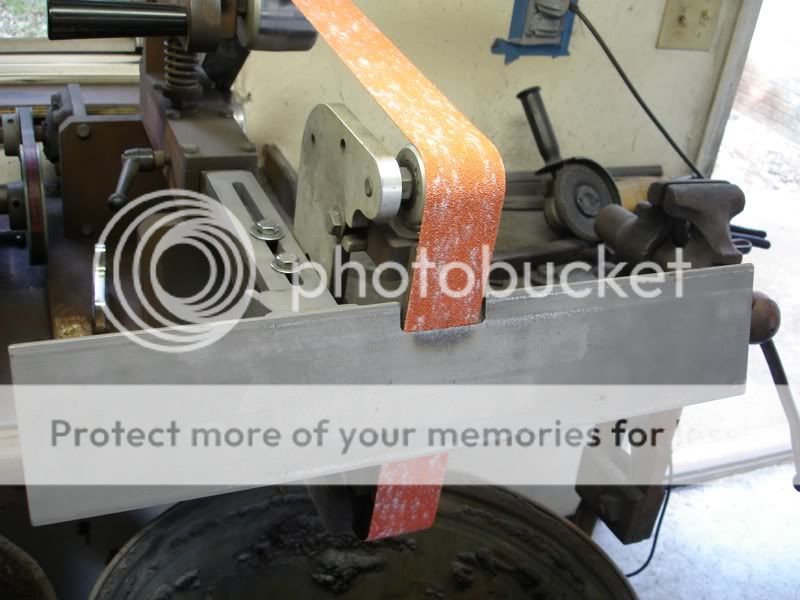
Now comes the fun part: grinding the bevels. This used to be really scary, til Steve Culver started producing this cool adjustable bevel fence. Yaah, Steve.

f48f6cba.jpg


With the fence set to a 24 degree bevel, taken from the knife drawings, the bevels are rough ground.

The collar assembly is ground separately, first,to avoid heating the ivory, then re-assembled and final ground with the walrus.

f5627475.jpg


The rough ground handle is then placed back on the rotating jig, and the bevels trued up with a mill file, using pencil rubbings as an aid, and then sanded to 6000 grit with sandpaper glued to brass strip.

8805ede1.jpg


Everything's crisp and shiny, and we're less than half through this sucker.

Don't you love your work, and isn't it fun?

7029eecc.jpg
 
A truly museum quality piece...
That's how I saw it too, Joe, and that was the idea behind that more formal and detail-filled composition of the image. In addition to all it's other virtues hailed above, I love the lines and the seamless integration of the D-guard and Dog-bone designs John has accomplished. The knife cuts a beautiful figure.

To fully appreciate the damascus you'd have to look at it in good light at different angles. I tried to show the pattern in all three views so it's possible for the viewer to complete the picture in their brain. It's a rewarding knife to look at closely. John's trademark fit and finish amazes most and surely makes a few others weep and give up.
This is a fantastic WIP thread with classy shop photos by John.
 
I can't thank you guys enough for sharing this with us mere mortals. This is priceless stuff for aspiring knifemakers like me. :thumbup:
 
Patrice Lemée;10826888 said:
I can't thank you guys enough for sharing this with us mere mortals. This is priceless stuff for aspiring knifemakers like me. :thumbup:

Agreed Patrice - and it's pretty valuable information for collectors as well. I'm constantly learning.

Everything's crisp and shiny, and we're less than half through this sucker.

Now THERE'S a sobering thought! Thanks to Jim for asking about the number of dogbones - I wad been wondering the same.

Roger
 
This is important to me as much as all of you guys. I handle scads of highly-finished pieces on a weekly basis. For me, they become a commodity to produce my work quickly and then move on.

There is NOTHING to suggest this allowance after watching this build. I'm also a pretty handy guy working with my hands, and machinery has been in my past. This is SO well done.

A good WIP helps us to appreciate how involved the process is, how individual it is; and it certainly justifies our purchases as collectors, and the prices required by the makers.

Props to all.

Coop
 
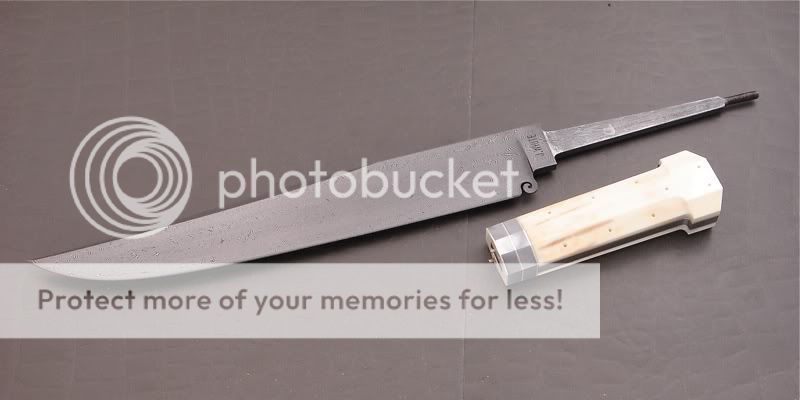
With the collar and handle assemblies complete, the length from ricasso to butt is set exactly, and the bow can be bent.

The bending jig is one of several I've made out of 1/8th mild steel plate, and sized to drawings of each D-guard knife. Once the bow is bent, it'll be re-annealed, and final adjustments can be made by hand, before the guard is hardened and spring tempered.

The bend is made using the jig and a couple polished steel pads.

d14241ac.jpg


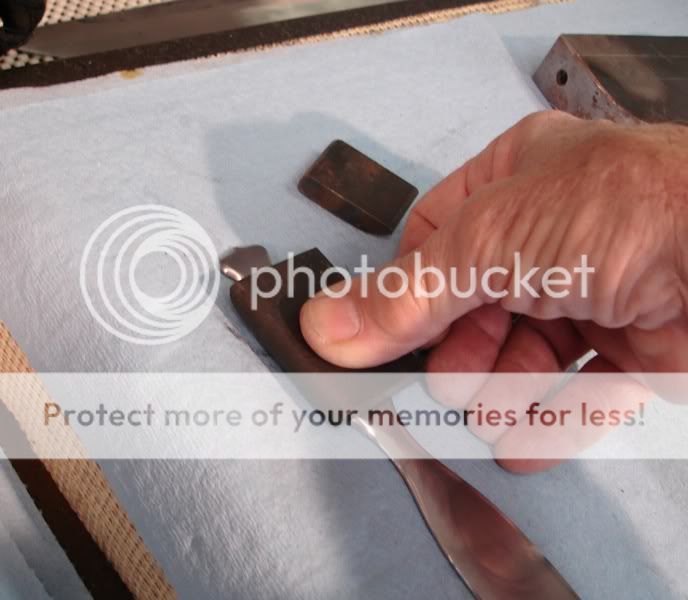
One of the pads, with a curved top, is super-glued to the front of the ricasso, being careful to align it so the thumb rest doesn't twist when bent.

665f5db6.jpg


A second pad is glued to the back of the ricasso. The polished surfaces of the pads prevent gouging the finish on the bow.

884e2116.jpg


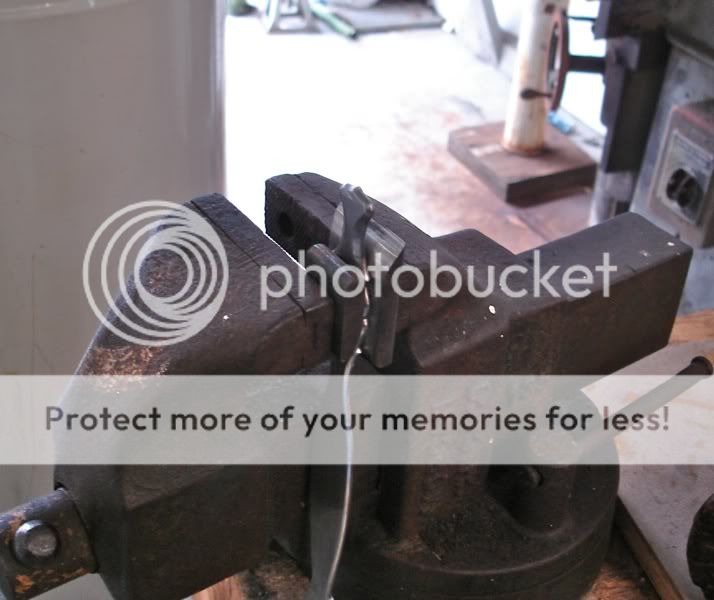
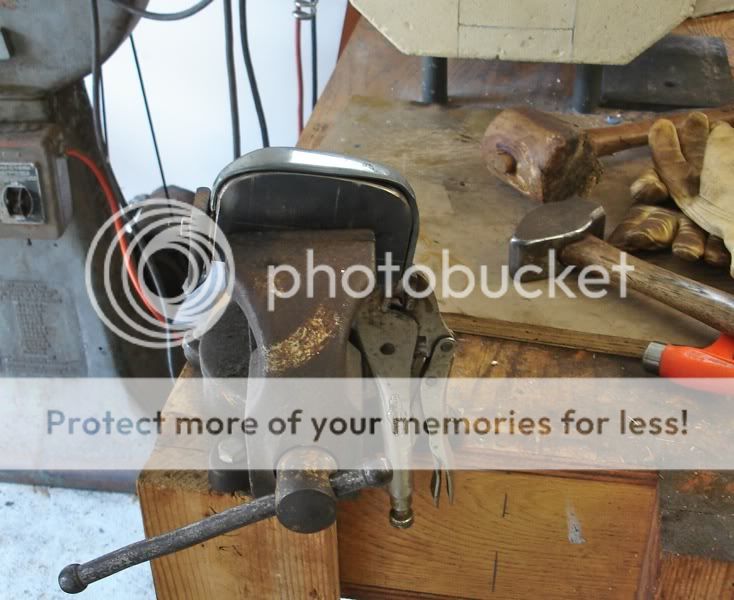
The pads are clamped in the vise with the thumb rest sticking up,

a8c3ee6d.jpg


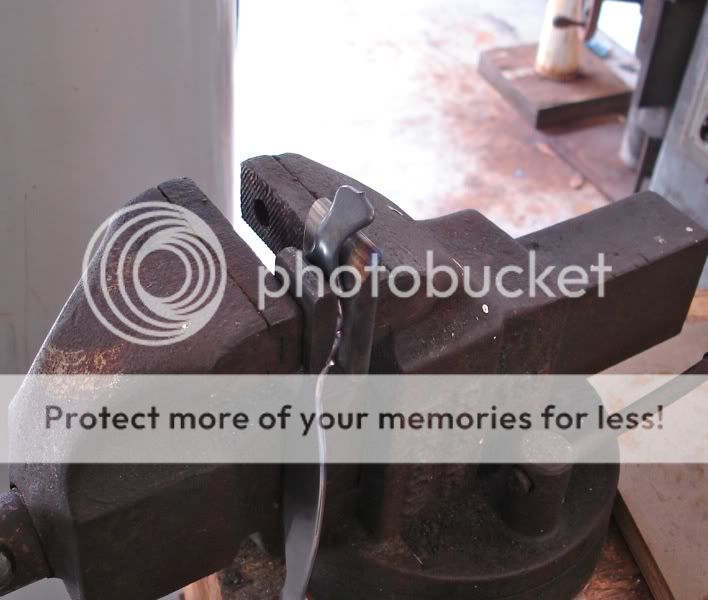
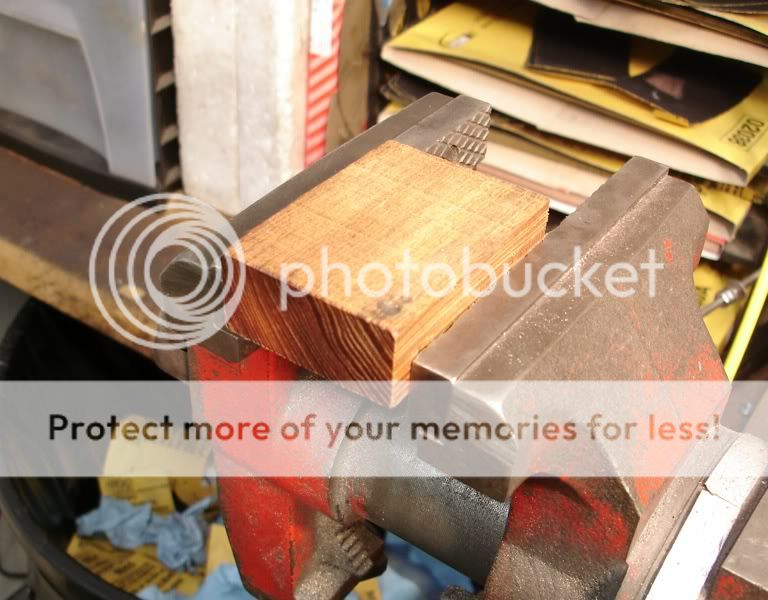
And the thumb rest heated with a torch, and the tip bent using a wooden mallet, again to reduce damage to the pre-sanded fitting.

6b5bda42.jpg


Next, the bow is bolted to the front of the bending jig, through the first pad, using a 1/4-20 bolt, with the sides ground to fit through the tang slot.

Very careful alignment is necessary, to spot the "Flat" behind the ricasso, and allow the bow to bend without twist.

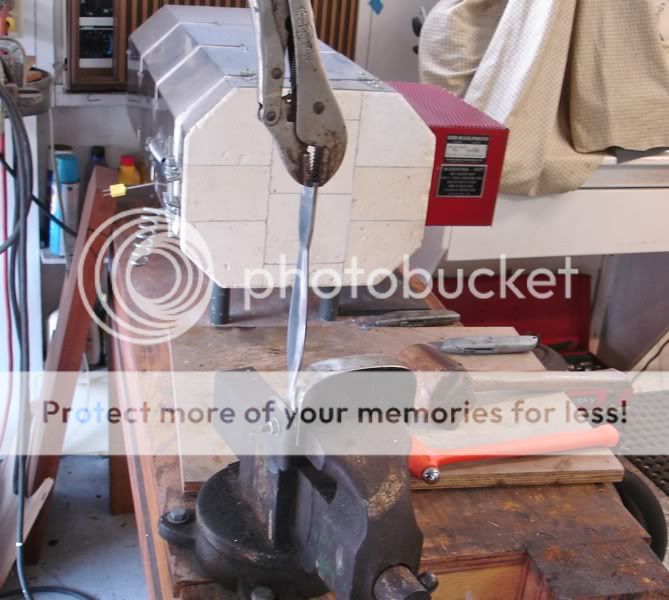
The jig is clamped in the vise, with a Vise-grip gripping that extra 1/2 inch of bow,

d6b6b381.jpg


And the bow heated and bent around the jig.

The trouble spots are at the"corners" where hammering with bronze and steel hammers is necessary. The start, center, and end will usually bend easily.

89d74b7c.jpg


The hammered areas will have to be re-filed and re-sanded, but some parts are still clean, or just fire-scaled.

Here you can see the whole bending set-up, and the newly bent bow.

f6c2f09a.jpg


Re-annealing the bent bow is necessary, so the final adjustments to the handle can be made, so the re-filing and sanding can proceed, and so the bow can be hardened and spring tempered with less chance of warping.

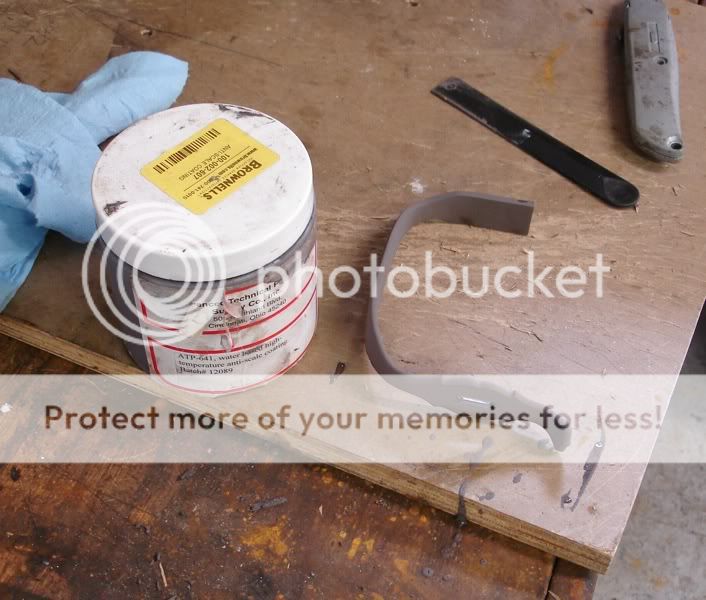
I use Brownell's 641 Anti-scale for all final heat-treating of finished fittings. I've found it absolutely necessary to allow the anti-scale to dry at least 12 hours before operation. There are still some minute spotting , and I'll have to go back to 400 grit on some parts.

Steve Culver has put an Argon injector on his oven, but still has much precise adjustments, and a learning curve. Nothing's easy here, I guess.

a373097c.jpg


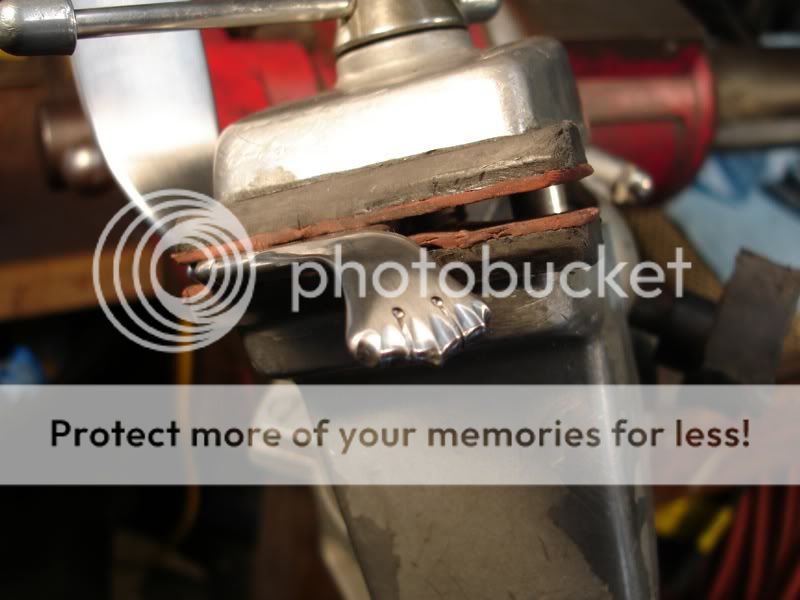
After re-sanding, I'll sooth my jangled nerves by filing the "Lion's Paw" on the thumb rest. (That's really why there's almost always some file-work somewhere on my knives. Have to get my head straight somehow.

5ae8370a.jpg


It fits!

464632b3.jpg
 
Thanks for going through all the trouble of documenting and posting this project up for us John. Your WIP's always answer a ton of questions for me and are probably the threads I spend the most time pouring through on Bladeforums. Outstanding work my friend, and seriously, THANK YOU!
 
With the handle assembly sanded to 6000 grit, a major project can be started, the domed Sterling silver pins.

It's of real interest to handle one of these Dogbones before and after the high domed pins are installed.

Before, the "hot edges" of all those crisp bevels make the handle quite uncomfortable in the hand.

After the pins are installed, the sizable domes fill the hand, and the Dogbone becomes an extremely smooth and comfortable grip which is easily indexed.

Those guys back in history knew what they were up to.


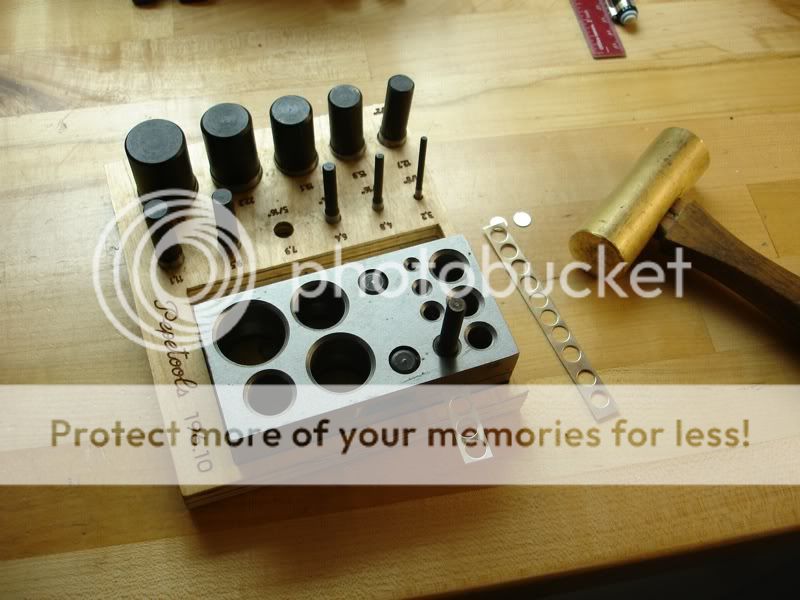
Pin installation begins by punching out 5/16ths discs from .020 silver sheet.

Half of the discs for the 18 pins get a #51 hole drilled before punching. Center the hole before you punch, and make a few extra.

85f284bf.jpg


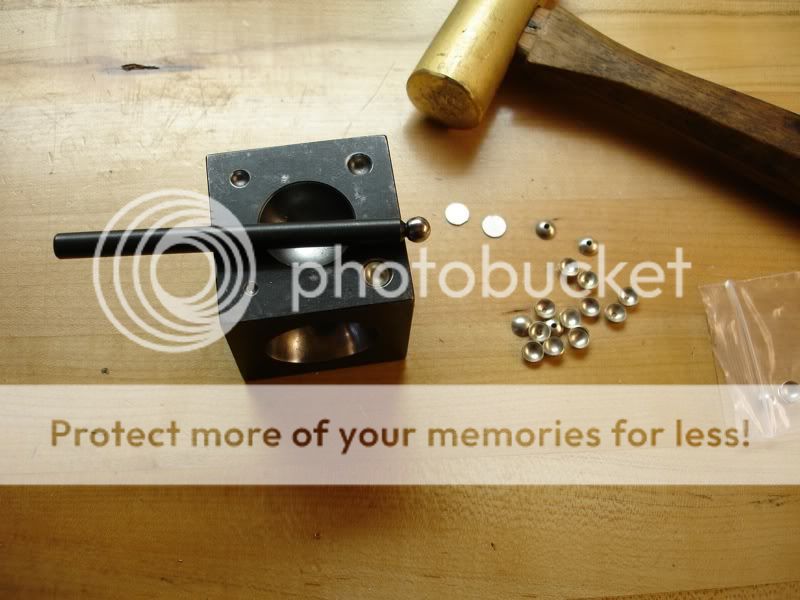
Dome the discs with a Dapping block and dap punch.

dd1747a5.jpg


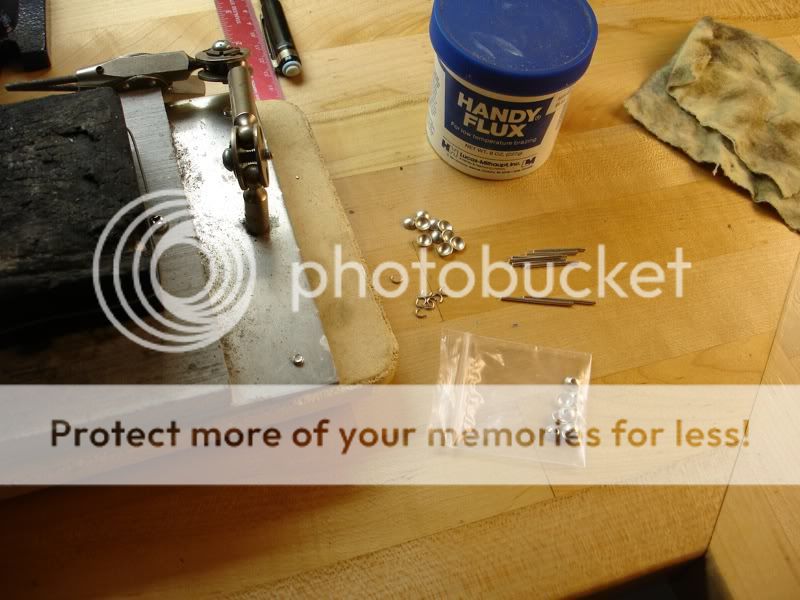
Cut some 1/16th silver pin stock, make a bunch of little half-circle solder rings, and get the soldering stuff ready.

978afda7.jpg


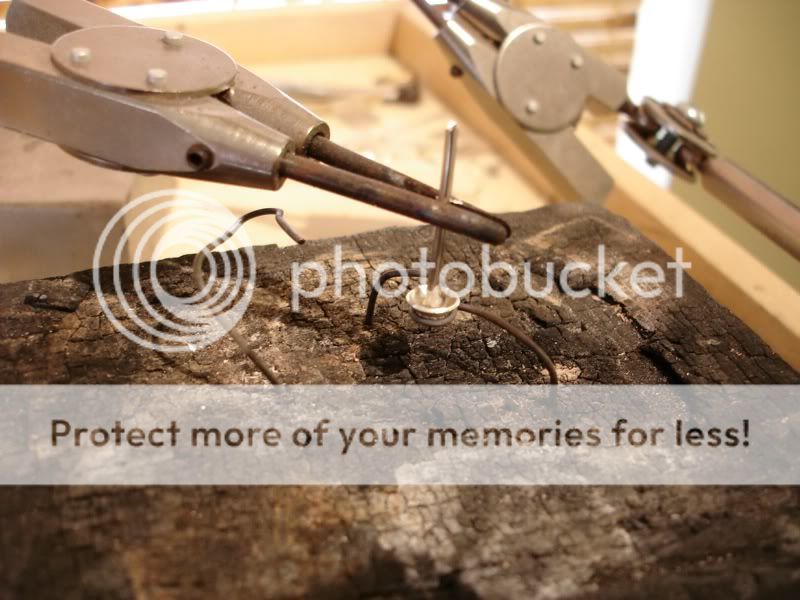
Set a dome upside down in a wire holder, flux a pin and a solder ring, and use a "third hand" soldering fixture to hold the pin upright. Centering and holding the pin vertical is the trick.

517839ac.jpg


Heat the dome from underneath til the solder just begins to flow, and then draw the flame up the pin quickly, and the solder will reach up the base of the pin to form a strong joint, looking like a tiny volcano holding the pin.

It's best to melt a couple pins when you first try this . It'll help expand your vocabulary!

818fffe4.jpg


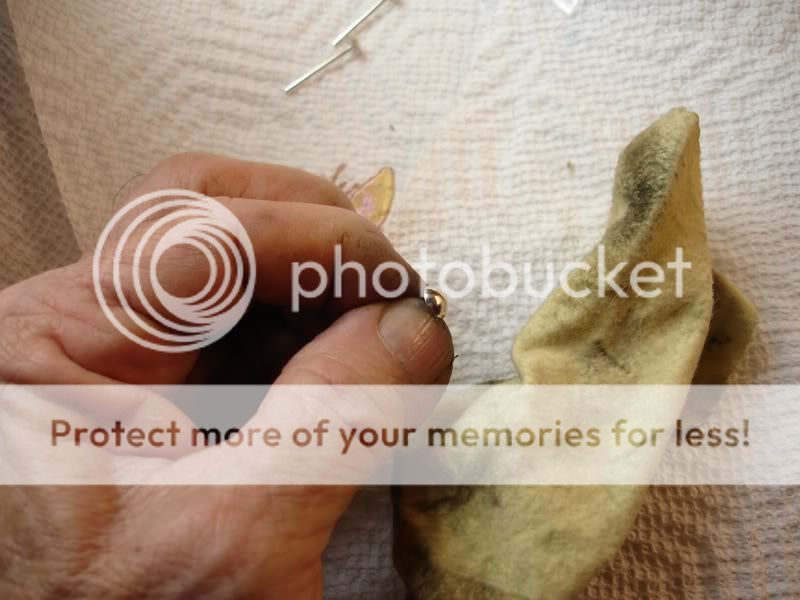
The soldered domes are "pickled" in "Rio Pickle" to remove flux and fire-scale, and can then be polished with a "Sunshine " polishing cloth.

af95627b.jpg


Since three of the pins on each side are set "on the flat" and six are set on the bevels, a little steel fixture with a flat and a bevel like the handle is used to set the domed heads at the correct angle.

One hole in the flat, one in the bevel: drop the pin in the one you need, and tap it with a wooden mallet.

9c2bb99a.jpg


f9d6338b.jpg


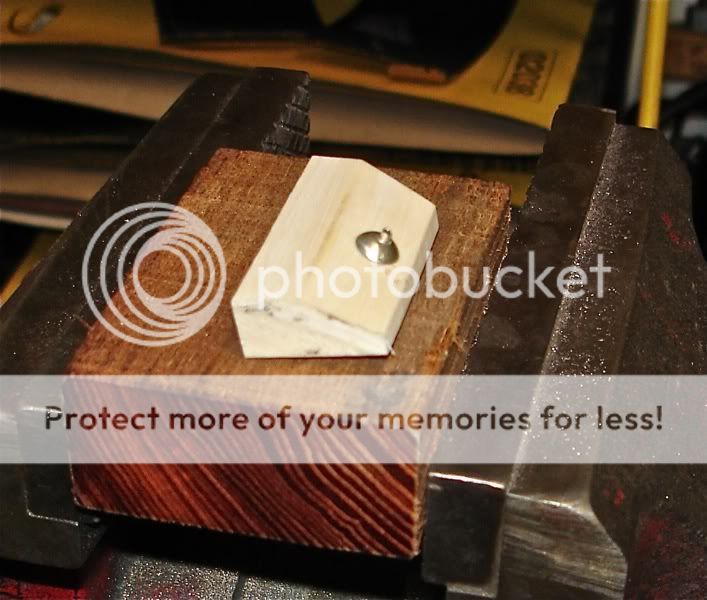
Push the pin in from one side, bend it to 90 degrees off the bevel on the other, drop a "dome with a hole" over it, back up the pin with a wooden block, and peen the pin with a dead-blow ball-pien hammer.

The idea is that you not be able to see the peened thru-pin in the dome. The trick for me is to peen it high enough to require filing down to shape, and sanding out, then polishing.

The trick is also to drill, remove and re-do if you can see the pin.

No shots of the peening process, but here's my high-tech back-up block.

91e4f1b9.jpg


Here's another look at the result.

83d9f9b6.jpg


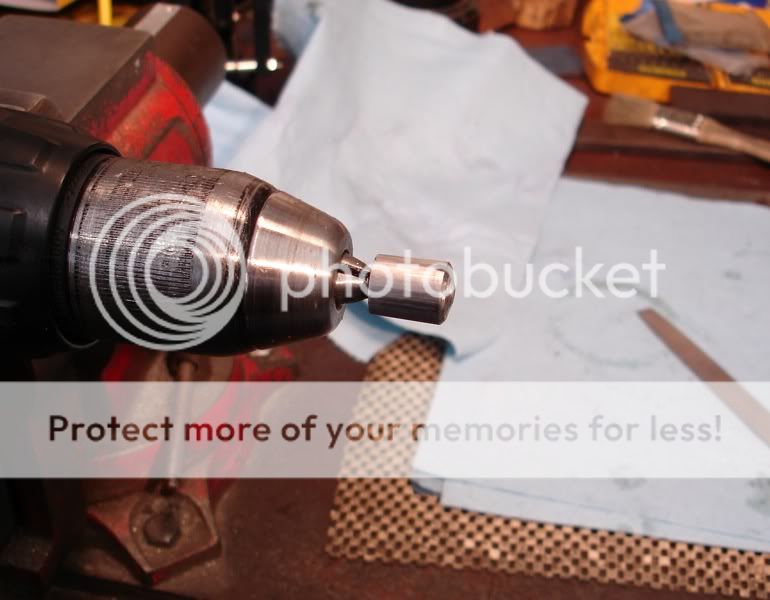
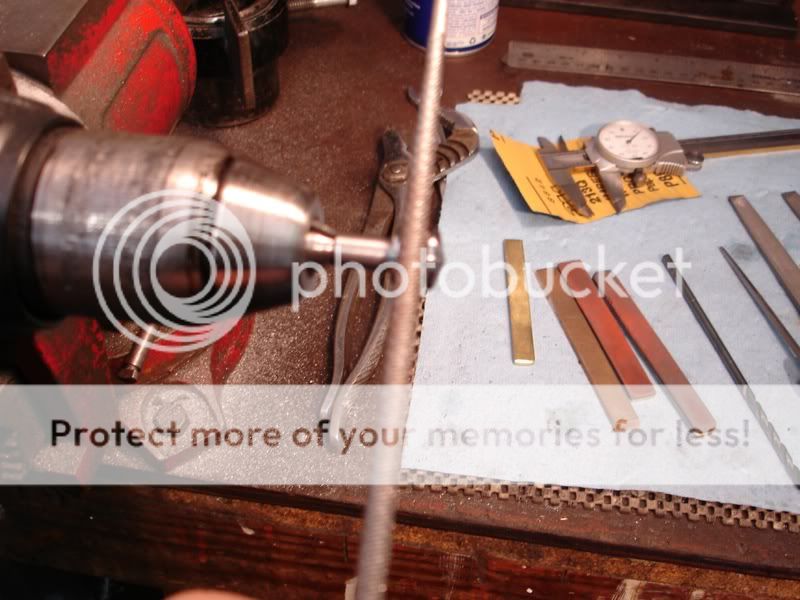
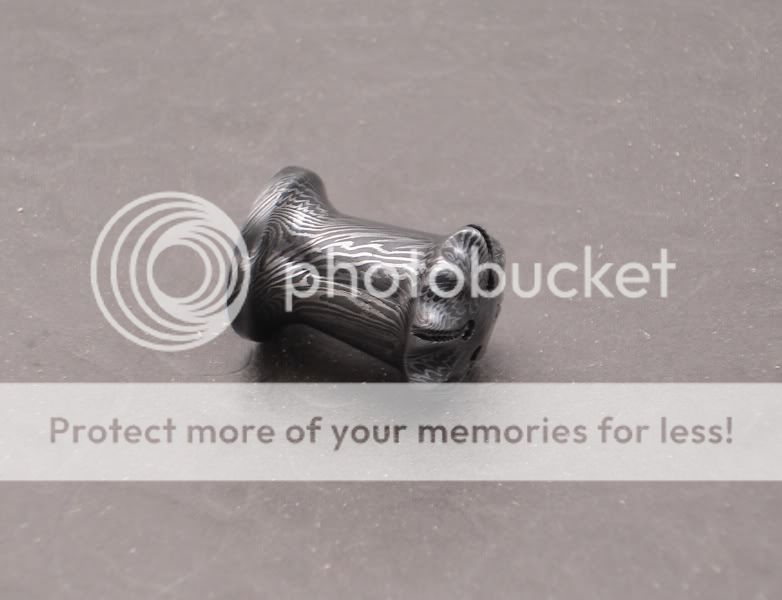
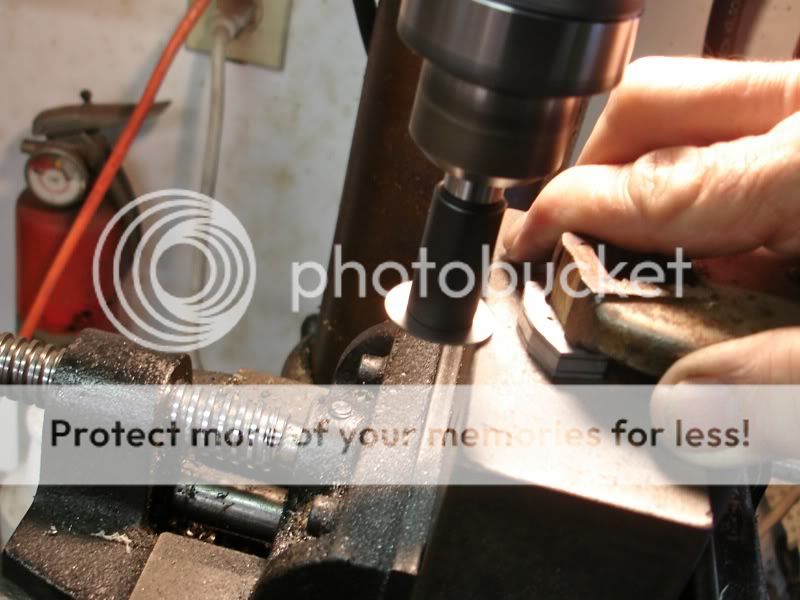
Finial and sheath stud are turned on an 18 volt drill, with chainsaw files, mill file, and sandpaper over brass strips with rubber faces.

1eb853ef.jpg


df93f4c6.jpg


915b7da5.jpg


Collars are grooved with a slitting saw and a steel block on the drill press.

79b7ec10.jpg


There's an escutcheon plate, a butt cap plate, file-work on the silver liners, and after all that, the bow, frames, and all the other damascus fittings to be hardened, spring tempered, re-sanded and etched.

I'll have nearly 120 hours in one of these puppies when I send it out to Paul Long and Buddy Thomason to do their part.

Is all this business worth the time? By this time in the afternoon, after another day in the shop, I'm never sure.

Come on by table 3-Q at Blade next month, take a look at this one and a couple other knives, and let me know what you think.

John White
 
Last edited:
I'm in awe. I read the pin peining thing twice and I'm still confused but I'll keep reading until it makes sense. What an invaluable thread this is and another fantastic piece John. Amazing work.
 
I feel like a guy beating to rocks together after seeing this kind of work. What great inspiration to us newer guys to the scene,,thank you so much John for posting these WIPs

Chad Harding
 
Stuart,

Here's a pic that'll make it more confusing.

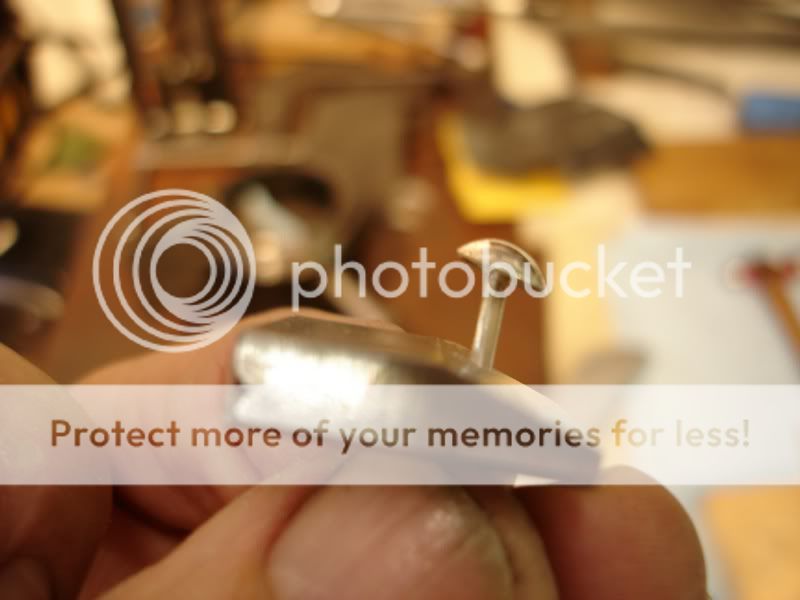
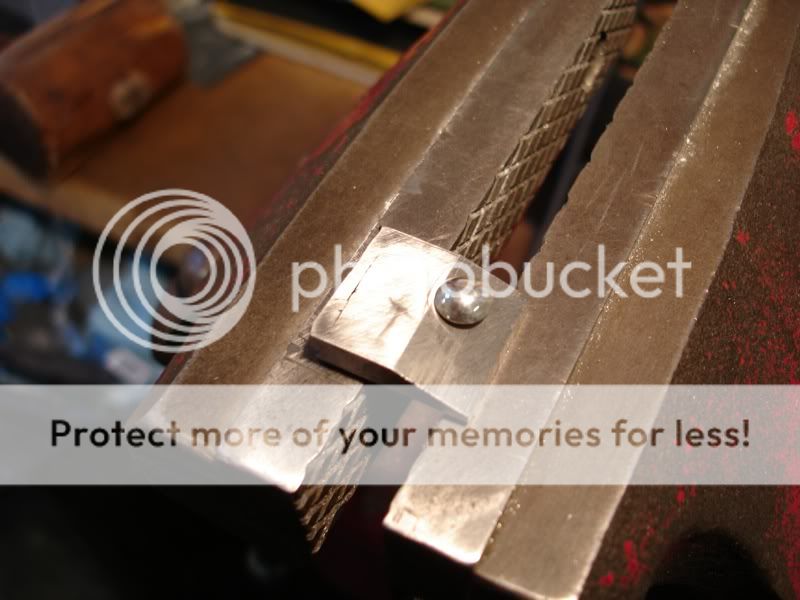
On one side of the handle sits the dome with a soldered pin, that goes through the handle . On the other side, out comes the pin, a dome with a hole goes over it, and gets peened.

This pic is of a test piece I made out of some ivory scrap.

Peen that!

a4dc07d0.jpg
 
Last edited:
Thanks John! Got it! I'm just surprised it doesn't deform the dome but maybe I'm a heavy hand with the hammer. Those photos with the punches and the dapping tools.. I didn't even know those tools existed. Really cool.
 
John, thanks for all the great information. Those punch and dapping sets are really must have tools. You make it look easy. I really look forward to seeing this one in a few weeks. You are the man.
Brion
 
"John, your work is great, I admire you a lot, and have learned a lot from you, thank you for showing and sharing your skills.
Greetings from Argentina,
Claudio
 
Last edited:
John,
Great WIP and a beautiful knife.
I think I'll have to get me some of those "3'rd hand" tools you used for soldering.
Thanks for the thread.
Jon
 
Back
Top