
-
The BladeForums.com 2024 Traditional Knife is available! Price is $250 ea (shipped within CONUS).
Order here: https://www.bladeforums.com/help/2024-traditional/
You are using an out of date browser. It may not display this or other websites correctly.
You should upgrade or use an alternative browser.
You should upgrade or use an alternative browser.
dangers of going past "critical temp"
- Thread starter JW Knives
- Start date

- Joined
- Nov 24, 2003
- Messages
- 2,357
Grain growth.
This will lead to a more fragile blade.
How much depends on how far over for how long.
You can fix this by normalizing a few times then quenching.
This will lead to a more fragile blade.
How much depends on how far over for how long.
You can fix this by normalizing a few times then quenching.

- Joined
- Jun 10, 2003
- Messages
- 15,288
Normally you harden from about 75-100 F above the critical !! It's different for each steel of course . When you go above the normal hardening temperature you get grain growth. Large grains produce a brittle steel as the major problem. To go 200 F above the normal temperature grain growth will be very fast.

- Joined
- Aug 27, 2004
- Messages
- 2,525
Its all about time and temperature. The recent threads about quenching mediums also come into play, however, if a given steel is heated far past its intended temp, and held for too long, or too short of time, then the quench doesn't really matter.
The word "Critical" is somewhat vague. To me the word "Critical" means........... Oh crap......... I'm about to die.
Like Dan said, too much heat is a bad thing. It causes grain growth. Why do we spend so much time normalizing and watching our temps? You just can't hit the nail anywhere near the head unless you have some control over your temperatures.
Test a few coupons at nominal temps for that piece of steel, then test a few where you intentionally over-shot the temps. Break the coupons and look at the grain structure. You will be pleasantly surprised.
Robert
The word "Critical" is somewhat vague. To me the word "Critical" means........... Oh crap......... I'm about to die.
Like Dan said, too much heat is a bad thing. It causes grain growth. Why do we spend so much time normalizing and watching our temps? You just can't hit the nail anywhere near the head unless you have some control over your temperatures.
Test a few coupons at nominal temps for that piece of steel, then test a few where you intentionally over-shot the temps. Break the coupons and look at the grain structure. You will be pleasantly surprised.
Robert
- Joined
- Aug 27, 2004
- Messages
- 2,525
JW, I heat treated many, many O-1 blades, not only with a torch, but also a propane forge. Although I got pretty good results, I was never satisfied until I got myself a digital read-out pyrometer and began using AAA at the suggested quenching temps.
I would not even entertain the thoughts of what quench medium is better than canola, or parks, or panther p**, but I can tell you that when you get control of your temperatures and soak times (remember that O-1 requires a little longer soak at temps), then you WILL see better results.
Also remember that you are going to get a certain amount of de-carb with not only O-1, but with other steels that you use a propane forge to heat treat with.
As with all things in life, for everything positive, there is always a little negative to ruin your day.
I would not even entertain the thoughts of what quench medium is better than canola, or parks, or panther p**, but I can tell you that when you get control of your temperatures and soak times (remember that O-1 requires a little longer soak at temps), then you WILL see better results.
Also remember that you are going to get a certain amount of de-carb with not only O-1, but with other steels that you use a propane forge to heat treat with.
As with all things in life, for everything positive, there is always a little negative to ruin your day.
- Joined
- Dec 15, 2009
- Messages
- 1,008
JW you can get a PID controller on Ebay for like $30-35, and a $20-30 thermocouple from Omega and monitor your forge temps.. that way you know you're soaking at 1500F or 1475F etc.. Of course you can buy Omega's digital thermometer instead of the Chinese PID but its around $150-200. (Thanks to Ed Caffrey for the PID idea.)
Depending on the steel used, you can also do other things that will give you fits. Higher than recommended temps will get too much of the alloying elements into solution, including carbon. This will have all sorts of odd effects, especially on the more complicated alloys, like D2 and stainless steels. As always, there are exceptions (like friction forged D2), but this is a general rule.

- Joined
- Oct 2, 2006
- Messages
- 3,238
With a complex steel like O-1 follow the manufacturer's temperature recommendations and soak it at that temperature for about 15 minutes from the time it looks like it is the same temperature as the inside of the forge, that will give you optimal results for typical blade thickness. Remember that your soak time does not start when you put it in, it starts when it gets up to temperature.
-Page
-Page
- Joined
- Aug 27, 2004
- Messages
- 2,525
I have thought about monitoring temps but wouldn't it be difficult to be accurate?. My forge is pro built (ill post a pic later) but would it not be a lot hotter at the spot where the flame comes out compared to the edges?
JW, Unless you use an upright forge (Don Fogg Style), you will have a hot-spot. Many get around this by putting the blade in a length of pipe, and the pipe inside the forge. The pipe helps to keep the heat more even.
Robert

- Joined
- Apr 14, 2011
- Messages
- 168
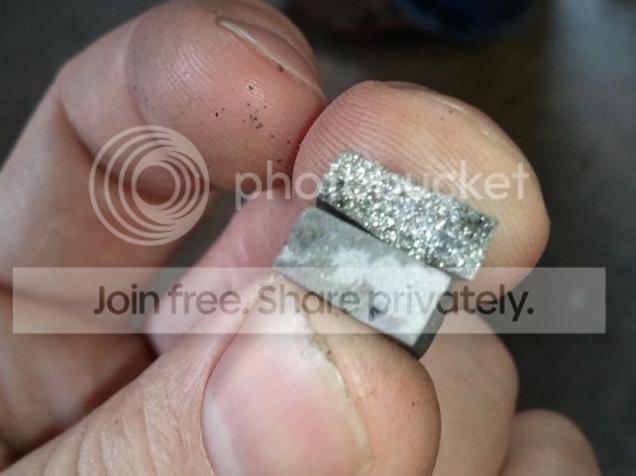
Personally, I would really like to see some up-close pics of grain that's grown too large for the aforementioned reasons and appropriate/acceptable grain size. I considered breaking one of my own knives to see, but it's tough to judge "large grains" vs "tight grains" if you've never seen either one. :/
Conceptually I understand what's being said, but a picture's worth a thousand words.
Conceptually I understand what's being said, but a picture's worth a thousand words.

- Joined
- Jan 6, 2005
- Messages
- 9,680
JW, Unless you use an upright forge (Don Fogg Style), you will have a hot-spot. Many get around this by putting the blade in a length of pipe, and the pipe inside the forge. The pipe helps to keep the heat more even.
Robert
Before I bought a kiln, I used a mufflepipe heat treat rig. It held 1500F +/-20F..... not bad.
Like Mete stated, "critical temp" is lower than the suggested Autenitizing temperatures. If I am not mistaken austenite begins to form in the mid 1300'sF and is almost completed by 1400F......... BEFORE non magnetic in many simple steels. The increase of 75-100F ensures full austenization. I believe that the continuous recycling of steel has induced soooo much alloying (in minute quantities) that it has effected transformation temperatures to a small degree. IT'S IN THE WATER, MAN!!!!!
- Joined
- Jan 6, 2005
- Messages
- 9,680
Personally, I would really like to see some up-close pics of grain that's grown too large for the aforementioned reasons and appropriate/acceptable grain size. I considered breaking one of my own knives to see, but it's tough to judge "large grains" vs "tight grains" if you've never seen either one. :/
Conceptually I understand what's being said, but a picture's worth a thousand words.
In lieu of a thousand words...
- Joined
- Apr 14, 2011
- Messages
- 168
In lieu of a thousand words...
Much obliged, Rick. That cleared it up for me... And in 994 words fewer than originally anticipated!


- Joined
- Jan 6, 2005
- Messages
- 9,680
Man, I want me some of that huge grained steel.
It comes free with one on my knives, bro. Still interested!
- Joined
- Dec 15, 2009
- Messages
- 1,008
Thanks Rick for that picture; it showed me that grain growth is not a microscopic nitpick but a very clear difference.

- Joined
- Feb 22, 2011
- Messages
- 566
So here's a pic of the small forge I use. Do any of you have a reasonable fix so that I can make it temp control. I can add a piece of tube / pipe. to create more of an oven effect. Does it matter what kind of pipe? Also what would be the best way to read to temp?
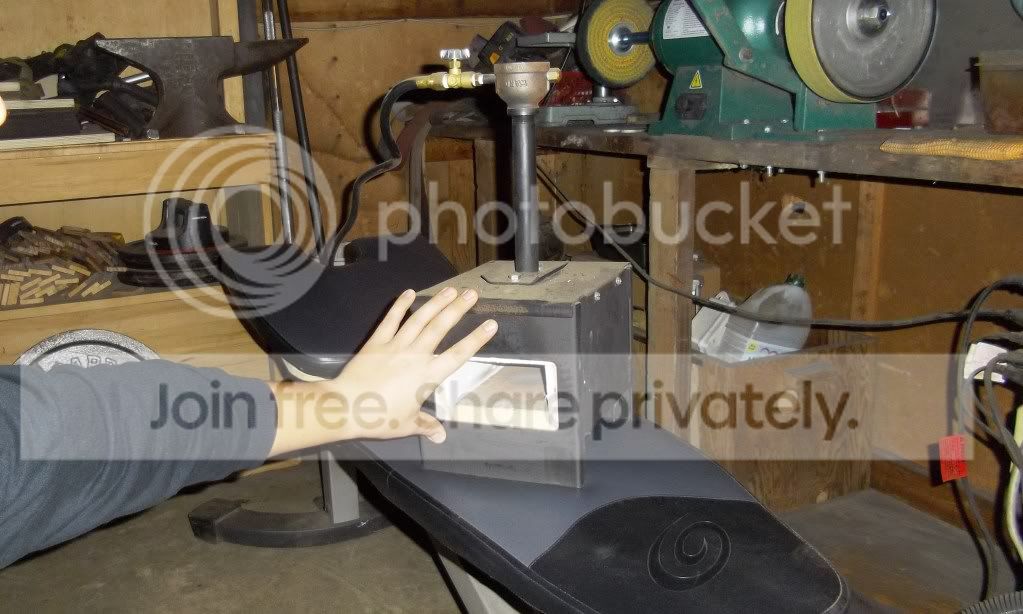
Hand is in pic for a size comparison.
Thanks for the help
Hand is in pic for a size comparison.
Thanks for the help