Darkening Carbon Steel?

Andersonbushcraft

Gold Member
Joined
Jun 14, 2019
Messages
175
Hey all,

How does the dark grey surface patina from a ferric chloride etch holdup/compare to something like a black oxide for darkening Carbon Steel? Looking for something that is not a coating that will chip off, but a controlled forced patina that is black or dark grey.

I want to try out a new user finish on some woods knives out of 8670 steel. I normally make a user finish by grinding to 120-220 then running it through the scotchbrite grits for a satin finish that tends to hid light scratches and wear a bit more than a 600 grit belt/handsand satin, but I want to darken the steel and add some mild corrosion resistance to it since the handle scales will only be attached with flared tubing.

I was thinking of trying either a bead blast followed by black oxide at peters after a heat treat or a dip in ferric chloride after they come back on a 120 grit scotchbrited finish. Probably a light coat of BLO to add some protection under the scales.

I've tried cold blue on a 120 sb before and it turned out pretty good for a working finish, but I honestly cant stand the smell and want a finish that could be used on food if needed.

Thanks in advance!
 
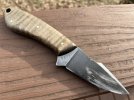
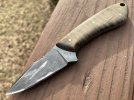
Here's a blade I made out of 1095 and hand sanded to #400 prior to darkening in a Caswell black oxide solution. The kydex sheath has been very rough on this finish as evident in pictures. I am happy with the finish otherwise. I haven't used ferric chloride yet, but will in the future. IMG_8935.jpgIMG_8934.jpg
 
Here's a blade I made out of 1095 and hand sanded to #400 prior to darkening in a Caswell black oxide solution. The kydex sheath has been very rough on this finish as evident in pictures. I am happy with the finish otherwise. I haven't used ferric chloride yet, but will in the future. View attachment 3116609View attachment 3116610
Thanks! That looks great! I've got a 400 grit hand sanded chopper out at Peter's currently for heat treat, bead blast, and hot black oxide, but life is busy these days and its hard to find the time to put a fine hand sand on a blade, I think in the time it took me to hand sand my chopper, I could have profiled and drilled another one. I developed a easy working finish a few years back for my using knives that I want to find the best way to darken up. Plus, ruining a nice hand sanded blade bashing in the woods always leaves a bad taste haha.


Was the caswell a cold black oxide or hot black oxide?

Thanks!
 
The oxide from FeCl, vinegar, acid, etc… will help protect the steel but the initial surface finish also plays a part. Coarser finish is generally more problematic as far as rust is concerned. I generally go to a 600 grit finish at a minimum whether I’m etching or not.

Consider the surface finish of your carbon steel blades to be dynamic. You’ll get scratches through the oxides and sheath wear that will compromise the protection the oxides provide. The patina will change over time. It will rust if not cleaned and oiled periodically.
 
The oxide from FeCl, vinegar, acid, etc… will help protect the steel but the initial surface finish also plays a part. Coarser finish is generally more problematic as far as rust is concerned. I generally go to a 600 grit finish at a minimum whether I’m etching or not.

Consider the surface finish of your carbon steel blades to be dynamic. You’ll get scratches through the oxides and sheath wear that will compromise the protection the oxides provide. The patina will change over time. It will rust if not cleaned and oiled periodically.
Thanks!

I've found when finishing with the particular combo Ive been doing, using scotchbrite belts, so long as my final belt grit is at or above the first scotchbrite belt grit equivalent, the end result is about the same in terms of appearance and unscientific fingernail feel, along with how quickly rust forms in the woods. I ground an aebl knife to 600 and hit it on the scotchbrite belts and it looked about the same as a 120 SB knife I had on the table. So for my particular user finish method, the 120 grinding belts gets me a solid base without the extra work and time a fancier piece requires.

Its worked for me for a while now, I'm mainly trying to subdue the finish so that it isnt as blinding when working on a sunny day, plus I love the look of a black/grey blade and micarta handles. I know the patina will wear, but im hoping it will help cut down on how fast rust forms in the field and help keep the tang from rusting too crazy under the scales, especially semi sealed up with boiled linseed oil on the metal before the scales are pinned. Not meant to be a rust proofing or lasting finish, just a nice field finish for working blades.
 
I do belts to 320 or 400 and then medium or fine scotch brite. Clean super well and etch in 3:1 FC. Some folks rinse and boil after the etch, but I don't.
I never found that a coffee etch (actually a coating more than an etch) was any good on a user.

I agree, you can make and grind three blades in the time you hand sand one ... that is why I have boxes of ground blades waiting to be sanded.

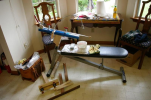
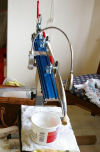
Every now and then I get the bug to hand sand blades and break out the togi bench. It is not a traditional togi dai. It is made from a folding weight bench. It does make hand sanding easier and more relaxing. I have several arms for different blades and sanding tasks. I can set it up anywhere. I take it on vacation sometimes.

1772071160750.png
1772071383269.png
1772071405746.png
 
I’ve never done a mustard finish but they look interesting.

I’ve seen makers do a natural browning by suspending a blade over a bath of caustic solution and going over the blade with steel wool every day or so until it reaches a nice brown finish. Tedious but a nice look.

Hoss
 
I've done quite a few 1084 blades in FC and blasted in FC. I would not blast them if you're just doing an oxide, FC finish, or rust bluing/browning like Hoss mentioned. Blasting doesn't make oxide and patina type finishes "hold" better or last longer, IME, and I can't imagine it's doing any favors for corrosion resistance (although I've never tested them side by side). Blasting is more useful for applied finishes like powder coating or even cold blueing.
 
I do belts to 320 or 400 and then medium or fine scotch brite. Clean super well and etch in 3:1 FC. Some folks rinse and boil after the etch, but I don't.
I never found that a coffee etch (actually a coating more than an etch) was any good on a user.

I agree, you can make and grind three blades in the time you hand sand one ... that is why I have boxes of ground blades waiting to be sanded.

Every now and then I get the bug to hand sand blades and break out the togi bench. It is not a traditional togi dai. It is made from a folding weight bench. It does make hand sanding easier and more relaxing. I have several arms for different blades and sanding tasks. I can set it up anywhere. I take it on vacation sometimes.

View attachment 3116878
View attachment 3116879
View attachment 3116880
Stacey,

That's a sweet set up! I might have to look into something similar. I make a few "big projects here or and there when I want to make something special and hand sand the blade and handle. I'll also use files to really true in the contours to really make the handle exactly how I want to shape it instead of fully shaping on serrated 1x72 belts, but I tend to save thay effort for special project sor something ill be using for years. I tend to make myself a set of knives to use every year to keep developing my style, get some ground time with them, and really dial stuff in, so I tend to take the easier route.

Thanks again!
 
I’ve never done a mustard finish but they look interesting.

I’ve seen makers do a natural browning by suspending a blade over a bath of caustic solution and going over the blade with steel wool every day or so until it reaches a nice brown finish. Tedious but a nice look.

Hoss
Thanks!

I tried something similar woth vinegar way back when I started, but could never seem to replicate the first one's rust brown color. Might have to look into it again.
 
I've done quite a few 1084 blades in FC and blasted in FC. I would not blast them if you're just doing an oxide, FC finish, or rust bluing/browning like Hoss mentioned. Blasting doesn't make oxide and patina type finishes "hold" better or last longer, IME, and I can't imagine it's doing any favors for corrosion resistance (although I've never tested them side by side). Blasting is more useful for applied finishes like powder coating or even cold blueing.
Thanks!

How'd your fc hold up against use? I've had some black oxide knives in the past that seemed to hold up great. Some of the powder/epoxy coats have been great, but I'm not a fan of how they wear compared to a surface conversion treatment that ages and patina in and around the wear. Never did much with FC, but I have a carbon damascus handled MEK that I haven't oiled in years and use to open boxes. There's some milded browning but no real active rust spots and it hasn't worn much bouncing around in a junk drawer, which really impressed me.

In regards to blasting, id only be blast if I go tue black oxide route so that I can get the treatment done in a one stop shop at Peter's. Wheni spoke to them about it right out of the quench it needs either refinished or blasted before it can be oxided.
 
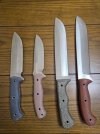
For reference, here is a photo of four knives all with a 120 grit and maroon scotchbrite finish. I'm hoping to come up woth something that will darken the finish and be subdued without overly exasperating the valleys of the grit.20251003_171252.jpg

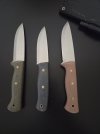
Here is some bushcrafters with 220, 400, and 600 grit that were all maroon scotchbrite, the finish looks and feels very similar.20260118_125421.jpg

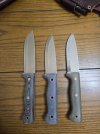
Finally, here is 220 blue scotchbrite vs 120 maroon and 220 maroon20251003_171544.jpg
 
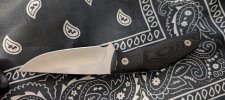
That looks great! Just about what im shooting for. Do you know what your bevel/flat grit finishes were on that?
I didn't make that knife, but my guess is a super clean 120. For my own hand sanded finish, going into the etch/stonewash I go to 400.
Most people recommend a clean 120-220 as a minimum to avoid seeing underlying scratches.
 
Back
Top