Darkening Carbon Steel?

I didn't make that knife, but my guess is a super clean 120. For my own hand sanded finish, going into the etch/stonewash I go to 400.
Most people recommend a clean 120-220 as a minimum to avoid seeing underlying scratches.
Thanks! For my user finish, I normally go grind bevels with 80 grit and finish with 120 then go maroon and blue scotchbrite, flats only ever see a 120 belt. Sometimes ill do a 180/220 trizac then the scotchbrites. I think ill have to play around with both grits and ferric chloride to see if I can get a nice dark grey finish without it overly highlighting the grit valleys.
 
Thanks!

How'd your fc hold up against use? I've had some black oxide knives in the past that seemed to hold up great. Some of the powder/epoxy coats have been great, but I'm not a fan of how they wear compared to a surface conversion treatment that ages and patina in and around the wear. Never did much with FC, but I have a carbon damascus handled MEK that I haven't oiled in years and use to open boxes. There's some milded browning but no real active rust spots and it hasn't worn much bouncing around in a junk drawer, which really impressed me.

In regards to blasting, id only be blast if I go tue black oxide route so that I can get the treatment done in a one stop shop at Peter's. Wheni spoke to them about it right out of the quench it needs either refinished or blasted before it can be oxided.
They seemed just fine for me and I like that all patinated finishes have somewhat of a "self-healing" property. I also agree that a lot of applied finishes don't look good after use although they can be quite tough. I did a powder coated A2 hatchet before and the first bit of firewood I split with it trashed the finish. It was still on there but...

I will also say that I have an Brian Goode knife here that's a 5-6 years old and looks very good with only a few faint scratches in it. This knife does not see a lot of use because I just wanted to own a knife from a friend, but I also don't seem to be able to resist occasionally cutting things with every knife I own. I don't recall the details, but I know Brian did/does a pretty long FC soak and he gets a much blacker blade than any I've done. It seems to hold up better than most.

I should also clearly state that I've never done or directly compared an oxide finish. I have used a ton of black oxide finishes tools which haven't really given me the impression that it would last longer than FC or wear as well, but I don't have anything but assumptions and anecdotes to base that on.
 
Wet coffee grinds....... Make a nice dark color....... Gotta find a pic of it..🙄
I have had a chance to find a photo? I am curious as I am about to do this to one of my knives. Debating coffee grounds or using a ton of instant coffee in warm water.
 
They seemed just fine for me and I like that all patinated finishes have somewhat of a "self-healing" property. I also agree that a lot of applied finishes don't look good after use although they can be quite tough. I did a powder coated A2 hatchet before and the first bit of firewood I split with it trashed the finish. It was still on there but...

I will also say that I have an Brian Goode knife here that's a 5-6 years old and looks very good with only a few faint scratches in it. This knife does not see a lot of use because I just wanted to own a knife from a friend, but I also don't seem to be able to resist occasionally cutting things with every knife I own. I don't recall the details, but I know Brian did/does a pretty long FC soak and he gets a much blacker blade than any I've done. It seems to hold up better than most.

I should also clearly state that I've never done or directly compared an oxide finish. I have used a ton of black oxide finishes tools which haven't really given me the impression that it would last longer than FC or wear as well, but I don't have anything but assumptions and anecdotes to base that on.
Thats what I've ran into with the powder coat finishes. Not a big fan. Some day id like to do one just to have one I made myself, but its not my favorite.

I've found milspec zinc phosphate parkerizing to be one of the best coatings I've used. It wears nice, works well, and seems to be more resistant wear. Kydex still seems to eat it though.
 
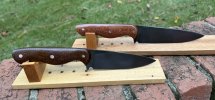
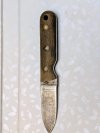
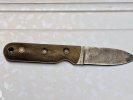
Here are two of mine in 80CrV2. If I remember correctly they were sanded to 600 grit before etch in FeCl. I dipped them 4-5 times for a total etch time of no more than about 3 minutes. I generally do shorter duration dips to avoid getting an orange peel texture.

IMG_0689.jpeg
 
Here are two of mine in 80CrV2. If I remember correctly they were sanded to 600 grit before etch in FeCl. I dipped them 4-5 times for a total etch time of no more than about 3 minutes. I generally do shorter duration dips to avoid getting an orange peel texture.

View attachment 3117777
This is perfect to know. I’m on the midst of refinishing mine. And debating what grit. I was trying to do a dual finish but idk if I really can. This is great to know.
 
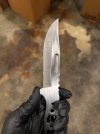
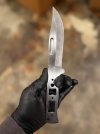
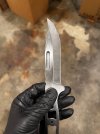
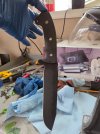
Here is what I’m working on for context
 

Attachments

  • IMG_3822.jpeg
    IMG_3822.jpeg
    160.2 KB · Views: 3
  • IMG_3820.jpeg
    IMG_3820.jpeg
    143.8 KB · Views: 3
  • IMG_3823.jpeg
    IMG_3823.jpeg
    175.9 KB · Views: 2
  • IMG_3818.jpeg
    IMG_3818.jpeg
    165.5 KB · Views: 2
You can finish to whatever grit you like but etching kind of ‘amplifies’ the surface finish for lack of a better term. Etching affects the surface and coarser scratch patterns increase the surface area so you can get different surface effects depending on the final grit of the finish. The differences can be subtle and don’t show up well in pictures but are noticeable in person. That doesn’t mean they’re bad, you just have to experiment a little to get the look you want. When I’m just trying to darken a knife I prefer the look I get when I do a hard etch with a surface finish between 400-800 grit. Again, that’s just my preference. Just do shorter etches while you’re dialing everything in.
 
You can finish to whatever grit you like but etching kind of ‘amplifies’ the surface finish for lack of a better term. Etching affects the surface and coarser scratch patterns increase the surface area so you can get different surface effects depending on the final grit of the finish. The differences can be subtle and don’t show up well in pictures but are noticeable in person. That doesn’t mean they’re bad, you just have to experiment a little to get the look you want. When I’m just trying to darken a knife I prefer the look I get when I do a hard etch with a surface finish between 400-800 grit. Again, that’s just my preference. Just do shorter etches while you’re dialing everything in.
I kinda messed up the hand sanding and was looking for guidance so this helps a lot. I know I need to go back and re sand it. We will see how it ends up.

I’m half tempted to rock tumble it lol
 
Beautiful work! I'll have to remember the multiple short dips!
It’s by no means an exact science but it gives you more control. Shorter etches limit the damage if something goes wrong which cuts down on re-sanding tremendously. Often 0000 steel wool is all it takes to remove a blemish and have everything ready to re-etch. I generally start with a 30-45 second dip followed by a 25-30 second dip then finish off with 10-20 second dips until I’m happy with the results. I wipe the blade down with windex and a CLEAN rag and let dry completely between dips. Everything must be completely clean. I’ve accidentally etched perfect finger prints into blades before. I think my FeCl is mixed around 7-1 or 8-1.

Just keep in mind that a lot of etching/darkening info out there is related to Damascus which is a whole different animal. You don’t want to etch mono steel nearly as long or as hard as pattern welded steel. All you’re trying to do with mono steel is force a patina which only takes seconds depending on how dark you want it.
 
It’s by no means an exact science but it gives you more control. Shorter etches limit the damage if something goes wrong which cuts down on re-sanding tremendously. Often 0000 steel wool is all it takes to remove a blemish and have everything ready to re-etch. I generally start with a 30-45 second dip followed by a 25-30 second dip then finish off with 10-20 second dips until I’m happy with the results. I wipe the blade down with windex and a CLEAN rag and let dry completely between dips. Everything must be completely clean. I’ve accidentally etched perfect finger prints into blades before. I think my FeCl is mixed around 7-1 or 8-1.

Just keep in mind that a lot of etching/darkening info out there is related to Damascus which is a whole different animal. You don’t want to etch mono steel nearly as long or as hard as pattern welded steel. All you’re trying to do with mono steel is force a patina which only takes seconds depending on how dark you want it.
Good to know! I've seen a lot about etching, follow by coffee dips, and all sorts of damascus stuff, but not a lot for a mono steel.
 
On the black oxide side, I heard back from the folks at Peter's today about their black oxiding service and blasting. From their experience, 220 grit is the coarsest that tends to disappear with blasting, making for a matte black finish with the oxide. 120-180 will still show the scratch pattern underneath.

That great news if you ask me, getting up to 220 doesnt add a lot of time, I've always heard you needed 400 to get scratches to disappear with blasting. I'll have to try a 220 grit belt finish and see how it turns out from them. Getting to 220 is pretty quick, but I dont have a surface grinder or rotating grinder. Chasing a uniformed 400 has always taken me forever with the minor inconsistencies freehanding flats on the platen gives me. On big blades/choppers it sometimes seems faster to hand sand haha.

Edit: actually that would make fancier pieces i want to black oxide go a lot faster too if they only need a 220 base hand sand.
 
Last edited:
So I used hot..!!!!...... wet grinds...not a ton of water......... I'd imagine if you made slurry it would work fantastic if submerged in it.......

5-8 yrs old I think...🤔....Old timer's strikes again..😉

You can see.on the tip where the water all made it way down thru the grinds as they dried out....I left it overnight........... Good luck with your endeavors....
 

Attachments

  • cee114fb-754c-4b22-ac83-da1b6ba347b7~1.jpg
    cee114fb-754c-4b22-ac83-da1b6ba347b7~1.jpg
    124 KB · Views: 4
  • 985c2a16-632f-4b24-87d1-6eddd726582f~1.jpg
    985c2a16-632f-4b24-87d1-6eddd726582f~1.jpg
    197.3 KB · Views: 3
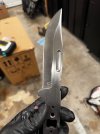
Here is black oxide over a bead blast from Peter's heat treat. After talking to them, this finish could be applied over a 220 finish. I'm going to try sending a 220 grit scotchbrited belt finish to them and see how it compares to a 230 hand sand. This one was a 400 grit hand sand.20260307_155255.jpg
 
Last edited:
Thats what I've ran into with the powder coat finishes. Not a big fan. Some day id like to do one just to have one I made myself, but its not my favorite.

I've found milspec zinc phosphate parkerizing to be one of the best coatings I've used. It wears nice, works well, and seems to be more resistant wear. Kydex still seems to eat it though.
I've recently started having some blades parkerized by a local gunsmith.

The one in the back with the green scales is one of them. It's been holding up way better than the caswell black oxide treatment that I sometimes use.
1000010342_jpg-3720441.JPG
 
Back
Top