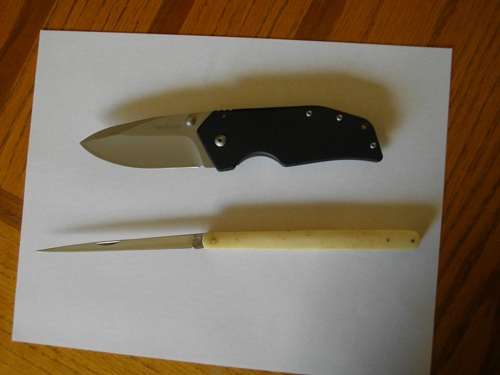
Dearth of "low-height" blades a result of lock designs?

OK. 1/4" just struck me as really narrow for a blade of that lenght. I thought of more like 1/3" as a minimum. I do not know traditional folding knives that well of course.

Here's a melon tester. Not too tactical, but great for cutting up fruit. My dad used to use this knife to clean turkeys. He liked the extra reach, yet narrow profile the main blade has.

scaled.php
 
Here's a melon tester. Not too tactical, but great for cutting up fruit. My dad used to use this knife to clean turkeys. He liked the extra reach, yet narrow profile the main blade has.

The A.G. Russell Fruit Testing Knife is like a single bladed version of that. The A.G. is an amazing knife, and a great deal for the money, too. I just wish there were some locking knives like it, perhaps with a blade closer to 3".
 
I'll post photos in a new thread, but I too like narrow blades. I have a couple such as the Kershaw Wild Wild Turkey, 2 Kershaw G10 Hawks, a Cold Steel 6" Ti-Lite, Busse Terror Monkey Desert Storm. Extrema Ratio Dark Talon, and a Boker Perrin Fancy Folder. To me narrow blades have a classic look that I like.
 
Good thread. :)

I'd say a little of both. Some folks like a more substantial blade and companies have provided them with that option. Seems that the market changed a bit in that regard.
 
I don't see how the lock has anything to do with it, other than a liner/frame lock bar having to be so narrow that it would be worthless on a 1/4 wide tang where the bar has to sit beneath the pivot pin that is in the middle of the tang. Probably has more to do with the fact that if you want the added strength of a certain sine thickness, then the blade has to be wider to also allow for a given primary grind angle. Widening the blade also increases bending resistance, just linearly instead of cubic like increasing thickness does.
 
I don't see how the lock has anything to do with it, other than a liner/frame lock bar having to be so narrow that it would be worthless on a 1/4 wide tang where the bar has to sit beneath the pivot pin that is in the middle of the tang. Probably has more to do with the fact that if you want the added strength of a certain sine thickness, then the blade has to be wider to also allow for a given primary grind angle. Widening the blade also increases bending resistance, just linearly instead of cubic like increasing thickness does.

I once saw a photo of a mid-1970's knife that had a variant of liner or frame lock (I can't remember which.) The lock engaged the entire width of the tang of the blade, and there was no stop pin to keep the blade from over-opening if the lock was held in the disengaged position.
 
I once saw a photo of a mid-1970's knife that had a variant of liner or frame lock (I can't remember which.) The lock engaged the entire width of the tang of the blade, and there was no stop pin to keep the blade from over-opening if the lock was held in the disengaged position.

Are you thinking of the Chris Reeve custom pre-dating the Sebenza and frame lock? There's a thread with pictures here somewhere, but I can't figure out what to google to find it :/

edit: found it http://www.bladeforums.com/forums/s...Reeve-quot-Lock-45-quot?p=7405285#post7405285
 
I tend to like a mid-range blade width. Don't want a spike, but I also don't care for a 1.5 inch wide blade. The wider blades are easier for me to sharpen, though. One that I've always liked, and doesn't seem to get enough credit, is the Fallkniven TK3. It is just under 3/4" wide at the bolster, and has a true 4 fingered grip (with my hands, which are medium sized). FFG, and 3G steel, I really like this folder.
 
If I plan on doing any real cutting I need a much beefier grip. I was using a smallish traditional the other day, than sharpening it after I was done. Man my knife holding hand cramped up badly. I can cut all day with a Endura, Blur, etc. and not have that problem.
 
Back
Top