
Deformation in edge after quench/temper

Joined
Sep 16, 2002
Messages
1,577
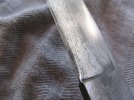
I noticed what looks like a small dent or deformation in the edge of this blade as I started cleaning it up this morning. I'm wondering if this would indicate anything in particular, such as minor warping, failed HT, etc. I didn't like how the first quench went with this one, so I actually did it a second time (if that makes any difference.)

I didn't mic the edge, but it's pretty thin. It doesn't show up great in the pic, but look about an inch forward of the plunge and hopefully it will be apparent.

Thanks much!
 

Attachments

  • IMG_1491.jpg
    IMG_1491.jpg
    41.3 KB · Views: 128
Kinda looks to me like you bumped against something prior to heat treat or when the steel was red. Normally, a bad heat treat would either warp the whole blade or make the edge look wavy. I have never seen it localized in one little deformation.
 
Finish grinding and make sure to check hardness all along the edge. I would guess it's not a big deal.
 
Thanks guys! The file skated all along the edge after quench so I believe it's hard, but the little deformation made me wonder if I was missing something. I suppose it might have happened before HT or perhaps even after the first quench which I didn't like but then didn't notice it until now.

Now that it's been tempered, I can no longer do the file hardness test, correct?
 
After tempering, you sure could check with a file. You should notice it cuts into the steel now... be gentle! I prefer to use the brass-rod test, that's a pretty good indicator on a nice thin edge like that. If you don't know how, just say so, it's easy as pie.

What kind of steel is it, and what temperature did you temper at?
 
Kinda looks to me like you bumped against something prior to heat treat or when the steel was red. Normally, a bad heat treat would either warp the whole blade or make the edge look wavy. I have never seen it localized in one little deformation.

that remindes me of a problem i was having. all the knives i quenched where coming out with slight bends in the tips and for the life of me i could not figuar out what was going on. well come to find out i was plunging the blade into the oil so fast that the blades tip would just barley tap the bottom of the quench tank and bend them :o . man did i feel like a newb :rolleyes::eek::foot:when i relized what i was doing.
 
After tempering, you sure could check with a file. You should notice it cuts into the steel now... be gentle! I prefer to use the brass-rod test, that's a pretty good indicator on a nice thin edge like that. If you don't know how, just say so, it's easy as pie.

What kind of steel is it, and what temperature did you temper at?

It's 1/8" O-1, tempered twice at ~400F. If the file will cut, what would I be looking for from a file test? I am familiar with the brass rod test but haven't done it before. Can I use 1/8" brass rod (I have some on hand), and do I need to sharpen it first or will it tell me something the way it is?


that remindes me of a problem i was having. all the knives i quenched where coming out with slight bends in the tips and for the life of me i could not figuar out what was going on. well come to find out i was plunging the blade into the oil so fast that the blades tip would just barley tap the bottom of the quench tank and bend them :o . man did i feel like a newb :rolleyes::eek::foot:when i relized what i was doing.

I sure don't remember hitting anything with it between the forge and quench tank, but since it's sort of an 'exciting' time anything is possible and I may not have realized it.
 
Last edited:
Not to hijack your thread, but the modulus of elasticity (Young's modulus) is the same whether or not the steel is hardened, and is very similar from steel to steel. If your edge is thin enough you'll be able to flex it on a brass rod, whether the steel is hardened or not is not relevant.


Last edited:
Hi Chris,

I've seen those before but it was a long time ago. Does this mean the brass rod test won't really tell me anything?

Edit to add: I guess it will tell me it is soft if it stays bent and hard if it returns to straight?
 
Last edited:
I guess it will tell me it is soft if it stays bent and hard if it returns to straight?
That's the problem with the test, it's irrelevant whether the steel is hard or soft. If you had two blades shaped exactly the same, but only heat treated one, both edges would flex equally on the brass rod. Under enough pressure the unhardened steel would deform and stay bent first, but up until that point they both flex the same. I suppose that if the edge chips out on a hardened blade in the brass rod test it would show that you somehow wrecked the steel in the heat treatment. I like Kevin Cashen's brass rod test. He chops through the rod to show that his edge can do it without damage.
 
Back
Top