
Design Comment

Fiddleback

Knifemaker
Moderator
Knifemaker / Craftsman / Service Provider
Joined
Oct 19, 2005
Messages
20,015
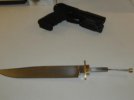
Attached is a pic of the tang construction of an expensive (600) production bowie knife with a 10+" long blade. I find it disgusting to thing that a knife in this price range has what I consider to be a very sub bar tang.

But, it has been theorized that this design is too complicated to be a corner cutting method. The idea is that there would be advantages to having a cable connected to a brass nut at the other side of the handle. One possible advantage could be that the "flex in the cable negates the possibility of breakage and reduces hand vibration."

I don't think this flies what so ever. But what do I know. So, I'd like to know what you guys think of this design. Please consider the theoretical advantages and let me know if you think that tang design would aid in standing up to common large bowie uses, or whether its a cheap dirty trick played on the pocketbooks of users.
 

Attachments

  • csknife.jpg
    csknife.jpg
    15.4 KB · Views: 408
That is different !! I'll bet it is for ease of production and cost saving.They don't have to worry about making a long tang and the flex of the cable may make up for minor dimensional problems.I assume also that it's a stock removal blade.
 
I think the tang is too short for real work. Ive often thought of a cable but how would you tighten it without using a loveless style nut. I dont see a cable being cheaper to manufacture. The advantage of the cable is that it is flexable and easy to assemble with curved handles. Not a bad idea if the tang was just longer. IMO
 
I think it is a method use for ease of manufacture. Don't see any reason otherwise to go that route. It sure doesn't appear to me to be an improved performance design.
 
From an engineering point of view, that long blade will put alot of pressure on the short tang. Even the mid part of the blade would have a 2X+ lever advantage over the tang. If someone gave a hard chop the force would be multiplied at the guard and cause the end on the tang to crack the handle. The cable would have to be really tight to prevent this movement. On a shorter blade this may work ok, but this seems a little long. I would hope that this is more of a presentation piece and someone would not do any chopping.
 
I totally agree Patrick. Not to mention you could potentially create a nunchaku type effect causing the blade (which has considerable more mass) to move with greater force potentially cracking the softer handle material. I don't think this was neccessarily cheaper to do, but a lot less labor intensive than fitting it accurately.
 
I think that could work for ease of manufacture in a shorter blade knife, saving time in the drilling/fitting of handle blocks to curved tangs. However, like others mentioned, too much lever action on that short tang with that long of a blade.

--nathan
 
Obviously made for looking at, not using. Problem with manufacturing companies, NO Experience, when it comes to using a knife. Bob Loveless once said: "I can teach a man the mechanical aspects of making a knife, but for the life of me I can't get across the concept of what makes a good usable knife" (or words to that effect).

So it boils down to $....build cheap, sell high. Contact the Company tell them what a POS their design is and how you would recommend they improve it.

John
 
The meat of that tang does look short. I do mine like John White, I snagged this pic of one of John's gorgeous bowies from the custom forum.

orig.jpg


Keep in mind, this is for a knife that will have a pommel nut.

I try to run a tang down to within 1/2-5/8" from the end of the handle in a regular hidden tang.
 
You guys seem to be having the same concerns I had. Thank you for participating.
 
I don't think the owner would have a problem with strength, but it is nice to know that it could take hard use.
 
Why not just put the design to use and test it? Depending on the materials that could be put together in a very solid way, in my opinion. Not saying it's the best way to make a knife, but none us is using the design so I say try it out before damning the designer.
 
It is not unknown in the industry to fit the tang with a flexible link to accomodate various curved handle materials.

How would you accomodate various curved antler pieces with one premade blade design?....Basically you couldn't unless the blades were made with a flexible tang.

In the construction industry this type of construction is usually referred to "Post Tensioning" where in the assembly is complete before cable or threaded rods are drawn tight afterwards. It works on large bridges so why not in a knife.

George
 
Because the kind of load on buildings and bridges is (relatively) static, esp. in comparison to the loading that a knife takes, in particular a large, chopper-type knife which takes sudden, high-intensity loads. It might work at first but after repeated use I'd be afraid that the cable would stretch and as it stretches it loses strength. The rigid connections in a traditional hidden-tang, even one with a single link would be much less likely to stretch and fail. Or so it seems to me.
 
Maybe not cable, but I recently learned of a similar method but instead of cable, use chainsaw chain with the teeth ground off. That way you still get the "flex" for curved handle material and a pretty decent amount of strength when the handle is filled with epoxy. Either brazed or riveted on. This makes the pommel much easier to fit as well. I would imagine on a large knife like that, I would use more tang and only a short amount of chain but the end result could still be the same. I was thinking of using this method the first time I attempt a hidden tang knife.
 
A chain is only as strong as its weakest link, in that case it would be the first link. When filled will epoxy is that strong enough, I dont know. The bending moment would be greatest on the first link, then that link if unbroken would transfer the force to the next link, on down the line until the entire chain is loaded. Even with the links welded I would worry,, mostly because I am not sure of the strength of the weld. That first weld must adsorb alot of shock and sudden force.

Looking at John Whites (fantastic) I can see the force transfered equally down the full length on the tang. With such a big blade that is great.. The whole handle will be in use when chopping. I really do not think a chain filled with epoxy would hold up on such a knife.

I started to use JW Weld rather than expoxy because of the stength, I was surprized how really strong it is. I think epoxy may have a little more flex which could be good in adsorbing blows without cracking or breaking. It would be interesting to see which would hold up better under these conditions.
 
As a comment on my blade Nick used as an example, the machine screw at the end is later cut down in length and used only to hold the butt-cap/ finial in place while the entire handle(stag hollowed of all soft pith) is filled with a marine structural epoxy, stiffened with colloidal silica. It's solid as a "rock", but not as brittle. For a take-down, the tang is finished smooth, waxed, and the handle cast to the tang. Hopefully, if the tang is properly tapered, and of two diminishing arcs, it will slide in and out, and contact the epoxy "case" at all points. If it sticks, cut it off and try again.

Of course, once you've stuck a fiberglass hull in a multi-$ mold, you're not afraid of losing a beautiful piece of stag...NOT.

John
 
Back
Top