
-
The BladeForums.com 2024 Traditional Knife is available! Price is $250 ea (shipped within CONUS).
Order here: https://www.bladeforums.com/help/2024-traditional/
You are using an out of date browser. It may not display this or other websites correctly.
You should upgrade or use an alternative browser.
You should upgrade or use an alternative browser.
Design critique for a paring knife
- Thread starter BChou-E29
- Start date
 which is going to be a paring knife for my dad. I've drawn up a digital render of the design and I'd like to know what some of the vets here think of it. Comments are welcome!

- Joined
- Dec 18, 2009
- Messages
- 107
Wouldn't a 'true' paring knife have a bit shorter of a blade in relation to the handle?
Typically you would want the tip of the blade no longer than the extended thumb of the user (due to the way the knife is 'typically' used in the kitchen while peeling, coring, etc).
Regardless of what you are calling it though, I like the design.
Typically you would want the tip of the blade no longer than the extended thumb of the user (due to the way the knife is 'typically' used in the kitchen while peeling, coring, etc).
Regardless of what you are calling it though, I like the design.

Nathan the Machinist
KnifeMaker / Machinist / Evil Genius
Moderator
Knifemaker / Craftsman / Service Provider
- Joined
- Feb 13, 2007
- Messages
- 19,522
I wouldn't attempt to make the edge with one single arc. They're generally straighter near the handle and more curved at the tip. Kinda like a Nike "swoosh".

- Joined
- Nov 8, 2005
- Messages
- 103
Also the protruding ricasso will prevent the bottom portion of the blade from contacting a cutting board; some folks prefer to use a paring knife for fine dicing of small veggies like shallots and and bardtenders love to use them for cutting fruit.
You may want to consider trimming it flush with the edge.
You may want to consider trimming it flush with the edge.


- Joined
- Dec 6, 2004
- Messages
- 6,212
the shape will more depend on how your dad wil be using the knife
if never on the board then the little guard might be welcome (less he peels with a parer)
as far as the tip and full arc again its all about the user
most all of mine have a fairly fine tip so that its easy to get into eyes of taters adn waht not ( i let a bit more steel out at the end so the edge bevel looks thicker and is a bit stronger)
hawk bill wharrnie and full arcing blades all have there use in the kitchen and a blend of the wharrnie and the full arc should get you the most usefulness
if never on the board then the little guard might be welcome (less he peels with a parer)
as far as the tip and full arc again its all about the user
most all of mine have a fairly fine tip so that its easy to get into eyes of taters adn waht not ( i let a bit more steel out at the end so the edge bevel looks thicker and is a bit stronger)
hawk bill wharrnie and full arcing blades all have there use in the kitchen and a blend of the wharrnie and the full arc should get you the most usefulness
- Joined
- Jan 13, 2006
- Messages
- 84
Here's one I made. It's kind of a cross between a paring knife and a "kitchen" knife. Longer than a paring, and a sharper point like what you're showing. Just for comparison.
http://www.bladeforums.com/forums/showthread.php?t=683387
http://www.bladeforums.com/forums/showthread.php?t=683387

- Joined
- Jul 4, 2009
- Messages
- 1,201
This is just my two cents, and remember that as far as knifemaking goes, I'm the last person you should listen to.
But I do have a degree in design, and I also am a very big kitchen knife fan, so it's those two areas where my thoughts are coming from.
First - the kitchen.
I think the "pointy" profile of the blade is great for kitchen work. Your dad is going to get a lot of use out of the first inch of that blade especially for basic utility tasks.
The pronounced guard you've drawn is a different issue. I think it might cause a little more difficulty using the knife on a cutting board or when the knife is used for peeling and deep cutting. Bringing it back to in-line with the edge is preferred for me. But even if you brought it back to in-line with the edge, the thickness there still has pros and cons. Here's a picture of a Wustoff with an integral guard, so you'll know what I'm talking about:

The pro is that it acts like a finger guard, so there's no accidentally notching your fingers when you get down to business. Another pro is that it provides a nice little 'stop" when you put the knife in your block. But this feature also has its drawbacks. it can stop you dead in your tracks when you're cutting deep into a melon or when you are peeling and kind of turns a 4" blade into a 3" blade because you never want use that last inch because you don't want the guard or the handle to get in your way.
All that said, I prefer a design used in "eastern" knives where not even the handle comes up to the heel of the blade. It's all free of anything, no guard no nothing. Here's an example of the basic design used by Shun:
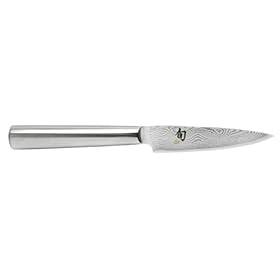
This knife allows full use of every milimeter of the blade edge.
Keep in mind that I know several people who can't stand my eastern blades. So all of this might be just me.
Second - the design.
The proflie of the handle is very traditional, and it's traditional because it WORKS. The human hand knows exactly where to go on this handle. both the pinky and the forefinger have a place to call home (which tells your brain exactly how far the knife is sticking out). This design is also often used with "flats" on the sides, which is a feature I love in a kitchen knife. This tells your brain, in a very physical way exactly which direction the blade is pointed. In the kitchen, the knife is an extension of the hand and your mind is on several things at once. This handle design is so familiar that it will instantly become second nature to use.
BUT - (you knew there would be a 'but' didn't you?) It's very traditional. This is where the artist in me kind of takes over. Traditional can be good, but it can almost look "store bought".
If you're going to spend a lot of time making a knife for your father, you might consider putting a little bit more personality into this aspect. Yes, you can definitely jazz it up with the right materials and that might be enough. But since we're only talking about profile at this point, I wonder if you might make a slight adjustment or two to let a little bit more personality show up.
The good part of designing on paper first is that you can always go back to the traditional profile if your other, more unique designs aren't working out.
But I do have a degree in design, and I also am a very big kitchen knife fan, so it's those two areas where my thoughts are coming from.
First - the kitchen.
I think the "pointy" profile of the blade is great for kitchen work. Your dad is going to get a lot of use out of the first inch of that blade especially for basic utility tasks.
The pronounced guard you've drawn is a different issue. I think it might cause a little more difficulty using the knife on a cutting board or when the knife is used for peeling and deep cutting. Bringing it back to in-line with the edge is preferred for me. But even if you brought it back to in-line with the edge, the thickness there still has pros and cons. Here's a picture of a Wustoff with an integral guard, so you'll know what I'm talking about:
The pro is that it acts like a finger guard, so there's no accidentally notching your fingers when you get down to business. Another pro is that it provides a nice little 'stop" when you put the knife in your block. But this feature also has its drawbacks. it can stop you dead in your tracks when you're cutting deep into a melon or when you are peeling and kind of turns a 4" blade into a 3" blade because you never want use that last inch because you don't want the guard or the handle to get in your way.
All that said, I prefer a design used in "eastern" knives where not even the handle comes up to the heel of the blade. It's all free of anything, no guard no nothing. Here's an example of the basic design used by Shun:
This knife allows full use of every milimeter of the blade edge.
Keep in mind that I know several people who can't stand my eastern blades. So all of this might be just me.
Second - the design.
The proflie of the handle is very traditional, and it's traditional because it WORKS. The human hand knows exactly where to go on this handle. both the pinky and the forefinger have a place to call home (which tells your brain exactly how far the knife is sticking out). This design is also often used with "flats" on the sides, which is a feature I love in a kitchen knife. This tells your brain, in a very physical way exactly which direction the blade is pointed. In the kitchen, the knife is an extension of the hand and your mind is on several things at once. This handle design is so familiar that it will instantly become second nature to use.
BUT - (you knew there would be a 'but' didn't you?) It's very traditional. This is where the artist in me kind of takes over. Traditional can be good, but it can almost look "store bought".
If you're going to spend a lot of time making a knife for your father, you might consider putting a little bit more personality into this aspect. Yes, you can definitely jazz it up with the right materials and that might be enough. But since we're only talking about profile at this point, I wonder if you might make a slight adjustment or two to let a little bit more personality show up.
The good part of designing on paper first is that you can always go back to the traditional profile if your other, more unique designs aren't working out.
Hmmm... All very good arguments here people. I've considered them and so far I've come up with this: took off the integrated guard and made the heel of the edge a lot straighter. Tinker, those pictures helped, I think I'm going to try that in a new design. But I got an idea of what I'm going for. Here's a rough profile I've done with a hacksaw and bench grinder. Whadya think?

By echo29, shot with SP560UZ at 2009-12-30
I've moved away from the Paring Knife concept and more towards the general utility sort.
Here's the fully profiled blank. Still needs bevels but we're getting there.

By echo29, shot with SP560UZ at 2009-12-30
By echo29, shot with SP560UZ at 2009-12-30
I've moved away from the Paring Knife concept and more towards the general utility sort.
Here's the fully profiled blank. Still needs bevels but we're getting there.
By echo29, shot with SP560UZ at 2009-12-30
Last edited: