Design Etching Question

Archer Here

Knifemaker / Craftsman / Service Provider
Joined
Nov 2, 2008
Messages
1,323
Hi Friends,
I know where to come when I have questions. One of my customers requested that I use an acid to etch some designs into the hilt of a sword I’m making for him, versus using a mold or an etching tool (dremel). Other than Damascus work, I’ve never tried to etch a design into a piece of steel with that acid. Is that the wrong stuff, and how do you mask off the parts you don’t want etched. Any help or link would be very much appreciated.

Thanks, Chris
 
One of the classic resists is "asphaltum", a black material that hardens to a material that's like a cross between tar and paint. It's a very good resist with decent handling characteristics. Dissolves easily in naphtha.
I would start with ferric chloride for the etchant. The reason is it's a good marriage with asphaltum.
Hydrochloric (muratic acid) will tend to defeat it at the edges. You will, in fact, have a hard time finding a good resist for etching any depth with hydrochloric acid.
Sulfuric acid tends to pit while it cuts, so I'd probably stay away from that.

The best advice is to do a test plate with the resist and etchant you plan to use. You can try different concentrations of etchant and etch times without risking your final parts.
Good luck.
 
Here's a little more info I got from the customer:

"we (the customer) got a powder he referred to as "Iron-Three-Chloride". We used some old nail varnish (acid resistance) to paint the metal and scratched our designs into it. Then we dissolved the powder in water, put it in an old enamel cooking pot and put it over a low heat in his garage with the axes in it. After a couple of hours the designs we had scratched out of the varnish (it was dark green and purple. A Goth) were deeply etched into the metal."

Just wondering if anyone else has used this method.
 
Chris,
I have a book that goes into etching pretty deep. I'll send you the book if you want. He uses an acid mix called "Royal Water". Its a very strong acid mix of Nitric and Muriatic Acid.(I think) It will dissolve Gold. I never tried it because the acid is so dangerous. It must be mixed properly or it will make bad things happen.(VERY BAD THINGS)If your interested drop me an E-mail with your address and I'll ship her to ya. If I can locate it.
In case I can't find it the book iis: Step-By-Step Knife Making by David Boyle
Here is a link to a copy on E-Bay
http://cgi.ebay.com/NEW-Step-by-Ste...emQQptZUS_Nonfiction_Book?hash=item414a75a729
 
Here's a little more info I got from the customer:

"we (the customer) got a powder he referred to as "Iron-Three-Chloride". We used some old nail varnish (acid resistance) to paint the metal and scratched our designs into it. Then we dissolved the powder in water, put it in an old enamel cooking pot and put it over a low heat in his garage with the axes in it. After a couple of hours the designs we had scratched out of the varnish (it was dark green and purple. A Goth) were deeply etched into the metal."

Just wondering if anyone else has used this method.

"Iron-Three-Chloride" is ferric chloride. Thy got the powder forum. I buy it as a liquid. But I also say that's your best bet to use.
 
I've been etching steel with ferric chloride for some time now. For a resist I use enamel spray paint. You will need to experiment a bit to determine the time required to reach the depth you want on the steel you are using. I would not suggest using this method on damascus, as the 'bright' layers will etch much more slowly than the dark, and it looks a bit funky... a stronger acid would be required for damascus, I think. This method works very well on copper, too.

I spray on the paint, avoiding runs and bubbles, and let it almost dry, then use a sharp scribe to cut the pattern I want through the paint. I then submerge the part to be etched in the FC. The time will depend on the strength of the etchant and the type of steel being etched... with my mix it takes about an hour and a half to get a good deep etch on 5160, a bit less for 1095, and a bit more for L6 or 15n20. Every thirty minutes or so of the etch, it is advised that you lightly brush the etched area with a feather to remove the oxides that form.

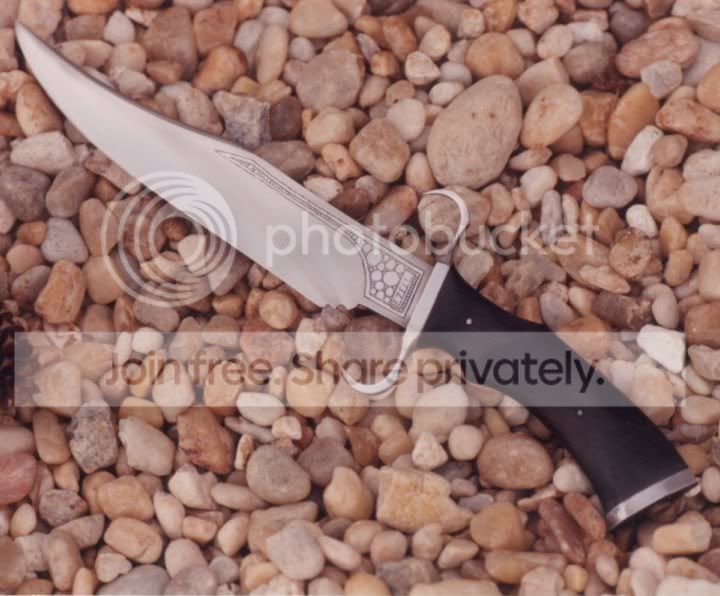
This is one I got a little crazy with...
Diablo.jpg
 
Thanks guys. I got some ferric chloride and I'll start experimenting with it. Great knife, by the way! :thumbup: I don't think I'll probably go with the Royal Water acid mix. That one sounds a bit dangerous. Wish me luck.

Chris
 
Back
Top