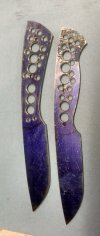
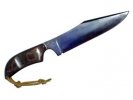
Design help

Blade looks nice.

For the handle, how long is it? It seem like the finger choil is too small. Also the hump in the middle of the blade may naturally push the hand toward the blade so you may want a larger integral guard. This may just be my opinion as I like deep choils and large guards for added protection from the blade.
 
I think you are letting the bar of steel tell you what the knife should look like. You're the boss. You tell that biotch what YOU want it to look like. Seriously, it is very "stiff" looking design-wise. It doesn't have any grace or flow. The handle looks uncomfortable. The belly in the handle looks too severe and a bit too far forward. I'm not sure why you have the top side straight as an arrow. If you are unfamiliar with the process of designing and making knives the best thing to do is to start with DRAWINGS. It is much easier to revise a sketch than to modify steel. If you need to add material it is no problem erasing a line and moving it over. Once you grind steel it's gone. Post up your drawings before you even look at your steel. We'll help you get the design worked out then you can start throwing sparks.

Additionally, people who have a passion for something are usually also students of that area of interest. Take the time to be a student of the craft. Read everything you can get your hands on. Be familiar with different established makers and their work. Know the terminology and basic design principles of why different parts of the knife are shaped and spaced the way they are. You may know that Pablo Picasso was an artist who painted wacky stuff. But a lot of people don't realize that by the time he was 14 years old he could already draw and paint at a master level. Because he already had such a strong foundation of his craft he was free to explore his imagination and break the rules. Work on establishing your foundation of understanding of knives.

Look through the gallery section on this site. Visit the websites of makers you like and examine their work. Don't just think "oh, that's cool". Study the lines. Notice the curvature of the spine, where the belly of the blade happens and to what degree. Look at the spacing between the plunge line and where the guard or handle scales start. Notice the shaping at the forward edge of the handle scales, the placement of pins in relation to each other and in relation to the handle edges. Take note of how lines from the spine and ricasso match up with the lines in the handle to create "flow". Notice the level of fit and finish (no scratches left in the surfaces and no gaps anywhere). Pay attention to the subtleties of design. Many times less is more but it is how you accomplish "less" that matters.
 
A tiny curve added to the spine will create more flow. Just drop the tip 1/4"and the butt 1/8" and make the top of the blade a curve and see how much that changes the look.

I don't know why all the new makers want a lump of steel sticking out below the edge, but making it even with the blade will make the knife look and cut better. The ricasso, and a small 3/16" choil (bisected by the plunge) are all you need there.

I would suggest you round the finger groove back 1/2" farther and take some of that belly out of the handle.

I like the butt of a knife to round back from the top to the bottom but there are folks who like it the other way like yours. To me, that sharp corner can be a rub issue on the hand. If you keep that arrangement, round the top corner a bit.
 
Last edited:
I think you are letting the bar of steel tell you what the knife should look like. You're the boss. You tell that biotch what YOU want it to look like. Seriously, it is very "stiff" looking design-wise. It doesn't have any grace or flow. The handle looks uncomfortable. The belly in the handle looks too severe and a bit too far forward. I'm not sure why you have the top side straight as an arrow. If you are unfamiliar with the process of designing and making knives the best thing to do is to start with DRAWINGS. It is much easier to revise a sketch than to modify steel. If you need to add material it is no problem erasing a line and moving it over. Once you grind steel it's gone. Post up your drawings before you even look at your steel. We'll help you get the design worked out then you can start throwing sparks.

Additionally, people who have a passion for something are usually also students of that area of interest. Take the time to be a student of the craft. Read everything you can get your hands on. Be familiar with different established makers and their work. Know the terminology and basic design principles of why different parts of the knife are shaped and spaced the way they are. You may know that Pablo Picasso was an artist who painted wacky stuff. But a lot of people don't realize that by the time he was 14 years old he could already draw and paint at a master level. Because he already had such a strong foundation of his craft he was free to explore his imagination and break the rules. Work on establishing your foundation of understanding of knives.

Look through the gallery section on this site. Visit the websites of makers you like and examine their work. Don't just think "oh, that's cool". Study the lines. Notice the curvature of the spine, where the belly of the blade happens and to what degree. Look at the spacing between the plunge line and where the guard or handle scales start. Notice the shaping at the forward edge of the handle scales, the placement of pins in relation to each other and in relation to the handle edges. Take note of how lines from the spine and ricasso match up with the lines in the handle to create "flow". Notice the level of fit and finish (no scratches left in the surfaces and no gaps anywhere). Pay attention to the subtleties of design. Many times less is more but it is how you accomplish "less" that matters.

This is some of the best advice you will receive. Straight forward and to the point. I cherish little lessons like these as a new maker. Thanks for this
 
Try this:

7OWCpU3.jpg

3YTsgq0.jpg


Also, you're already using Imgur, it'd make life easier for us if you would use the link they provide for posting images on forums. Just click the copy button and paste in your forum post.

ClWXJUH.jpg
 
Kuraki has a very good drawing there. I would make the next one in that basic shape. The only change I personally would make to it is to extend the edge line about 1/8" or so past the tiny choil. This keeps the finger away from a sharp [pointed corner that would be created by the curved finger groove directly meeting the semi-circle of the choil.

The re-draw image of your knife is better. Because you are trying to salvage an already profiled blank, I would just round back the finger groove a bit more, and keep the second recess as it is at the butt. This will make the bottom of the handle closer to Kuraki's drawings. Maybe take a little less off the top of the handle, too.

BTW, I would like to thank Kuraki and the others who draw out what I try to say in words. It is very helpful to the new makers.
 
I definitely think the two pics of the second knife you posted are making progress. Some people including myself prefer more of a straight handle than a drooped (downwardly angled) one for certain applications.

At the same time designing a good straight handle is harder than it sounds. This is because long perfectly ruler straight sections of the handle tend to be uncomfortable. Even straight stilleto type blades tend to have a wasp waisted handle.

Take a look at this straight handle by Fred Perrin. I am not saying you should copy this handle but maybe some inspiration.

perrin_military_bowie.jpg


please note I am not a maker I am just talking from using knives. :)
 
I don't understand the propensity for a finger choil that depth - 2/3 the width of the handle or blade. I see it all over IG, mostly from newer makers. I can't see how it's useful, either practically or aesthetically, especially on larger knives. It seems like when held by the index finger and thumb it would have no control, but maybe I'm wrong.
 
Looks like you might still be able to reshape that one to get something like these. Feel free to use the designs. Both have 4-3/8" handles and 3-5/8" blades.
IMG_20171030_111901.jpg
 
Okay , kuraki, im gonna try to copy ur knife and see what it get. I dont know why i keep putting the finger choil in, i guess to prevent hand from slipping forward.
 
I don't understand the propensity for a finger choil that depth - 2/3 the width of the handle or blade. I see it all over IG, mostly from newer makers. I can't see how it's useful, either practically or aesthetically, especially on larger knives. It seems like when held by the index finger and thumb it would have no control, but maybe I'm wrong.

As someone who is just starting out I think that there are 2 reasons. There are probably many more but these are what I have noticed.

The first is that roughed in grooves go to far and cleanup overshoots.

The second is that most common knives to be used are folders and kitchen knives. If you hold your new small hunter like my Benchmade Osborne it feels ok. It takes a little time to adjust feel to realize how a fixed blade should feel.

I personally am still having trouble with this balance especially on large knifes. I find that many modern knives are over thick compared to historical tools that were used daily. Modern axe handles probably have 3X the weight as classic handles. And many budget knives have over large handles that limit how they are used but look beefy and hard core. I am realizing that often it's more of a matter of making the handle larger in some areas and making sure that I have enough material so when I make something that scales I don't undersize other areas.

Don't know if that makes sense. Lol. But it's my 2 cents
 
I think kuraki was commenting on the image lapedog posted. Those very deep finger grooves can easily lead to a broken blade. half you finger width is all it needs for grip control. On my index finger that would be 10-12mm deep, or about 3/8". 1/2" depth of the finger notch would be enough for most any hand.
 
Back
Top