
Designing a Kitchen Knife, a good place to start

Joined
Jan 29, 2010
Messages
2,804
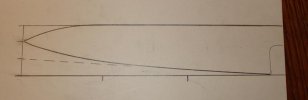
There is some interest in kitchen knives here on BF. I see some that are well designed and some that could use a little work.

Attached is a common profile for many Japanese chef's knives. You can see that they have a flatish edge toward the heel and they curve slightly every 1/3 toward the tip. This is a good place to start and will work for a range of sizes. Notice that the rectangle is divided into thirds across the bottom and at the front.

The drop in the tip is also about 1/3 from the top of the spine. This profile is a good one.

Hoss
 

Attachments

  • 001.jpg
    001.jpg
    12.1 KB · Views: 159
Hi Devin, great topic and thanks for sharing. I've just started with kitchen knives and find although they look simple, I find myself having lots of questions and not finding much in the way of information online.
Expanding on your sketch, and hypothetically saying the blade length is 240mm, what would be a good starting point for the dimension below and would they change proportionally as the blade length became less?

Thanks in advance for any input!

TangDim.png
 
These can vary quite a bit so use these as a starting point.
W1= .54
W2= .76
L1= 3.5
L2= .625
R = .375
Heel height is about 21-22% of edge length

Hoss
 
So since I'm in the middle of making my first gyuto and first wa handle, well starting over I guess cause I snapped it while straightening it. When you grind a Japanese knife, what is the best geometry? I see grinds that are full flat, and some that are hollow about 3/4 up the heel.
I was planning to do a plunge less flat grind as my material is .078" aebl and I only have a 10" wheel for hollows.
 
For something that thin, grind it convex, both sides, half way up the blade.

Hoss
 
<.100
Lots of high end kitchen knives have a distal taper and are over 1/8 inch above the heel.

Hoss
 
Good stuff. Thanks Devin.
 
Just got done comparing the one I snapped yesterday to the dimensions listed here and I was surprisingly close with the exception of the radius of the heel. It was a very short knife at only 6". I just profiled another, this time out of .100 AEB-l.
Used the 1/3rd rules listed here.
C94F65D5-C5B0-47E6-82AC-581F7E5EC41F_zpsirvhe1t2.jpg

This one is an 8" blade and yes the handle is long right now.
Feel free to make suggestions, it's my first kitchen knife
 
Kevin, that looks good. Don't shorten the handle yet, as a longer handle can make a kitchen knife balance better. When done most of the way, pretend cut with it a bit and shorten only as needed. For a blade like that with a wa handle, I go around 6" ... 5" minimum for smaller hands.
 
There is some interest in kitchen knives here on BF. I see some that are well designed and some
that could use a little work.
Attached is a common profile for many Japanese chef's knives. You can see that they have a flatish edge toward the heel
and they curve slightly every 1/3 toward the tip. This is a good place to start and will work for a range of sizes. Notice
that the rectangle is divided into thirds across the bottom and at the front.

The drop in the tip is also about 1/3 from the top of the spine. This profile is a good one.

Hoss

Thank you for your input and guidance! The subtleties of kitchen cutlery are what make them so much fun to study and make, and use :)

One thing I would add, is something Ethan Becker explained to me a few months ago, when I brought a couple of my chef's knives to his home and asked him to put them through their paces...

He liked the thin, distal tapered grind, especially for forward slicing cuts. He liked the sharpness and ability to choke up with a pinch grip. That's the easy part. ;)

But he outright scolded me to "Avoid a hard heel."

Now... what the heck is a hard heel? :confused: Being new to the chef's knife game, I had never heard of such a thing. But when he allowed me to compare my knives with one of his that he felt was ground and sharpened properly, I immediately noticed the difference.

Ethan explained to me, a "hard heel" is a heel without relief, that comes down hard on the cutting board when finishing rocking/dicing cuts. It makes even a very good knife feel chunky and clumsy.

A "soft heel" has just a bit of curve to it, and allows for a much smoother range of motion to finish the cut... and continue with further cuts.

The difference is only a few thousandths of an inch, and it only takes a moment to make a good knife cut and "feel" much better. A soft heel really does make a knife far more comfortable and "lively" to use.

tumblr_o0drxxj7e71ug44tmo1_400.jpg
 
Good point. The drawing was traced from a Japanese gyuto, I did not change anything.

The heel area is "flatish" meaning that it is almost flat. An edge that is too flat is clunky on the board. The Japanese do like a pointy heel for pulling out fish eyes and potato prep etc.

Culinary schools here use different cutting techniques than in Japan. Most schools here prefer a european profile knife.

Hoss
 
James, the easiest way to get that "soft" heel the first time out is to mess up if you use a belt to set the initial edge. ;)
 
Good point. The drawing was traced from a Japanese gyuto, I did not change anything.

The heel area is "flatish" meaning that it is almost flat. An edge that is too flat is clunky on the board. The Japanese do like a pointy heel for pulling out fish eyes and potato prep etc.

Culinary schools here use different cutting techniques than in Japan. Most schools here prefer a european profile knife.

Hoss

I know almost nothing about Japanese knives or techniques :o Just sharing what someone (a European-style chef, for the most part) taught me :)

James, the easiest way to get that "soft" heel the first time out is to mess up if you use a belt to set the initial edge. ;)

Shhh, that's a trade secret... :p
 
Back
Top