Here are all my notes on fire making, from a recent Tom Brown Survival/Tracking class.
Fire
Fire is a gift from the creator. One needs to have a relationship with fire and respect it. The basic principle of fire is simply the right mixture of fuel, oxygen and heat. Before making a fire one needs to choose a location to build a fire. Make sure there is the availability of materials and water near by, check the wind, and look overhead and under the fire pit location. Dig out an area (pit). If needed build a reflector wall. Reflector walls work good if the ground is wet or covered by snow, line the pit with dry materials. Always remember the Leave No Trace rule when dismantling a fire.
Fuel - look for dry dead, and not poisonous wood.
Kindling - Start in stages with pencil lead size wood first than move up to pencil size, than finger, wrist, and so forth.
Tinder - bundle size of softball. The material needs to be really dry and fine. Coal extenders can be added to the tinder to help give extra life to an ember. These extenders are the extra dust from your bow & drill, ground up fungus, or even pounded palm tree branches.
When building a fire, arrange the kindling and the Fuel in a Teepee formation. This Teepee shape burns well and gives off the least amount of smoke.
The instructors also added several times to be sure to give thanks for the gift of fire. It took many years for a tree to grow. The tree took in the suns light and the nutrients from the soil-earth; we then harvested the tree to aid us in making out fire. We used the branch and twigs to fuel the flames, and we used the wood to build our fireboards and spindle to create the heat to start to flame. Give Thanks for the Gift.
Friction Fires
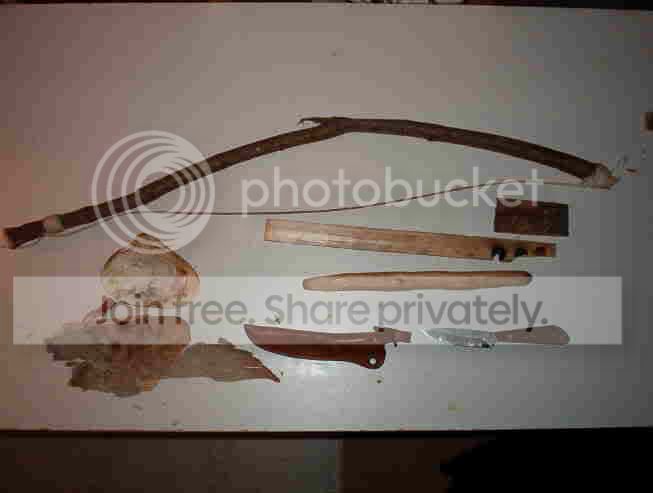
This is a very spiritual thing that is hard to explain us less you have created fire by friction. Always remember your place in the journey of life; the heart needs to be in the right place to achieve success. To build a bow and drill set, first you need the right parts.
Bow - Arm length stick or branch with a slight curve.
Bowstring Knot at top and adjustable knot on bottom (clove hitch or a couple of half hitches work best) The string can be a piece of paracord, shoe string, piece of leather, or even a cordage made from plant fibers.
Spindle Straight smooth round stick, 8-9 in length, usually the distance from thump to pinky when hand open and fingers spread out. One end of the spindle needs to be sharp and pointy, and the bottom needs to be blunter.
Handheld The wood needs to be as hard or harder than the spindle. Needs to fit comfortably in the hand. The hand should be half-open while holding the hand held.
Fireboard & notch The fireboard should be the same hardness as the spindle. Flatten top and bottom of the board and then square off the sides. The board should be around thumb thickness. The board should be long enough for you to be able to place your foot and the spindle on the board. The board should be at least two thumbs wide. Remember 3-5 fires per hole in the fireboard. Start to burn-in-socket/notch at least 1/8 inch from side of board. Position is very important. Place foot on fireboard (ball of foot). The hole should be close to foot for better control. The hand holding the Handhold and controlling the spindle should rest on shin. Lube the handhold notch with animal fat, oil from hair or face or even soap. Carve the notch into the fireboard. Divide the burned hole into 8ths and cut out one of the pieces forming a v-shape. Warm up the set before starting the process, 3-5 strokes will accomplish this. Start stroking the bow back and forth while applying downward pressure, this will fill the notch up will dust. Increase the speed to create heat. Increase speed again after the board starts smoking. You know you have a coal when the dust continues to smoke after you have stooped the process. Be patient with the coal, you have time. Let the coal grow before placing it into your tinder bundle. Blow into flame.
Bow drill Woods:
You should avoid hard woods like oak, hickory, and walnut. Also try to avoid soft, resins woods like pine, spruce, and fir.
Good woods
Cedar
buckeye
aspen
Palm
Viburium
Juniper
Sumac
Basswood
Elderberry
Sassafras
Birch
Box elder
Sycamore
Beech
Tamarack
Maple
Sage
Mesquite
Ash
Cottonwood
Guava
Yucca
Any fruit Tree
*Thumbnail Test If your Thumbnail starts to crush, and does not dent, stay away from the wood, it is too soft. If your Thumbnail can just dent the wood, the wood is perfect for a bow drill set.
Cordage
Cordage is all but indispensable in a survival situation. It can be used for bowstrings, fishing line, trap triggers, snares, and lashings. The techniques for making cordage are actually quite simple to master, and the materials needed to do so are plentiful in most areas.
The Reverse Wrap
For a tighter and much stronger wrap, start with two pieces of material and twist the one strand toward you until it almost kinks. Then bring the bottom stand once around the one you just twisted and twist the fiber in the same manner. The tension of the twist holds the pieces together. Continue the process until you have your desired length.
Splicing
In order to make a long rope or string, you can simply splice together shorter pieces as necessary by using the reverse technique. Just simply twist in another piece and continue twisting and wrapping as before. When you come to an end, add an additional piece, and so forth. Make sure that you never have two splices in the same place. A splice must always be wrapped with a solid strand for strength.
Sources of Cordage Materials
When harvesting materials for making cordage, always remember your place as a caretaker and spread the seeds. This will help to insure the plant will survive.
Wood Stalks
Dogbane
Milkweed
Indian hemp
Sting nettle
Leaves
Yucca
Palm
Cattail
Iris
Inner Bark
Red cedar
Oak
Cottonwood
Basswood
* For the South West Florida area Palm and various vines will work best *
Soaking can help most plants and bark to become better cord, and can help you to be able to separate the plant material from the cordage fibers.
When gathering rootlets for cordage, look for exposed roots from water run off, worn away banks, etc. Some rootlets that make good cordage and rope are Pine, juniper, spruce, and cedar. Try to develop a relationship with the plants in your area, spend time with each plant. Learn and understand the principals and apply then environmentally.
Other Cordage Material
Animal sinew can be used to produce some extremely strong cord. Because of its strength, sinew is really good for making bowstrings, fishing lines, snares, wrapping, and thread. Another useful property of sinew is that, when wetted with saliva before wrapping, it shrinks and dries as hard as glue. The longest sinew is form in the white cords that run along either side of an animals backbone, but you can get usable lengths from tendons and ligaments attached to muscles and bone. Simply cut out the sinew, clean and dry it. To separate the individual fiber, pound each strand with a rock, and than put it into hot water. Rawhide can also me used to make some great cordage, simply cut thin strips, you can obtain great lengths by cutting the hide in a spiral. For greater strength braid a few strips together.
Natural Bowstring Cordage
It is important to remember that if using natural materials for your bowstring not to let the cord rub on itself, because the friction will cause the string to break. When using natural cordage, a flexible bow is needed. Keep the bow tilted (pointing downward), as this will also help keep the cord from rubbing itself.


 )
)



 er than a fire drill.