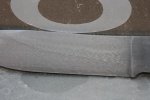
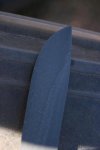
Did I mess up?

Joined
Nov 23, 2005
Messages
1,841
Hi all,

Can anyone tell what this design is and what caused it? It's 1/8" 1075, edge quenched in ATF. I kind of like the way it turned out, and there's a quench line that is fairly visible. I ended up finishing the blade anyway:o, but would like to know what I did (and whether it is good or bad or...)

Thanks,

Walter
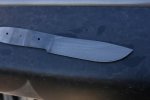
banding 1.jpg

banding2.jpg

banding3.jpg

(Sorry about the pics, I had a hard time getting the detail to show)
 
Hey Walter,
I'm curious to know.... How did the HT turn out? The hamon looks very nice.
- Mitch
 
Thanks Mitch,

It seems to have turned out pretty well. It sharpended up nice and holds an edge, but I left it sitting in the sheath for a week and rusted it pretty bad:eek: so I polished it but lost the hamon.

Walt
 
Chuck, I don't have an account on that site, but is it a picture of Mr. Lively's knife that had a (relatively) big thread here in W&C? I've followed that thread a bit, but I haven't seen a picture of the knife being discussed yet.

Thanks,

Walter
 
Careful or Fluffy will threaten to sue you too. (see now why Kevin Cashen has called what's happening between Fluffy and Tim Lively a wake up call?)
 
Thanks Mitch,

It seems to have turned out pretty well. It sharpended up nice and holds an edge, but I left it sitting in the sheath for a week and rusted it pretty bad:eek: so I polished it but lost the hamon.

Walt

Quench in ATF...... Hmmmmm.... Wait a minute.... you're not giving away any "double-secret probation" secrets, are you?:D
- Mitch
P.S. Just kidding around, Walt, for what's going on on Kevin's thread.
 
Looks good, I for one try to bring that kind of activity out in a blade. It's a bit larger and more distinct than what I'm seeing in my blades, but I'm using a differant steel. I've heard of people saying to let it soak at temp longer to get rid of the banding, but from my test my blades with banding out cut and are tougher than my blades without the banding, so I'll continue to try to get it to show up.

If the rust isn't too bad you can always refinish it and re-etch.
 
Looks good, I for one try to bring that kind of activity out in a blade. It's a bit larger and more distinct than what I'm seeing in my blades, but I'm using a differant steel. I've heard of people saying to let it soak at temp longer to get rid of the banding, but from my test my blades with banding out cut and are tougher than my blades without the banding, so I'll continue to try to get it to show up.

If the rust isn't too bad you can always refinish it and re-etch.
Will, why do you think that is? I heard the thing to do is to get rid of the banding. Isn't that part of refining grain structure?:confused: Thanks
- Mitch
 
Thanks all, I am trying to re-etch to get the activity to show up better, but it doesn't seem to want to show very well. If I remember I did an interupted quench on this one, simply because I hadn't done one before. I have another one that shows similar (though fainter) activity that I quenched in the pre-heated ATF for thirty seconds and then put in a trough with water covered by ATF. I figure I'll keep trying different things until I come up with something cool enough that people will give me some tequila for it:D:foot:

Walt

(NO offense intended towards the PITA that Mr. Lively is going through-I really hope all of that gets resolved quickly and painlessly for all.)
 
I think the reason I'm getting better performance with my blades is that I'm using a high alloy(compared to plain high carbon) 52100, low temp forging, lots and lots of low temp heats and forging at low temp, and a multiple quench. I basicly never let the blade get above criticle to cause grain growth and the blade doesn't spend much time at criticle for quenching. I wind up with a very fine grain and leave the blade at a higher level of hardness than blades that I soaked at temp. It works for me and my methouds.

Now if I had a heat treat oven with digital controls and could do some more experiments with dead on temp control I might be able to get a gane in performance the other way by holding the steel at just under criticle for a longer period of time, but it's a little hard to do with a gas forge and the low tec. way I'm set up. But for now the tripple quench and low temp forging works for me, not to say that others can't do better a differant way. I think the reason it works is that I don't have precise temp controls and that by trying to soak I run over temp slightly and cause a small amount of grain growth. By tripple quenching I'm only bring the blade up to the low end of criticle temp long enough to quench I'm not getting a complete transformation requiring a couple more quenches, but I'm also keeping the grain from enlarging. What ever is causing it it works for me, though I'm always looking to try new things and ways of doing things.

Also the banding I get is a good bit finner and fainter than damascus, not nearly as prominate as the above blade, but then I'm using differant steel and methouds. The thing to do is make anouther and then compare, and experiment and see what works best for you.
 
I'm thinking that the banding, in itself, doesn't have to do anything directly with the improved performance of your blades; it's the more refined grained structure that you are getting with the lower temp heats that is the real factor in the higher performance of your blades.
...Just my 2 cents. But, either way, I'm glad you're getting better results. Thanks for the reply...I'm just starting to really learn about refining grain structure, so I'm very interested when someone is kind enough to post anything concerning it. Thanks again. :thumbup:
- Mitch
 
I started to answer the post when it came out, but resisted. Now the ice has been broken:

Oh, my God, you've created Wootz. Run, Run,Run for you lives !!

Hard to say what you have without a better photo and all, but if the quench line polished out, you may only be looking at nothing more than the surface decarb and scale lines. Sand it down a bit more and see if the pattern is still there after an etch.
Stacy
 
Thanks Mitch,

It seems to have turned out pretty well. It sharpended up nice and holds an edge, but I left it sitting in the sheath for a week and rusted it pretty bad:eek: so I polished it but lost the hamon.

Walt

what!! I have knives that have spent years inthe sheath and they dont rust. Was it damp or something?
 
what!! I have knives that have spent years inthe sheath and they dont rust. Was it damp or something?

I was going to ask the exact same thing! The leather must have been damp, brother. I've never had a problem with a knife starting to rust in a leather sheath; heard a lot of concern by some people about storing your HC knives in leather, but I've never seen it.
- Mitch
 
Walter,
Yep the knife TL put up and caused all the traffic/concern. Your grain looks exactly like his. THere are several things that can happen to a knife stored in a sheath. Leather absorbs moisture and can cause rust. The leather may have been dyed with chemicals that are not friendly to steel. Then it may have been put up with a fingerprint on it. I have a few knives that have been stored in sheaths for years also and they have started rusting a little. But it took 10yrs. I find it is a good practice not to store in sheaths. No sense taking that chance esp on a collectable.

Chuck
 
i use 1075 and i never had one do that but what i'm using is 3/16" thick and already heat treated to a point since the steel comes from a cultivator disc. landar15, are you heating your blades in an oven?
 
what!! I have knives that have spent years inthe sheath and they dont rust. Was it damp or something?

Yeah, I had dampened the sheath, molded it to the knife, set it on top of a heater vent, and then forgot about it when I left for work the next day. When I returned ten days later it had a pretty good amount of rust, mostly close to the welt. It cleaned off pretty well, but I can't get the pattern in the steel to show as well as it did. It's still there, just pretty faint. I'm fairly sure it's alloy or carbide banding of some sort. Now if I can just get it to happen again!

Walt
 
here is food for thought. I was told by Sandy, a well seasoned leather maker, that by wet molding the sheath the tightness or holding strength can be taken out of it. Think about it....on a basic pouch sheath its the sheath NOT bending to fit the knife that causes friction to hold the knife is. By molding the knife, your relaxing friction points for a looser fit. Some may not have this view, but it makes since to me. I dont bother wet molding at all.
 
here is food for thought. I was told by Sandy, a well seasoned leather maker, that by wet molding the sheath the tightness or holding strength can be taken out of it. Think about it....on a basic pouch sheath its the sheath NOT bending to fit the knife that causes friction to hold the knife is. By molding the knife, your relaxing friction points for a looser fit. Some may not have this view, but it makes since to me. I dont bother wet molding at all.

Brian,
By wet molding, you are adding friction to keep the knife in the sheath. You are correct in your idea that the sheath not bending to fit the knife causes the friction to hold it in, but that doesn't mean that by wet molding you are relaxing the friction; on the contrary, you are increasing it substantially.
-Mitch
 
Back
Top