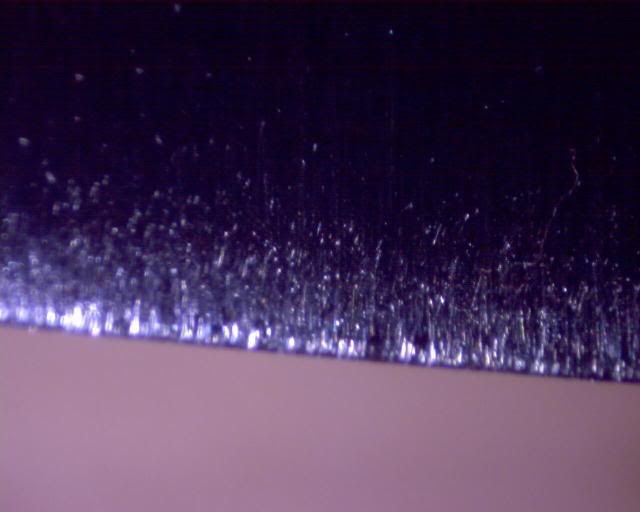
Differences in a smooth polished edge vs. Toothy polished.

Joined
Feb 4, 2009
Messages
1,914
Lately I've been experimenting with a lot of different edge types. I was wondering what your guys' preferences were regarding degree of polish. Sometimes I just give whatever polish feels the sharpest for that particular knife.

For example, on my tenacious i went from an Extra coarse dmt to medium spyderco to remove the burr to fine spyderco to slighty polish out some scratches. I then buffed on the paper wheel with white compound. The coarse looks shiny and still has grind lines. Personally, I love the look of this type of edge. Sometimes when I look at all of the pictures of blade edges, I feel pressured to give it a mirror finish, but to be honest after a while they don't look too great and don't cut as well as I'd like. US made spyderco's are sharpened on a coarse belt and then buffed without compound and yet they're sharp and stay sharp.

I know I'm dancing around a bit so my real question is what type of edge do you prefer and why? I would love some pictures :thumbup:
 
Last edited:
not trying to get anything started I honestly want to know what people like and why and that's it.
 
I much prefer polished edges, but sometimes I stop at the Medium Spyderco triangles. This give a hair shaving edge, and is still a little toothy. Most times I'll sharpen in the belt sander with leather belts, then go to the Sharpmaker to touch up in between. I have a TSEK from Benchmade in 440C that has never had a full metal removal sharpening, just touch up on the fine white Sharpmaker triangles and stropping. I've tried toothy edges and found them not to work for the type of cutting I do. I suppose I should try a really toothy edge on one blade of my trapper slip joint and see how I like it for a month or 2.
 
Here's how I see it, when your edge is sharpened with a medium grit (we'll say 600) the "teeth" are what cut and make the edge feel sharp. When you use this edge the "teeth" that extend out from the main mass of the steel are the first things to become damaged and deformed.

When your edge has been polish (say 8000 or higher) after progressing through the grits the teeth that were once their are almost gone and what your left with is a solid mass of refined steel. I view this as a better edge because the only thing that can deform is the steel and not small ridges at the end of it.

Over the years I have always asked those that I sharpen for how the edge has performed. Besides being sharp I have almost always got the comment that "my edge seems to be lasting longer" and "wow I've never seen a knife cut like that". Even my mom complains if her kitchen knives are not finished to at least 8000 grit, she's probably my best feedback because she knows nothing about the edge except when it does anwhen it does not cut well.

A sharper knife is sharper, its just a whole lot harder to finish a edge to a high grit and get it sharp than it is to get a sharp edge with a coarse stone.
 
There is some mystery here for me, depending on steel. Some steels perform best for me when the edge bevels are nicely polished. 420HC, SAK steel, 12c27, AUS8 all seem to love taking a mirror smooth polished edge, and return the favor with very good performance. Other steels are less consistent for me, some preferring a toothier edge with the polished edge getting mysteriously poorer performance.
 
that was really helpful knifenut. I know exactly what you're talking about and it makes alot of sense. Thanks alot bud!
 
shecky I would agree with you. For example s30v doesn't perform all that well for me at least when it has a mirror finish. Sometimes I wish I could have knives that would look great and be sharp but that will never happen. As of now I'm still learning. I have messed up some good knives and had some epiphonies along the way. Loving knives isn't alll that easy lol.
 
Here's how I see it, when your edge is sharpened with a medium grit (we'll say 600) the "teeth" are what cut and make the edge feel sharp. When you use this edge the "teeth" that extend out from the main mass of the steel are the first things to become damaged and deformed.

When your edge has been polish (say 8000 or higher) after progressing through the grits the teeth that were once their are almost gone and what your left with is a solid mass of refined steel. I view this as a better edge because the only thing that can deform is the steel and not small ridges at the end of it.

Over the years I have always asked those that I sharpen for how the edge has performed. Besides being sharp I have almost always got the comment that "my edge seems to be lasting longer" and "wow I've never seen a knife cut like that". Even my mom complains if her kitchen knives are not finished to at least 8000 grit, she's probably my best feedback because she knows nothing about the edge except when it does anwhen it does not cut well.

A sharper knife is sharper, its just a whole lot harder to finish a edge to a high grit and get it sharp than it is to get a sharp edge with a coarse stone.

I agree with all of this.
 
I put the most polished edges on my knives that my sharpening equipment lets me.

I've tried using rocks, cinder blocks, various grits of arkansas/ceramic/diamond stones, steels (Grooved and smooth), sandpaper etc.....not to mention various strops....

Low grit edges are certainly serviceable, Tom Krein is good proof of that. But if my equipment allows me to go past 120 grit, I won't be stopping there.

I've found the more polished the edge is, the longer it lasts, and the better it cuts. I hear a lot of talk on the forums about how certain steels like a toothy edge, or how low grit edges slice certain things better, but I've never found this to be true and I've experimented on this for years. I've done multiple head to head tests of knives in the same steel and geometry with different levels of edge polish. So much has been said about low grit edges being superior for cutting rope, but comparing a knife finished on a DMT X course and a knife finished on a Spyderco UF ceramic stone I've found the latter outcuts the former by a huge margin. The force required to cut the rope is drastically reduced the more polished I go in my experience, not to mention it's ability to push cut thin sections of wood, fruits and veggies etc.

Every single knife I own will take a polished edge. Every single one. I don't have any knives that "like a toothy edge," and that includes 420HC, S30V, S60V, 13C27, 12C28, 1095, 1080, SR101, S7, ZDP189, 8Cr13MoV, 154CM, D2, CPMD2, H1, 52100, CV, 440C, VG10 and a few I'm probably forgetting.

I put polished edges on my axes, my chopping knives, kitchen knives, pocket knives, SAKs, multitools, SAK awls, can openers, scissors etc.

Everything I said has been true for me with both plain edges and serrated edges.
 
I'm right there with ya Vivi, I'll get some comparison pic's up in the morning.
 
I've noticed, when using 'cheap' kitchen knives, that sometimes they might benefit a little bit with a slightly toothier edge. Specifically, when slicing tomatos, I've noticed that a couple of my cheapo knives, with what seemed to be pretty soft (or just simply inferior) steel, didn't accomplish this task very well for very long with a highly polished edge on them. For instance, I've compared two different knives for tomato slicing. One was your basic Walmart special (for 6 or 7 bucks I think), and the other was an A.G. Russell 'Deer Hunter' drop point in VG10 steel. I put polished edges on both, using my Lansky sharpener. The cheap knife initially seemed to cut pretty well, but then began to 'slide' over the skin on the tomato with actually cutting through it. The VG10 blade went through the tomato like the proverbial hot knife through butter, and has never faltered to this day. I used a fine diamond hone to slightly 'rough up' the edge on the cheap knife a little bit, giving it some extra bite. That seemed to be what that knife needed, it seems to slice a little better for longer with that edge. I think the teeth on that blade help to hide some of the otherwise inferior character of that steel (whatever it is). I wonder if maybe that's why a lot of 'inexpensive' kitchen knives come with serrated edges on them?

I do know this: Of all the knives I've owned with quality steel, they've ALWAYS gotten better when I polished the edge on 'em. The very first time I experienced an 'OH MY GOD' reaction to the cutting performance of a blade, was after polishing the edge on it to a mirror finish. I literally never realized how sharp a blade's edge could be until that point. Even steels that I used to consider 'average' (like 420HC, 440C, and Case's so-called 'Tru-Sharp Surgical Stainless') have benefited greatly by further refining and polishing the edge on them. It's raised my appreciation and respect for the sharpening arts to a whole new level.
 
I've noticed, when using 'cheap' kitchen knives, that sometimes they might benefit a little bit with a slightly toothier edge......

Interesting observations with the kitchen knives. I wonder if increasing the edge thickness on the cheap knife, but still giving it a high polish, would affect edge retention at all?
 
I find that when I leave my kitchen knives with a "toothy" edge, it's usually because I'm just being lazy. I try to justify it, saying it will slice better, but my roommates notice and tell me the knife is dull. I guess they're spoiled by mirror edges.
 
I've noticed, when using 'cheap' kitchen knives, that sometimes they might benefit a little bit with a slightly toothier edge. Specifically, when slicing tomatos, I've noticed that a couple of my cheapo knives, with what seemed to be pretty soft (or just simply inferior) steel, didn't accomplish this task very well for very long with a highly polished edge on them. For instance, I've compared two different knives for tomato slicing. One was your basic Walmart special (for 6 or 7 bucks I think), and the other was an A.G. Russell 'Deer Hunter' drop point in VG10 steel. I put polished edges on both, using my Lansky sharpener. The cheap knife initially seemed to cut pretty well, but then began to 'slide' over the skin on the tomato with actually cutting through it. The VG10 blade went through the tomato like the proverbial hot knife through butter, and has never faltered to this day. I used a fine diamond hone to slightly 'rough up' the edge on the cheap knife a little bit, giving it some extra bite. That seemed to be what that knife needed, it seems to slice a little better for longer with that edge. I think the teeth on that blade help to hide some of the otherwise inferior character of that steel (whatever it is). I wonder if maybe that's why a lot of 'inexpensive' kitchen knives come with serrated edges on them?

I do know this: Of all the knives I've owned with quality steel, they've ALWAYS gotten better when I polished the edge on 'em. The very first time I experienced an 'OH MY GOD' reaction to the cutting performance of a blade, was after polishing the edge on it to a mirror finish. I literally never realized how sharp a blade's edge could be until that point. Even steels that I used to consider 'average' (like 420HC, 440C, and Case's so-called 'Tru-Sharp Surgical Stainless') have benefited greatly by further refining and polishing the edge on them. It's raised my appreciation and respect for the sharpening arts to a whole new level.

Good to see you back on the forum. I thought you split for awhile. I looked and saw you have been posting, I just must have missed it.
 
BRKT gunny

Factory edge just sharp enough to shave
PIC068.jpg


After sharpening would pass a HHT-3/4
PIC069.jpg
 
knifenut that edge is beautiful.. I wish mine could look like that. Hoenstly I've never whittled a a hair andd probably won't be able to until I see my girlfriend considering all of my hair is buzzed!
 
Here is a bit of food for thought.

I will start by saying that I prefer polished edges for everything for various reasons, but edge durability being the top reason.

When this topic comes up I can not help but feel that some responders are giving a testimony based on their abilities AND (and here is the big one) based on what they experience before standing up from the sharpening table. OTOH most responders here (so far) are what I typically recognize as way above average knife user/sharpeners.

A toothy edge will tend to bite really well but degrade more quickly than a polished one for obvious (to me at least) reasons as posted above by others. Using almost every method I was ever shown as a boy, a toothy edge will present as VERY sharp (thumb test, fingernail test, cutting paper, cutting fruit, veggies, shaving, etc.). Practically any test that most average people (non-knife zealots) will use should result in a passing grade for a toothy edge.

Further, some people in their efforts to polish will use various (bad) techniques and actually achieve a nicer looking bevel (naked eye) with rolled or burred edges that performs poorly compared to the what they were holding minutes ago while sitting in front of the coarser media.

The last point I will bring up deals with the user preference. Some people prefer a serrated knife for everything for example...it is easy to understand (for me at least) how these people will prefer a toothy edge. Regardless of your theories on that idea, you can probably follow the concept that a toothy edge will saw cut some things better than a polished edge...if not here is a demo:

Get a two identical knives of a decent steel and put a polished edge on one and a very well done toothy edge (somewhat like the factory edges Spyderco delivers). Now using only the weight of the knife do some sawing motions over a roll of toilet tissue, or a fresh tomato. The toothy edge usually cuts deeper with less pressure using this cutting technique. BUT!!! to everyone's points above, the polished edge will be slicing better after both knives have been used extensively....this gets to the "durability" discussion.

Edit to add: Another portion of the discussion could go into the type of steel. Some steels (typically cheaper knives) seem to ONLY perform with coarse edges. Perhaps a better craftsman than I can polish the edge on a mild steel blade with good results, but in my experience cheap steel's only hope is a coarse edge that needs constant attention.
 
Last edited:
Good to see you back on the forum. I thought you split for awhile. I looked and saw you have been posting, I just must have missed it.

Thank you CJ. I was away for a bit, had some distractions to deal with (and still do, actually). But, I do find it easy to get pulled back to the BF. I find it quite relaxing and therapeutic... helps maintain my sense of sanity :p.
 
Back
Top