So from the information you've given me , I can safely say that 1 batch of M390 Bohler steel could be drastically different than say if Crucible tried to manufacture M390?..
You would think they have the alloys down to a science in 2017 and anyone should be able to create a consistent product with today's technology? I understand their will be hiccups in how homogenous 1 batch might be over another but naturally the manufacture would just call it a loss and throw it out?
If we know the chemistry of an alloy I don't see why their should be so many .."variables" when producing such a product?
Also..would you go as far as to say the Rockwell of certain steels are tested per the manufacturers? Example say Crucible thinks s30v just shines like a diamond at let's say 53RC. But Bohler laughs at their face because they have the resources and facts that prove s30v is way too brittle at 53 so they make theirs at 51?
(I know nothing about the "logistics" of Rockwell i.e if they are their own entity or rather just a standardized sub set of numbers and stats? I just haven't given that much research time to this side of knives sadly)
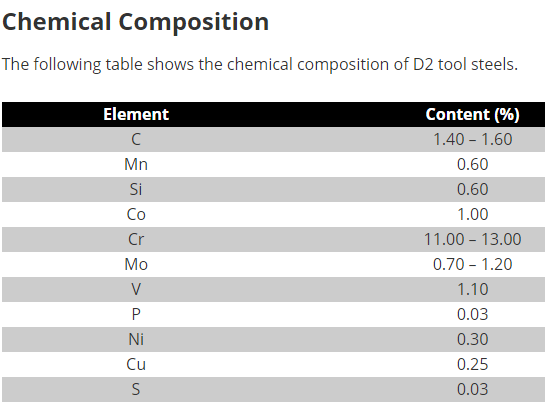
Let me give an example so it's more clear. Here's a picture of the composition of D2:
from:
http://www.azom.com/article.aspx?ArticleID=6214
There is a range of acceptable fractions for each element. This is common with many steels. It means that not all D2 has the same elemental composition. Then with heat treatment there are even more differences. Starting out with a different composition is going to yield different steel from batch to batch. Are the differences noticeable? That's a separate issue.
I'm not saying that Crucible would make M390 differently from Bohler. I'm saying batch to batch for every steel regardless of who makes it there are going to be differences at the atomic or molecular level. If Bohler makes M390 in a batch of let's say 1000 lbs, is that batch going to have exactly 19.00000 lbs of carbon? (1.9% carbon) What if it has 18.99999 lbs of carbon? Is that close enough or does it have to be exactly 19.00000 lbs of carbon? Where is the line drawn for what is called M390? That's where specifications and tolerances come into play.
And that's precisely the point. There will always be differences. I'm not suggesting those differences are going to amount to anything that anyone would be able to reliably tell apart. The point is that there are specifications and if something is "good enough" for a given application then that's what happens.
Going from raw steel to a finished product like a blade requires shaping the blade. Grinding at high temperatures will affect the steel. Heat treatment adds additional changes. What if the blade is heat treated with 1 degree of difference from another blade? What about 0.5 degrees of difference? What changes does that cause? Are they noticeable?
There are numerous variables and without going to extreme lengths to control everything it's impossible to achieve the exact same results every time. What we get is something that's
virtually identical or nearly impossible to tell the difference. However, looking at the microstructure of any non-homogeneous material, it's evident that piece 1 of steel A is not identical at a molecular or atomic level to piece 2 of steel A. Like I mentioned before, the only substances that will be identical are pure crystalline ones, most likely created in a lab.
So, my long-winded point is that Damascus is not the only steel that is going to vary from batch to batch. Every non-homogeneous material is going to vary. The question is really this: "By how much must it vary for someone to notice a difference?" In the case of Damascus, it depends on the materials and methods just like any other steel. I hope this clarifies my previous comments.