
Hi Everyone.
I am a hobbyist level tinkerer and I love making things. I am working on making a kitchen knife for my wife's birthday, but have run into an extremely unfortunate issue. I am working with a piece of 1095 + 15n20 damascus that I purchased online. It took a ton of work to get the piece perfectly flat and even and ready to go for cutting out the shape of the knife prior to heat treating. I have cut out the knife blank and sanded it, and woe is me, there is a little slot of delamination exactly in the center of what is to be the cutting edge. I couldn't get very good pictures of the problem, so I have created some diagrams showing it. The picture below illustrates the problem from two different views (the red is the slot of delamination):
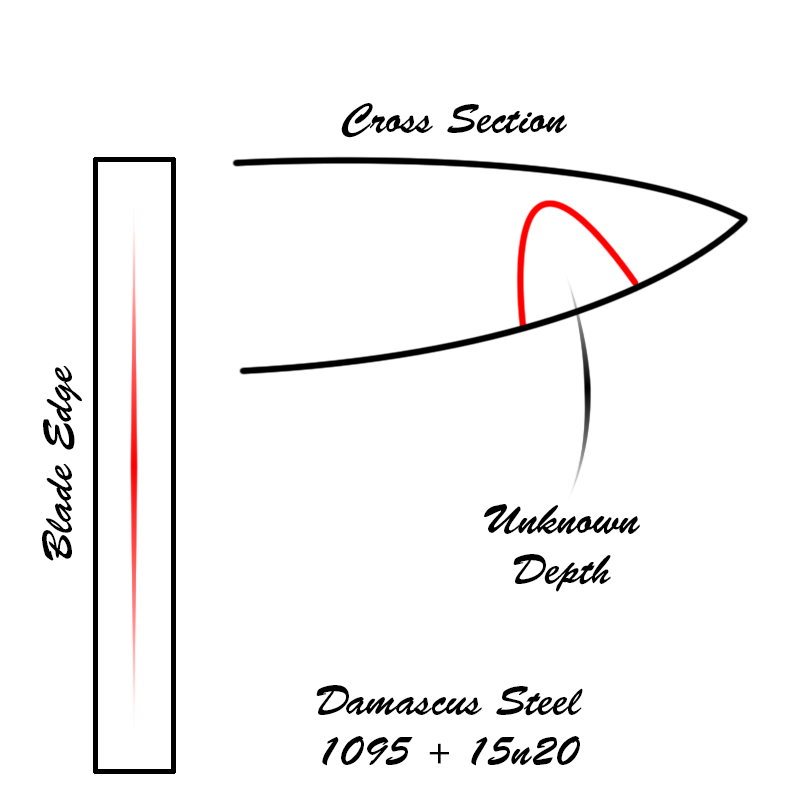
Now, given the material cost and the amount of effort that has gone into this thing already I really don't want to purchase another piece of metal and start over. I'm not a pro at this and don't have the tools or skills to do anything very quickly, so it might not look like much but a lot of hours have already been invested into this piece of metal. I have already changed the profile of the knife quite a bit as I attempted to grind past the delamination, but I don't want to alter the shape any further and I have no way of knowing how deep the slot goes, all I know is that it doesn't go all the way through because it isn't visible on the other side. I am looking for any possible solutions. One silver lining in the problem is that the slot is right in the part of the kitchen knife that really doesn't ever get used. 90% of the work of a kitchen knife is done with the belly of the knife and the other 10% is fine work with the tip, and luckily this delamination slot is in a small area between the two.
The first, most obvious solution that came to mind was to simply heat up that part of the blade real hot and smack it together or squeeze it in a vice in an attempt to get the layers to weld together. My main issue with that is that I have no good way to clean out the slot since it is so tiny, so I doubt I would be able to get a good weld. Any thoughts on this idea?
The other potential solution that I have thought up is to grind down the edge in that area, similar to a cavity in a tooth, and then fill it up with a tig welder bead and grind it down flush. I have created a diagram for what this process would entail:
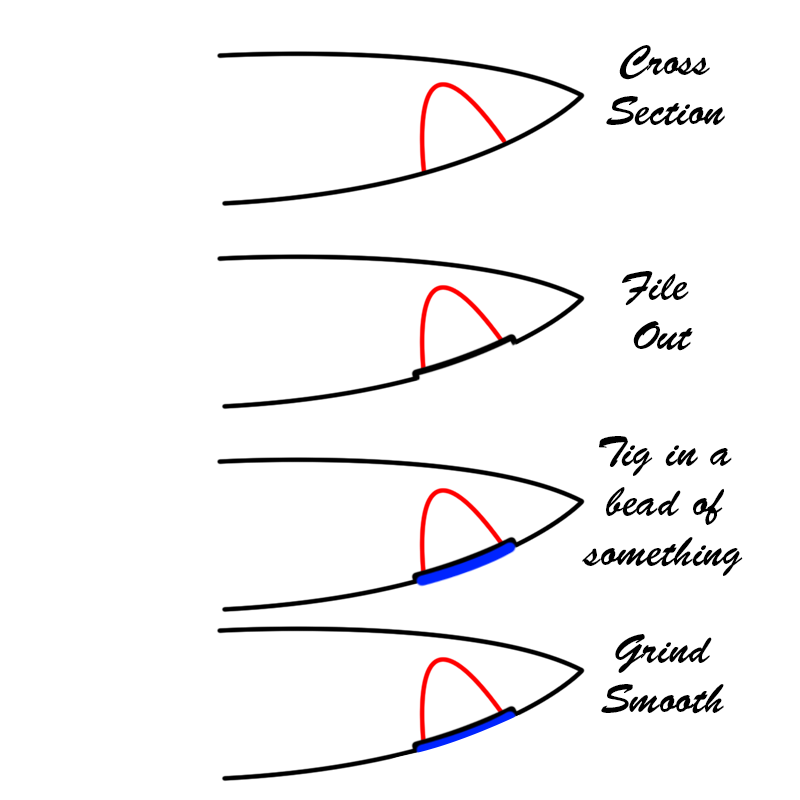
It seems like it could be a decent solution, because I would only file down about 1/16th of an inch, and I am planning to do the final grinding of the secondary bevel after acid etching the damascus, so the whole edge would be shiny anyways and you shouldn't be able to tell there is a small portion there that isn't damascus. Since that portion of the edge doesn't really do any work it doesn't really matter that most welding materials won't hold a decent edge, it would be mostly cosmetic. Does this seem like a decent solution? If so, what welding medium should I use to fill the "cavity"?
EDIT: I have a friend who is a great welder and I have the pieces of the metal I sawed off when cutting out the knife blank. I could have him use a tig torch and pool some of the cutoff into the gap, obviously with a big pre-heat and post-heat of the welding area, that might do the trick.
I would love any tips and suggestions about how I can save this project. Thanks for reading!
I am a hobbyist level tinkerer and I love making things. I am working on making a kitchen knife for my wife's birthday, but have run into an extremely unfortunate issue. I am working with a piece of 1095 + 15n20 damascus that I purchased online. It took a ton of work to get the piece perfectly flat and even and ready to go for cutting out the shape of the knife prior to heat treating. I have cut out the knife blank and sanded it, and woe is me, there is a little slot of delamination exactly in the center of what is to be the cutting edge. I couldn't get very good pictures of the problem, so I have created some diagrams showing it. The picture below illustrates the problem from two different views (the red is the slot of delamination):
Now, given the material cost and the amount of effort that has gone into this thing already I really don't want to purchase another piece of metal and start over. I'm not a pro at this and don't have the tools or skills to do anything very quickly, so it might not look like much but a lot of hours have already been invested into this piece of metal. I have already changed the profile of the knife quite a bit as I attempted to grind past the delamination, but I don't want to alter the shape any further and I have no way of knowing how deep the slot goes, all I know is that it doesn't go all the way through because it isn't visible on the other side. I am looking for any possible solutions. One silver lining in the problem is that the slot is right in the part of the kitchen knife that really doesn't ever get used. 90% of the work of a kitchen knife is done with the belly of the knife and the other 10% is fine work with the tip, and luckily this delamination slot is in a small area between the two.
The first, most obvious solution that came to mind was to simply heat up that part of the blade real hot and smack it together or squeeze it in a vice in an attempt to get the layers to weld together. My main issue with that is that I have no good way to clean out the slot since it is so tiny, so I doubt I would be able to get a good weld. Any thoughts on this idea?
The other potential solution that I have thought up is to grind down the edge in that area, similar to a cavity in a tooth, and then fill it up with a tig welder bead and grind it down flush. I have created a diagram for what this process would entail:
It seems like it could be a decent solution, because I would only file down about 1/16th of an inch, and I am planning to do the final grinding of the secondary bevel after acid etching the damascus, so the whole edge would be shiny anyways and you shouldn't be able to tell there is a small portion there that isn't damascus. Since that portion of the edge doesn't really do any work it doesn't really matter that most welding materials won't hold a decent edge, it would be mostly cosmetic. Does this seem like a decent solution? If so, what welding medium should I use to fill the "cavity"?
EDIT: I have a friend who is a great welder and I have the pieces of the metal I sawed off when cutting out the knife blank. I could have him use a tig torch and pool some of the cutoff into the gap, obviously with a big pre-heat and post-heat of the welding area, that might do the trick.
I would love any tips and suggestions about how I can save this project. Thanks for reading!
Last edited:


