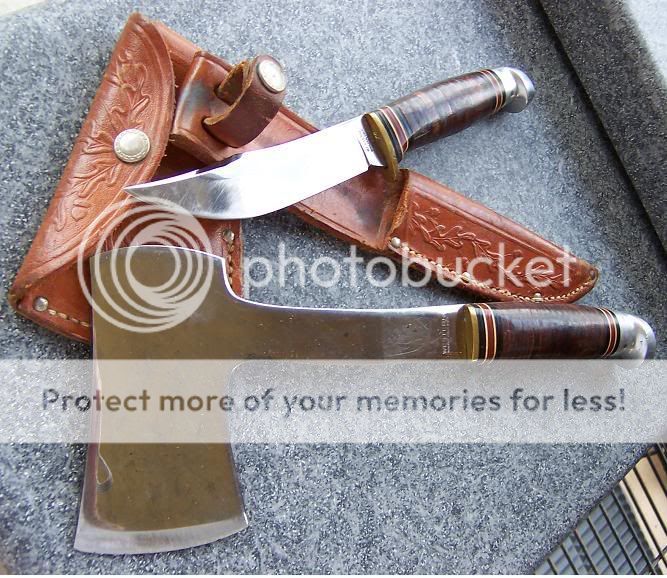
SunnyD, Nice set-up. The old timers had thought all this through, many years ago, when they came up with those knife/hatchet sets.
I remember having a cheaper version as a kid.
Hollowdweller, you da man, I agee with you regarding weight, chopping ability and edge angle. Most things in the physical world can be seen in such a light, the yin and yang.
You reduce size, angle must be more acute and sharper to mitigate the loss of weight. As you also said, the user must compensate with speed/force depending on the size. I think this type of principal holds true for axes, knives , and life in general. There is always a trade-off. it doesn't mean it's bad, it's just different. We trade light weight/compactness for brute chopping ability, or vice versa.
Hammering. Sorry to the Grandfors or Wetterling crowd, but it's preposterous that you can't hammer with the flat face of a hatchet. That's what it was originally designed for! A hatchet is a hand axe/hammer combo. We are talking about hardened steel here. With the exception of Case hardended nails, a vast majority of nails are soft metal. Any hand axe/hatchet should be able to drive them all day long, for decades with no more than surface scratches. Likewise, as was mentioned, tent pegs should be no problem.
Wooden dowels, same same.
With that said, let's look at mushroomed hatchet heads for a moment.
Culprit #1: pounding other hardended steel objects is a No-No. Hatchets were not intended to pound on a splitting wedge.
Culprit #2: Using the hatchet as a splitting wedge and hammering it with a steel hammer or other hardened carbon steel. Big No-No.
By and large, that's where mushrooming comes from, basically it's from abuse. After mushrooming comes the cracking and the danger.
I would suspect that the companies named above, tell people not to use them as hammers for insurance purposes. Easier for the lawyer to simply say NO, then to delineate the cases where it is proper and Not.
One should be able to hammer 12 penny framing nails or wooden pegs virtually forever without a problem.
When pounding steel against steel, the hatchet is typically not quite as Hard and containes a little less carbon, than say a Hammer. It's that small difference that mushrooms the hatchet head, and leaves the harder hammer intact. That's been my experience, mileage may vary.
On Wooden handles: (and tools with sockets)
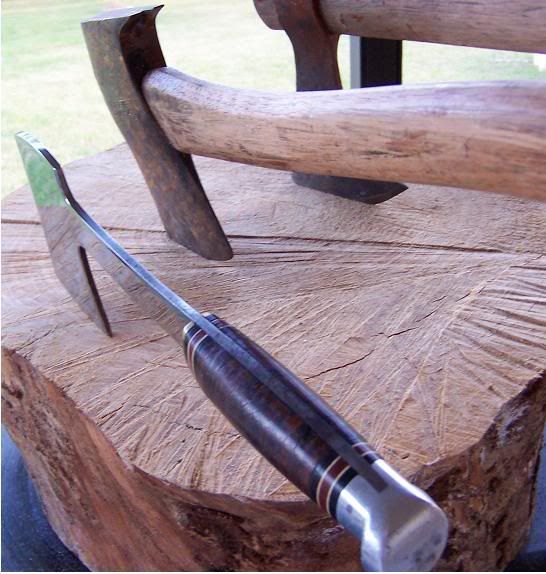
Tradition meets newer materials. I know the new composite handes are very tough, no argument there. But a wooden handled tool can be rehandled indefinitely. In the Wilderness, it wouldn't take a lot of effort to scrounge up some decent hardwood, shape it, harden it over the campfire, and re-handle into a socketed tool.
I understand the fiskers and gerber "Could" be rehandled, in a pinch, using the "stone age" lashing design, but they may not be quite as sturdy in the long run.
For now, I'm sticking with wooden handles. In a wilderness situation it makes sense, in a survival situation it could really be a big difference if you were to break a handle.
Good thread.




 You and Thomas Linton, I mean.


 )
)


 or if I did, at least the handle would be protected.