Do you ever consider a knife's price vs. its cost to produce and sell?

That's quite interesting... Whether or not a knife which is being offered for sale is priced at MSRP or the [current] street price doesn't mean all that much to me. The price could still be a ripoff.

On the other hand, the stated price compared to its actual cost of sales means a lot to me. That's what determines real value.

How are you going to know what the COS is for any knife? This proprietary info that, as far as I know, is NOT public.

The only relevant info for a consumer is the purchase price and, whether or not it's a good "value" has to be deduced from the quality of materials used and the quality of construction relative to other knives sold in the marketplace.

So, as far as I'm concerned, it's really only the price that really matters (assuming all other factors in terms of quality of materials/workmanship are equal (which, of course, may not necessarily be the case).
 
Last edited:
How are you going to know what the COS is for any knife? This proprietary info that, as far as I know, is NOT public.

The only relevant info for a consumer is the purchase price and, whether or not it's a good "value" has to be deduced from the quality of materials used and the quality of construction relative to other knives sold in the marketplace.

So, as far as I'm concerned, it's really only the price that really matters (assuming all other factors in tersm of quality of materials/workmanship) are equal (which, of course, may not necessarily be the case).
That's a legitimate question. I've worked in new product development for many years. One of the tasks, working in conjunction with purchasing agents, manufacturing folks, cost accountants and others, is the costing of components or of finished products. It's a formal, analytical process. Essentially you determine the process that's going to be used to produce the product, then apply machine rates, labor rates, overhead levels, etc., etc. Add that to the cost of raw materials and you derive a helpful number that's used both for pricing of finished products and for negotiating with vendors who might make some of the component or finished goods.

In some cases costing deals with truly proprietary processes which are subcontracted. In the world of knives, heat-treating is a prime example. Unless you have the ability and desire to develop (and thus cost) the process in-house, you'll largely have to evaluate the price of the heat-treating based on a competitive bidding process with others able to do the work.
 
Last edited:
Don't get me wrong -- I realize the relationship between the Cost of Goods Sold (COGS) and the sales price can differ wildly depending on the product. The COGS of a bag of rice at the local grocery greatly influences the price it's being sold for. On the other hand, the COGS of wholesale diamonds being sold by DeBeers doesn't influence their ultimate sales price nearly as much. I also understand it's in the seller's best interest to maximize their profit in most situations. I get all of that.

I was thinking today about The Opinel Model #13 -- the "Opinel Giant." It has an 8.5" (22 cm) blade made of 12C27 Sandvik Stainless Steel. A very simple knife, pretty much like most other Opinels. It's often offered for $99.99. Neat blade in some ways.

AvbudD2.jpeg

I thought about the Giant Opinel (which I have long coveted for some reason?) while using my Bearhard folding hand saw with a 10" SK5 blade. It's a good saw. I sometimes carry it when I hike (so I'm not tempted to "baton" anything.) I paid $19.95 for it about a year ago. While the two instruments aren't really directly comparable in some ways, their COGS are generally comparable. I do wonder why Opinel charges 5X for its product? I suspect it's "because it can." That's probably the only real reason why I've never picked one up.

o6kI0yC.jpeg


Sometimes though, I find it disconcerting when the price of some knives, have such little relation to their GOGS. Not as bad as jewelry and the like, but still out of whack at times. Does anyone else here ever feel that way?


If you think about it their are four factors that determine the price of something.

1)The cost to produce it (including the cost to sell it.. distribution, etc)
2) the volume of sales
3) the desirability or reputation of the brand
4) The price that can be charged based on the demand for the item versus the supply of the item or the competition in the marketplace.

For #1 I think you are very wrong about cost of goods being equivalent. Country of origin, materials used, finish of the blade (grind and heat treat) and amount of hand work required are all different. I would suspect the Opinel has a much higher cost to manufacture.

For #2, The target customer base is much larger for the saw. The saw company can afford a lower profit because of higher volume of sales. For the large Opinel it's probably only knife enthusiasts who also happen to be Opinel enthusiasts who would be the customer base.

Now #3 could be a desirable reputation from the standpoint of social standing such as something like a Coach wallet or Louis Vuitton handbag.
It could also be something like a Surefire flashlight, where the desirability is derived from a reputation that it always turns on when you need it. This is more like Opinel in this case. They have obtained a following due to a reputation for making a quality product that works for a reasonable price. There is also a bit of retro appeal. Any of these factors means people are generally willing to pay more than for a similar item.

For #4 there is no shortage of pruning saws. Someone like Gerber might get a few bucks more based on name reputation but anyone else is going to lose out to a similar product at a lower price. On the flip side, I would bet the demand on the Opinel knife is so small that only a high profit margin on the thing make it worth their while to even make or sell it. Also by definition Opinel is the only supplier for this knife so they don't need to worry about competition.

I think both items are priced about right.
 
If you think about it their are four factors that determine the price of something.

1)The cost to produce it (including the cost to sell it.. distribution, etc)
2) the volume of sales
3) the desirability or reputation of the brand
4) The price that can be charged based on the demand for the item versus the supply of the item or the competition in the marketplace.

For #1 I think you are very wrong about cost of goods being equivalent. Country of origin, materials used, finish of the blade (grind and heat treat) and amount of hand work required are all different. I would suspect the Opinel has a much higher cost to manufacture.

For #2, The target customer base is much larger for the saw. The saw company can afford a lower profit because of higher volume of sales. For the large Opinel it's probably only knife enthusiasts who also happen to be Opinel enthusiasts who would be the customer base.

Now #3 could be a desirable reputation from the standpoint of social standing such as something like a Coach wallet or Louis Vuitton handbag.
It could also be something like a Surefire flashlight, where the desirability is derived from a reputation that it always turns on when you need it. This is more like Opinel in this case. They have obtained a following due to a reputation for making a quality product that works for a reasonable price. There is also a bit of retro appeal. Any of these factors means people are generally willing to pay more than for a similar item.

For #4 there is no shortage of pruning saws. Someone like Gerber might get a few bucks more based on name reputation but anyone else is going to lose out to a similar product at a lower price. On the flip side, I would bet the demand on the Opinel knife is so small that only a high profit margin on the thing make it worth their while to even make or sell it. Also by definition Opinel is the only supplier for this knife so they don't need to worry about competition.

I think both items are priced about right.
First, I didn't say there were only four factors. Please don't lie about what I posted. There can be a HUGE multitude of things to consider (e.g. tooling depreciation schedules, projected product lifecycles, expected maintainability and warrenty expenses, etc., etc.) depending on what's being costed which neither you nor I mentioned. Thankfully, both examples I used are fairly simple and straightforward.

In the end, it's all (in theory) about maximizing profit given the profit margin/unit vs. sales volume relationship. Well, except for the obvious exceptions of course like loss leaders (e.g. Costco rotisserie chickens) and attention-getters like the Giant Opinel which function more like a form of advertisement for the company, than a real revenue runner.

It's clear the Giant Opinel's price has little relationship to its COS. That gives me pause when it comes to purchasing. That's really neither here nor there when compared to some knives which have an even weaker (much weaker in some cases) price/COS relationships.

Some seem to get very defensive about this? Perhaps because they own products whose price have little relationship to their COS? Frankly I don't care.
 
First, I didn't say there were only four factors. Please don't lie about what I posted. There can be a HUGE multitude of things to consider (e.g. tooling depreciation schedules, projected product lifecycles, expected maintainability and warrenty expenses, etc., etc.) depending on what's being costed which neither you nor I mentioned. Thankfully, both examples I used are fairly simple and straightforward.

In the end, it's all (in theory) about maximizing profit given the profit margin/unit vs. sales volume relationship. Well, except for the obvious exceptions of course like loss leaders (e.g. Costco rotisserie chickens) and attention-getters like the Giant Opinel which function more like a form of advertisement for the company, than a real revenue runner.

It's clear the Giant Opinel's price has little relationship to its COS. That gives me pause when it comes to purchasing. That's really neither here nor there when compared to some knives which have an even weaker (much weaker in some cases) price/COS relationships.

Some seem to get very defensive about this? Perhaps because they own products whose price have little relationship to their COS? Frankly I don't care.
I'm confused. You didn't say there were four factors, I did! Tooling depreciation etc is item #1 I mentioned.

I'm really not sure what you mean by lying about what you posted.

Anyway, it was a fun exercise to think about why things cost what they do and I even learned that their is a market (however small) for giant Opinel knives and that such things exist. Lol
 
It's the main factor as to why I won't pay even lower end premium prices for China made knives. Or shoes. Or anything for that matter.

Without turning this into the typical political bs, it's just a personal preference. I'm not "against" chinese made goods persay, but the main driving force for companies to relocate/outsource their manufacturing processes there is to save costs, so as a consumer, if/when I see that label I expect to save costs as well. A $200+ pair of sneakers made in China, I'd rather put towards a pair of Red Wing boots made in the USA. If/when I do buy shoes made there, you best believe I found 'em on sale, on the clearance rack, or they cost <$50 from the gates. So for me it is the same with knives. No matter how appealing a design might be to me, I would never spend $100+ on a knife made in China, and even at that price it's a big push and has to really appeal to me to even consider it.
When there are just so many other quality options and designs made in Europe and the USA in that $100 - $200+ range, I personally just can't justify a Chinese knife for the same price, understanding to some extent the cost of production over there vs. here and Europe. When I do buy one from there, it's always been sub-$100, and still nearly always at an even further discounted sale price, unless it was <$30 to begin with.

Just like the manufacturers who outsource production there, I too am looking to save as much money as possible if/when I'm buying something from there.
 
It's the main factor as to why I won't pay even lower end premium prices for China made knives. Or shoes. Or anything for that matter.

Without turning this into the typical political bs, it's just a personal preference. I'm not "against" chinese made goods persay, but the main driving force for companies to relocate/outsource their manufacturing processes there is to save costs, so as a consumer, if/when I see that label I expect to save costs as well. A $200+ pair of sneakers made in China, I'd rather put towards a pair of Red Wing boots made in the USA. If/when I do buy shoes made there, you best believe I found 'em on sale, on the clearance rack, or they cost <$50 from the gates. So for me it is the same with knives. No matter how appealing a design might be to me, I would never spend $100+ on a knife made in China, and even at that price it's a big push and has to really appeal to me to even consider it.
When there are just so many other quality options and designs made in Europe and the USA in that $100 - $200+ range, I personally just can't justify a Chinese knife for the same price, understanding to some extent the cost of production over there vs. here and Europe. When I do buy one from there, it's always been sub-$100, and still nearly always at an even further discounted sale price, unless it was <$30 to begin with.

Just like the manufacturers who outsource production there, I too am looking to save as much money as possible if/when I'm buying something from there.
Except that's not typically the case of course. Either the price is lower, or the knife is substantially better...
 
... I kind of want the giant opinel now. 😁

I have 1 of them. It’s a pretty cool picnic knife. Great for watermelon and birthday cake. The fact that it folds into the handle adds a level of safety you don’t get by wrapping a kitchen knife in a towel.

The OP makes an interesting point about that saw. It would make a great knife for a fraction of the cost.

My original reason for wanting and buying the Opinel 13? It reminded me of the huge sales display knives that are never for sale but I always wanted. Same thing with the set that comes in the glass top box. It’s almost like Opinel made extra oversized sales models and countertop displays cases so we all could finally have one of our own.
 
Last edited:
Price is usually subjective. The cost of materials is only a small fraction of what goes into making a high quality knife. Most of the people I know wouldn’t dream of paying more than $100 for any knife. However, I care enough about quality and craftsmanship that I usually go after knives produced by reputable manufacturers, and this generally comes with a higher price tag. Companies like Spyderco, Benchmade, CRK, etc worked hard to build a reputation to justify their prices and that’s why people are willing to pay premium prices for their products.
 
This past week I gifted my mailman a Kershaw Scallion and a Kershaw Blur. Both were unused and new in box.

He buys Eafengrow’s from China.

You would have thought I gave him a Sebenza. He was blown away. He raved about the quality…from two lower end Kershaws.

He’s a good cat and I felt he deserved them. He can’t afford to buy real quality knives….and there’s nothing wrong with that. Sometimes I wish I was the same.

So Chinese knives fill a place in the knife ecosystem…..much in the same way quality USA, German, Russian, and customs do.
 
No, this isn't a worry that I've ever had. If I feel something is overpriced I genuinely don't care about the costs involved for the manufacturer, only for myself, same if I feel it's a bargain. The company is in it to make money, I'm in it to enjoy my hobby. I find worrying about exactly how much money they're making on my purchases is superfluous, possibly even antithetical, to my stated goal.
 
First, I didn't say there were only four factors. Please don't lie about what I posted. There can be a HUGE multitude of things to consider (e.g. tooling depreciation schedules, projected product lifecycles, expected maintainability and warrenty expenses, etc., etc.) depending on what's being costed which neither you nor I mentioned. Thankfully, both examples I used are fairly simple and straightforward.

In the end, it's all (in theory) about maximizing profit given the profit margin/unit vs. sales volume relationship. Well, except for the obvious exceptions of course like loss leaders (e.g. Costco rotisserie chickens) and attention-getters like the Giant Opinel which function more like a form of advertisement for the company, than a real revenue runner.

It's clear the Giant Opinel's price has little relationship to its COS. That gives me pause when it comes to purchasing. That's really neither here nor there when compared to some knives which have an even weaker (much weaker in some cases) price/COS relationships.

Some seem to get very defensive about this? Perhaps because they own products whose price have little relationship to their COS? Frankly I don't care.
The reason you're getting what you perceive as defensive answers is that you seem to be genuinely curious, but most that ask this type of question are trying to direct it into an attack on certain knife companies that they've decided are too expensive. It happens very routinely here and gets fairly tiresome.
 
This past week I gifted my mailman a Kershaw Scallion and a Kershaw Blur. Both were unused and new in box.

He buys Eafengrow’s from China.

You would have thought I gave him a Sebenza. He was blown away. He raved about the quality…from two lower end Kershaws.

He’s a good cat and I felt he deserved them. He can’t afford to buy real quality knives….and there’s nothing wrong with that. Sometimes I wish I was the same.

So Chinese knives fill a place in the knife ecosystem…..much in the same way quality USA, German, Russian, and customs do.
More and more it's becoming ridiculous to attempt to corral "Chinese knives" as necessarily being of low quality. More than a few are built to quality levels which well exceed a great many from the US, Europe and other part of Asia. I recently purchased a Civivi Praxis while I believe measures up very favorably to a Kershaw Blur, at a greatly reduced price.
 
More and more it's becoming ridiculous to attempt to corral "Chinese knives" as necessarily being of low quality. More than a few are built to quality levels which well exceed a great many from the US, Europe and other part of Asia.

Agreed. There is nothing wrong with his Eafengrows that I can see other than premium steels.
 
Did someone mention customs yet?
If I see a knife and I get the little voice that says "why is this thing 900$ again? Oh it's a 'custom'" then I know the knife is not for me.

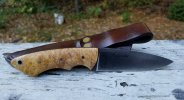
For reference, here is my malanika malanika small hunter, CRUWEAR, beautiful wood, leather sheath fits like Dr Scholls. 325$. Took him months to make and fit and finish is...impeccable.
Screenshot_20210605-090038_Gallery.jpg

Tell me again why your piece deserves 900$ again? Or 2000$? Your time is worth more than a humble blacksmith in Europe? Your knife is more popular? Hmmm...

To each their own. As soon as that question creeps in on me, I stay away.

I'm fine with secondary market driving up costs of production knives...its how the world works. I sold my limited edition blue eyes ultimate dragon for 50$. Its individual perception of "worth" and dont let anyone else tell you otherwise.

I feel like the guy with the honda complaining about ferraris lol. Alright rant over I promise, thanks for reading.
 
First, I didn't say there were only four factors. Please don't lie about what I posted...
I don't think the member you were responding to was lying. He was attempting to answer your questions and points. Please choose your terms a bit more carefully to avoid unnecessary misunderstandings.
 
Back
Top