I'm looking at getting a custom fixed blade in Damascus steel, and I wondered if the ridges on Damascus have any effect on its ability to slice? I have a Damascus blade, but it is hollow ground and the new one I plan to be flat ground. Anyone with experience on this?

-
The BladeForums.com 2024 Traditional Knife is available! Price is $250 ea (shipped within CONUS).
Order here: https://www.bladeforums.com/help/2024-traditional/
You are using an out of date browser. It may not display this or other websites correctly.
You should upgrade or use an alternative browser.
You should upgrade or use an alternative browser.
Does Damascus negatively affect slicing?
- Thread starter SCWillson
- Start date
This is going to sound like a marcinek quote  , but I believe it depends on what you are slicing and the number of layers of Damascus. I have quite a few of them and find that the ones with fewer layers have a sawing effect which is good for solid objects but not so much for soft ones (e.g. wood vs cheese) The ones with many layers (e.g. 500) seem to be so smooth as to have no effect. Just my experience, I'm no expert.
, but I believe it depends on what you are slicing and the number of layers of Damascus. I have quite a few of them and find that the ones with fewer layers have a sawing effect which is good for solid objects but not so much for soft ones (e.g. wood vs cheese) The ones with many layers (e.g. 500) seem to be so smooth as to have no effect. Just my experience, I'm no expert. 

- Joined
- Nov 29, 2010
- Messages
- 345
I wouldn't think that damascus has any demonstrable affect on cutting. The ridges should be pretty smooth, imagine laminated steel but finer and waaaay more numerous (which I think? would make it smoother. Like building a sphere out of squares) and it should give an idea. If laminated steel can slice wonderfully (my fallkniven f1 is a razor).

- Joined
- May 5, 2013
- Messages
- 3,618
I have never found an issue with the slicing capability of Damascus (layered steel)
I am sure there is a quantifiable difference under a laboratory environment cutting TP, but really real world...no.
If it's really poor quality then perhaps, but I have never owned anything like that....
I am sure there is a quantifiable difference under a laboratory environment cutting TP, but really real world...no.
If it's really poor quality then perhaps, but I have never owned anything like that....


- Joined
- Sep 23, 2016
- Messages
- 463
My cutting edge isn't Damascus, but I feel no difference in this with any of my other yanagi style knives.
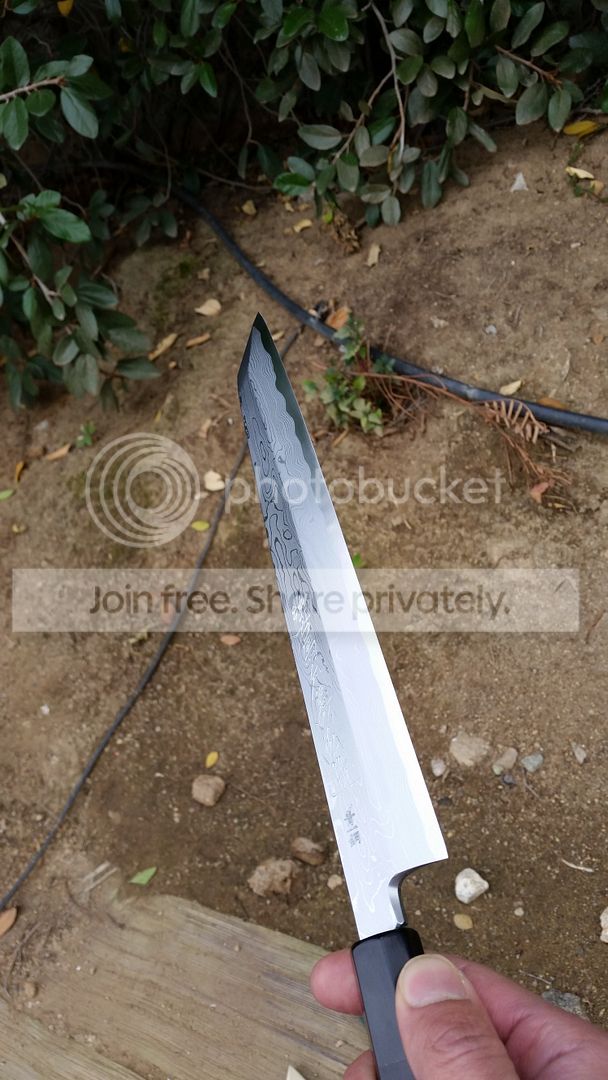
Beautiful.
Damascus should be used as shown above^ not as an edge but as a "backbone". Its very strong and tough but generally doesn't have great edge retention. Again making it perfect for a backbone but using a much harder/keen steel core.
Isn't that how/why it was designed? Like the old Japanese traditionals? Very strong and tough yet malleable steel that can take a hell of a beating used for the majority of the blade but using a much harder steel for the edge/core to become razor sharp and stay sharp for a longer amount of time? (because a hard steel for the full blade would be more prone to breaking?)
This is why I don't understand why anyone would buy a full damascus/damasteel blade other than looks alone. Not very functional considering the other options out there.

Petunia D. Feeble
I sharpen things.
- Joined
- Jun 30, 2016
- Messages
- 4,695
It really depends on the blade finish and what you're slicing. If it's fairly polished, then no. But if it's a deep etch and you're slicing raw fish, then yes, it will affect slicing.

- Joined
- Jul 23, 2007
- Messages
- 3,889
Damascus is beautiful but what are the real world benefits ?
Probably none, but I think it is beautiful and since it's a custom knife for my personal use I don't really care if others like it or not. There are lots of features and materials used on knives that don't have "real world benefits." (Why, for example, would anyone use natural handle materials like wood or horn when synthetics like G10 or micarta are manifestly superior in durability and ease of maintenance?)Damascus is beautiful but what are the real world benefits ?

jdm61
itinerant metal pounder
- Joined
- Aug 12, 2005
- Messages
- 47,357
If the blade is properly heat treated and sharpened, then the answer is no. Properly done, damascus performs like its component steels. 1084 and 15N20 will perfom like 1080 with a bit of nickel added. The "damascus cutting effect" is myth when it comes to modern pattern welded steels. There may have been something to it when talking about old wootz that was not hardened to the same level as today, but that would likely be a result of significant stringers of very hard precipitated iron and vanadium micro carbides in the matrix as wootz was a monosteel.
Last edited:

- Joined
- Jun 7, 2002
- Messages
- 3,411
i used a cable damascus hunter/fishing knife for years as a house knife. it has a fat convex edge. first, it's the easiest knife to sharpen. just a few passes on a soft smooth stone and it's ready. but it also dulls faster than most steels. it has something to do with the uneven layering, causing weak points along the edge. that's why i thought a convex edge will work best.