• Happy Thanksgiving to all of you! I hope that you all have something to be grateful for this year and for many years to come
  • America has reached 250 years, and I am grateful to be here, in the best country in the world. Thank every one of you who helps make this country a better place, those who have gone before and risked it all, and those who've paid the ultimate price to make the United States what we are today.

    Happy Birthday America! Let Freedom Ring for all time!

Does it makes a difference?

Joined
Dec 20, 2007
Messages
355
Does it makkes a difference if I mix brands of diamond bench stones while sharpening?
Not grits but let's say I go from a DMT fine to a Lansky extra fine?
 
Does it makkes a difference if I mix brands of diamond bench stones while sharpening?
Not grits but let's say I go from a DMT fine to a Lansky extra fine?

That depends entirely on what finished result you expect. If it's working to your satisfaction, I wouldn't worry about it.

DMT is known for their 'monocrystalline' diamond (individual crystals of more consistent size), whereas many/most others use 'polycrystalline' diamond (crystals clumped together in somewhat less consistent particle sizes). The 'poly' stuff is usually the most common and less expensive, and is probably what Lansky is using. But the 'mono' type on DMT's hones is known for producing a much more consistent finish, especially at the finer grits.

Ordinarily, it's much easier to predict results if staying within one type/make of abrasives, if one is just starting out, and striving for a particular finish (like a high polish). But, after using them a while, you might find a certain combination or sequence of hones & abrasives that works for the steel, and produces the finish you want. Nothing's wrong with that; I do it all the time. :)
 
Last edited:
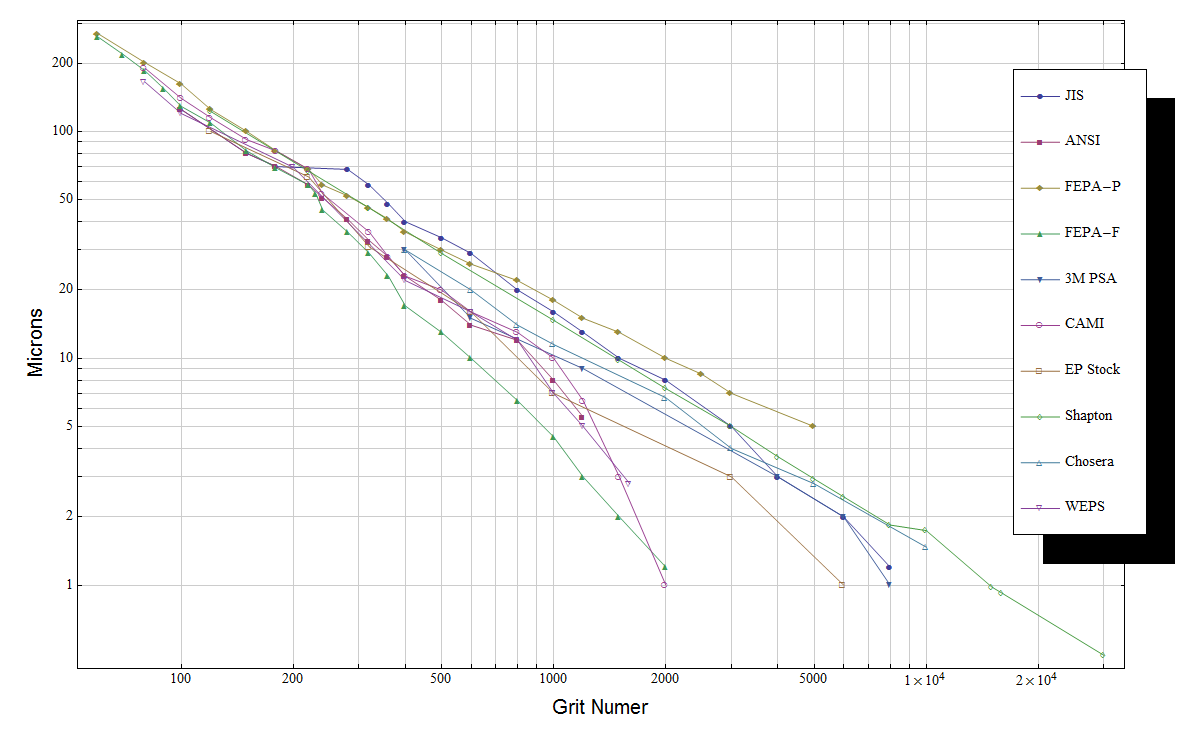
Sadly, "600 Grit" from one company can be quite different than "600 Grit" from another company. And that's not even considering that aluminum-oxide often cuts differently than diamond, etc. Beyond this, there is no reason not to, in my opinion. So if it works for you, then go for it! :) (I do this myself.)

If you're curious about how "the same" grit number means different things for different standards, and even for different companies using the same standard, then it's worth looking at Komitadjie's Grand Unified Grit Chart. The thread for the Grand Unified Grit Chart is here (I think Komitadjie has the most recent version of the chart towards the end of the thread):
http://www.bladeforums.com/forums/showthread.php/856708-The-Grand-Unified-Grit-Chart

If you want a graphical version of the chart, Mr. Wizard made some nice plots. You can find that here, in this thread on knifeforums.com. This thread not only has a graph, but it also has some information about what the grit standards actually mean (and don't mean):
http://www.knifeforums.com/forums/showtopic.php?tid/904090/tp/7/
ovRLE.png


If you think that's useful, then please thank Komitadjie and Mr. Wizard! :)

Sincerely,
--Lagrangian
 
Last edited:
It is useful information. Komitadjie and Mr. Wizard along with you, Lagrangian, David and members of this forum deserve a very BIG THANKS!
I do not post much but I regularly follow the Maintenance, T & E threads and have learned a lot.
 
Back
Top