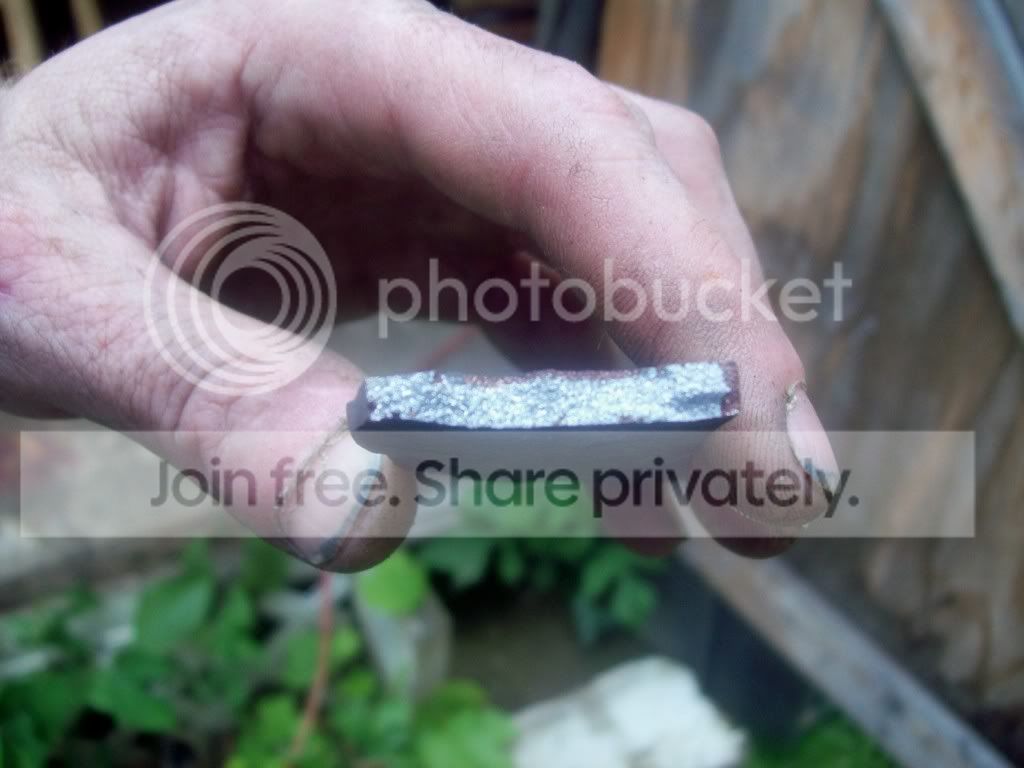
Does this look right?

Joined
Apr 14, 2009
Messages
159
This doesn't seem right to me. This blade was broken on purpose to see what was going on. Does this grain look right? And what are the brown spots near the edges? This is a tine from a tiller so i'm guessing from the info I could find that it was made from 1085. the blade was tempered at about bright orange heat for an hour then water cooled. would like to know if I'm doing this right. Thanks in advance for any feedback.

badknife.jpg


http://i452.photobucket.com/albums/qq247/connrebel/Blacksmithing/badknife.jpg
 
Hard to tell, but it does look like pretty big grain.

The dark coloration could be from cracks that occurred prior to heat treating, or even during the quench? Was this blade forged?

Assuming it is 1084 (and this is a big assumption), your heat treating is way off. For hardening, you should bring 1084 to a bit above nonmagnetic, hold for a minute or two, and then quench in a fast oil or brine. Water is pretty aggressive, and you will often find blades breaking/cracking just from the quench. You can add salt (about 9-10% by weight) to the water to make it less aggressive. Agitate the blade up and down or tip to butt until it has cooled to near oil/water/brine temperature. From there, temper it around 350-400 degrees for 2 hours.

I have a couple of suspicions. One, you probably overheated the steel. What method are you using to control temperature? Is this a coal fire, propane forge, oven? True orange heat is pretty damned hot, and when you overshoot the critical temperature by too much, you get very rapid grain size growth, especially when held there for an hour. Big grains weaken the steel. What method are you using to tell what temperature you're at?

Another suspicion is that it may or may not be 1084. Knowing what steel it is will greatly help you, as each steel has a very specific set of heat treating requirements.

That said, you're doing the right thing by experimenting to try and figure out what is going on in the steel. I'd get a method to tell what temperature you're at (magnet will get you in the ball park), normalize a couple of times by heating to 50-100 degrees above non magnetic and air cooling to reoom temperatures, harden (perform a shorter hold...maybe 5 minutes max), and quench in a brine heated to around 100 degrees. Then break it again before tempering and see what you get.

--nathan

 
Welcome to the forums.

OK, I'll be direct. You need to read up on heat treatment before you try it again.

Here is some basic info on what went wrong:

Bright orange is different to different people and in different light, but any orange color is way too high. Red orange is 1600F , orange = 1700F, bright orange = 1800F.

The heating you did at orange heat ( should be about 1550F for 1085) is called Austenitization, or just soaking for a simple term. It is getting the steel ready for the quench. With 1085, the length of time should be long enough to evenly heat the steel, and not much more. Five minutes would be more than needed. If the temperature is too high and the time is too long ( both problems in your blade), the grain would grow enormously.

A water quench is very violent and likely put tiny cracks ( you can't always see them) in the steel.... along the large grain boundaries. Fast oil would have been a much better choice.

After the heating and then quench, the steel should be tempered, which is holding the steel at about 400F for one or two hours. This is usually repeated after cooling to room temperature.

The tiller blade could be many types of steel, and you have no real way of knowing which it is. Contacting the manufacturer of the tines may help with a steel type, but more than likely the tines are made in China, and the manufacturer doesn't know the exact steel make-up. Using a known steel will help avoid a lot of problems.

Read up and try it again. I would suggest you post the blade and your intended HT before you do it. That way you can get some input before the problems arise.

Stacy

BTW, that dark area may be a deep layer of decarb, or a crack.
Stacy
 
Last edited:
I was thinking the same about using a tine. It's almost impossible to tell what the steel really is, short of having it analyzed.
 
Lot of good information already presented...... lot of tines are 1095 but if it's off of an old machine it's pretty stressed.
 
thanks for everyones replys and all the feedback. the assumption was mine from a junkyard steel sheet i had found. And we all no what happens when you assume......... so that being the case I shall try this again this weekend and do it right. I'm using a coal forge, Temp is controlled by sight (didnt use a magnet. will get one) And obviously I DIDNT understand the process of heat treatment like I thought I did. So again thanks for everyone taking the time to help me out with this and I will post pics and info as it becomes available. Oh BTW the blade was forged in as much as it was straightened and the tang was formed.
 
Please post only post photos that are properly focused. The dark areas indicate a prior crack.
There is no purpose in water cooling after temper.
Brine quench is the most aggressive. Heating water based quenches makes them less aggressive.
 
Back
Top